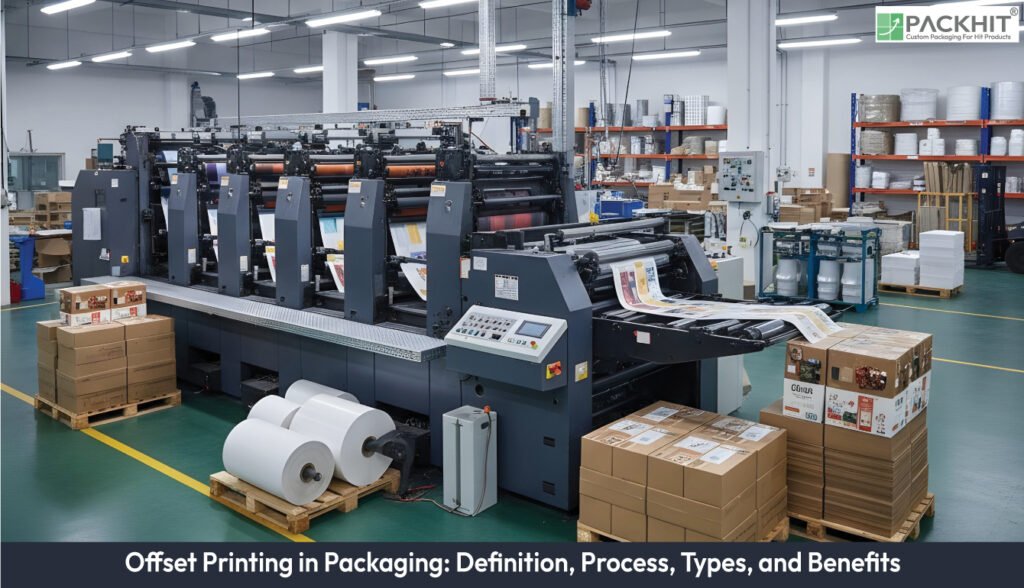
Offset printing serves as a versatile and high-fidelity method for producing packaging components across industries. Plate-based imaging, precise colour control, and structured press workflows enable consistent reproduction for cartons, labels, sleeves, and promotional materials. Selection among sheet-fed, web-fed, and specialised variants balances run length, substrate compatibility, and finishing requirements. Key benefits include cost efficiency at scale, strong colour fidelity, wide substrate support, finishing flexibility, and high throughput, while modern process improvements reduce environmental impact. Evolving industry practices, hybrid workflows, and digital integration continue to expand the capabilities and adoption of offset printing in packaging production.
- What is Offset Printing?
- Why is Offset Printing Important in Packaging?
- How Does the Offset Printing Process Work for Packaging?
- 1. Plate Production
- 2. Ink Distribution
- 3. Image Transfer to Substrate
- 4. Drying and Post-Press Finishing
- Which Types of Offset Printing are Used for Packaging?
- What are the Benefits of Offset Printing for Packaging?
- Cost-Effective Printing
- Accurate Colour Reproduction
- Superior Print Quality
- High-Speed Production
- Extended Plate Life
- Dense Ink Coverage
- Improved Environmental Performance
- What are the Main Applications of Offset Printing in Packaging?
- How Does Offset Printing Differ from Digital Printing?
What is Offset Printing?
Offset printing is a plate-based lithographic printing process that reproduces images and text on a substrate by indirect ink transfer. As a printing process, offset printing uses aluminium lithographic plates, a rubber blanket and impression mechanisms (examples: plate cylinder, blanket cylinder, impression cylinder) to move an inked image from matrix to substrate. The lithographic principle operates on a physical basis: oil-based ink adheres to hydrophobic image areas while water (dampening solution) covers hydrophilic non-image areas, keeping ink and dampening fluid separate. The offset printing process uses plates and a precise ink–water balance rather than direct digital printing. Known as offset lithography or planographic printing, the method produces high-quality, consistent reproduction for commercial and packaging runs, including cartons and labels.
Why is Offset Printing Important in Packaging?
Offset printing delivers high-quality, consistent images for packaging while supporting a wide range of materials and large production runs. Offset printing ensures accurate colour reproduction for CMYK processes and spot or Pantone matching, allowing brand-critical logos and artwork to maintain integrity. Heavy solid-ink coverage prints cleanly on substrates such as paperboard for folding cartons, corrugated fibreboard, plastic films, metallic sheets, and textured stocks like linen and felt. Post-press finishing, including lamination, foil stamping, embossing, and varnish, integrates effectively with offset runs. Offset printing provides predictable colour consistency and supports complex finishing sequences that define tactile and visual packaging qualities.
How Does the Offset Printing Process Work for Packaging?
The offset printing workflow follows a series of coordinated steps that transform digital artwork into high-quality, finished packaging components. The main stages of the process are outlined below.
1. Plate Production
Metal plates, usually grained aluminium, form the foundation for offset printing. Artwork is separated into CMYK or designated spot colours, then imaged onto plates via computer-to-plate (CTP) systems. Technicians develop the plates, wash off residues, apply protective coatings or gumming, and verify registration marks and trapping accuracy before installation on the press.
2. Ink Distribution
The press spreads ink across a network of rollers that contact the plates. A dampening solution maintains non-image areas as hydrophilic, allowing ink to adhere solely to image zones. Press operators calibrate ink keys and adjust viscosity to ensure uniform colour density and consistent ink coverage throughout the print run.
3. Image Transfer to Substrate
Each plate deposits ink onto a rubber blanket, which in turn transfers the image onto paperboard, paper, or other substrates. Controlled pressure from the impression cylinder produces sharp, detailed prints. Multi-unit presses align successive colours using mechanical registration and inline sensors to maintain precise colour registration.
4. Drying and Post-Press Finishing
Inks dry or cure through hot-air, infrared, or UV systems for UV-compatible inks. Printed sheets move to finishing stages, which may include varnishing, lamination, foil stamping, embossing, die-cutting, folding, and glueing. Quality checks confirm colour density, registration, and sheet alignment before converters trim, stack, and palletise the completed runs.
Which Types of Offset Printing are Used for Packaging?
Packaging production uses several established offset printing types, including sheet-fed offset printing and web-fed offset printing. Each offset type serves a distinct operational role in packaging, with selection determined by substrate thickness, production volume, finishing complexity, and cost structure. The primary and specialised types of offset printing are listed below.
Sheet-Fed Offset Printing
Sheet-fed offset printing uses individual sheets and suits short-to-medium production runs with high design complexity. Folding cartons, luxury cartons, promotional sleeves, and pharmaceutical packaging rely heavily on sheet-fed presses because heavy paperboard, speciality coatings, and precision finishing remain fully compatible with this format.
Web-Fed Offset Printing
Web-fed offset printing covers high-volume, continuous-run production using paper or film rolls. Variants include heatset and coldset processes. Heatset web offset employs high-temperature dryers to rapidly set inks, producing coated, gloss-rich packaging inserts, wraps, and graphics-heavy components. Coldset web offset relies on ink absorption for drying, making it suitable for newsprint-style inserts, instruction leaflets, and cost-sensitive paper packaging. Both methods offer consistent output, high speed, and the option for inline finishing, supporting efficient production of long-run packaging jobs.
UV Offset Printing
UV offset uses ultraviolet-curable inks that harden instantly under UV light. Food cartons, cosmetic packaging, and premium retail boxes adopt UV offset for scuff resistance, dense colour saturation, and immediate finishing compatibility.
Waterless Offset Printing
Waterless offset eliminates dampening solution and uses silicone-coated plates to control ink transfer. High-detail packaging graphics, fine halftones, and sensitive substrates benefit from improved dot sharpness and reduced ink emulsification.
What are the Benefits of Offset Printing for Packaging?
Offset printing gives packaging production cost, colour, speed, and substrate advantages that remain stable across long runs.
Cost-Effective Printing
Cost efficiency in offset printing comes from the way plate setup spreads across quantity. Plate makeready introduces an upfront charge, and the cost per unit falls once runs pass about 2,000 pieces. Print shops that balance digital and offset equipment, such as those described in trade discussions comparing both systems, show this break‑even pattern across routine commercial work.
Accurate Colour Reproduction
Colour fidelity in offset printing uses CMYK separation and fixed spot Pantone inks to repeat brand colours across batches. Press operators rely on plate-based imaging and calibrated ink keys to hold density within tight tolerances. Brand‑critical logos and packaging ranges depend on strict Pantone consistency across cartons, inserts, and labels.
Superior Print Quality
Image quality and consistency in offset printing come from indirect plate‑to‑blanket transfer. The rubber blanket keeps halftones stable, and water balance avoids streaks or washout. Production lines maintain uniformity across thousands of impressions without tonal drift.
High-Speed Production
Sheet-fed and web-fed offset presses produce large volumes quickly with stable output quality. Throughput and scalability in offset printing appear in sheet-fed capacities around 18,000 sheets and web‑fed speeds near 120,000 pages per hour. Continuous runs create consistent stacks for die‑cutting queues and reduce pauses during carton or label production.
Extended Plate Life
Plate durability in offset printing extends across thousands of impressions on aluminium lithographic plates. Plate changes interrupt production less often, which steadies workflow during long carton or insert batches.
Dense Ink Coverage
Dense solid colours and dark backgrounds print smoothly without streaks or banding. Suitability for special processes in offset printing applies to large solid‑coverage areas and complex finishing sequences. Areas with dense ink loads print more cleanly with blanket transfer than with toner‑based digital systems, which guides packaging teams that require heavy coverage or metallic embellishment.
Improved Environmental Performance
Environmental progress in offset printing results from plate chemistry reformulation, lower‑VOC washes, and waste‑management controls that reduce earlier solvent use. Modern dampening systems create steadier ink‑water ratios, cut spoilage, and limit reprints.
What are the Main Applications of Offset Printing in Packaging?
Offset printing is applied to primary and secondary packaging components as well as ancillary printed items that accompany packaged goods.
- Retail Cartons and Printed Boxes: Present brand colours with plate-based CMYK or spot inks that hold density across long runs. Retail cartons, pharmaceutical cartons, and cosmetic cartons rely on varnish, foil, and embossing that depend on a dry, even ink surface.
- Product Labels and Packaging Sleeves: Maintain colour consistency through calibrated ink keys and controlled ink–water balance. Pressure-sensitive labels and shrink sleeves use offset for dense solids and legible microtext that remain stable on coated and uncoated substrates.
- Carrier Bags and Protective Wraps: Carry repeat graphics across various stock weights. Paper bags and printed wraps rely on blanket transfer to keep halftones uniform and to prevent streaking when ink sits on porous or fibrous surfaces.
- Instruction Inserts: Print instruction text and diagrams with predictable registration. Leaflets, booklets, and instruction manuals use offset to control type clarity and keep tonal variation within narrow tolerances across batches.
- Promotional Packaging: Uses offset when artwork requires strong solids, Pantone accuracy, and finishing steps. Display cartons and promotional sleeves combine printed layers with coatings or embossing that depend on uniform ink laydown.
- Post-Press Conversion: Include lamination, trimming, folding, and binding sequences that convert printed sheets into final packaging elements. Suppliers that control design-to-binding workflows reduce registration faults and limit remakes.
How Does Offset Printing Differ from Digital Printing?
Offset printing differs from digital printing by using plate-based indirect transfer, while digital printing applies direct imaging without plates.
The table below compares offset printing and digital printing across cost structure, print quality, colour accuracy, run length, finishing options, and production flexibility to help select the most suitable method for packaging and commercial print jobs.
| Aspect | Offset Printing | Digital Printing |
|---|---|---|
| Imaging Mechanism | Plate-based indirect transfer from plate to blanket to substrate | Direct imaging without plates using toner or inkjet |
| Run-Length Economics | Higher setup cost but lower unit cost beyond about 2,000 units | Stable unit cost regardless of volume, higher cost at scale |
| Variable-Data Capability | Limited suitability for variable content due to plate dependency | Strong support for personalisation, barcodes, and serialisation |
| Substrate and Finishing | Broad support for heavy boards, metallics, textured stocks, embossing, and foil | Narrower substrate range with limited finishing strength |
| Colour Matching | High Pantone and spot-colour accuracy for brand-critical work | Spot colours may vary without extended inks or tight calibration |
| Turnaround and Flexibility | Longer setup and proofing, but efficient for large scheduled projects | Fast setup and quick delivery for short-run jobs |
| Hybrid Workflow Use | Serves as the base layer for hybrid print production | Adds variable content to offset-printed base layers |
| Best-Use Decision Rule | Best choice for high volumes, strict colour accuracy, and heavy finishing | Best choice for short runs, urgent jobs, and variable-data printing |
Offset printing delivers the greatest value for high-volume packaging that requires strict colour accuracy and advanced finishing, while digital printing remains the preferred choice for short runs, rapid turnaround, and personalised content.