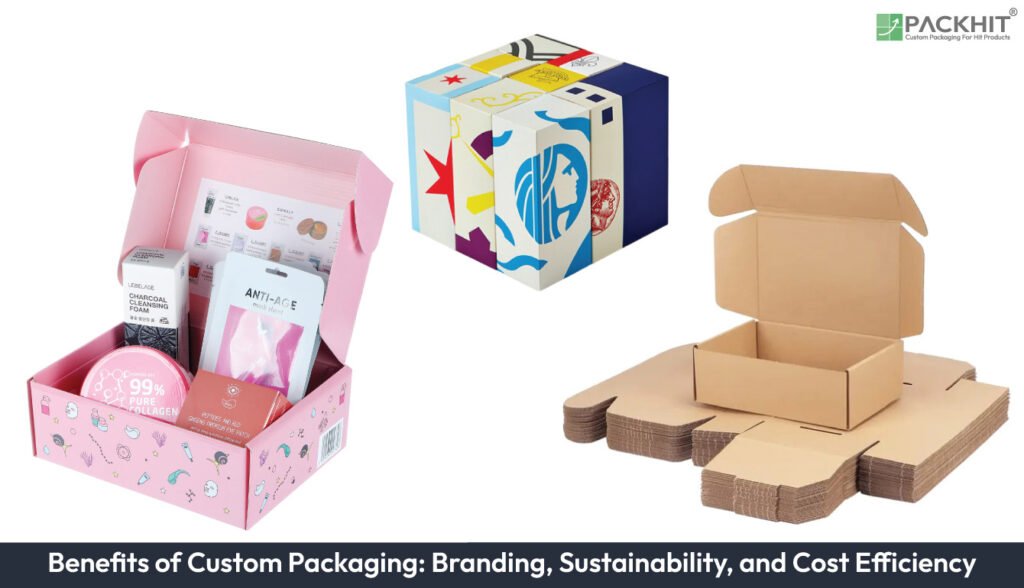
Custom packaging enhances brand impact, supports sustainable material use, and improves cost efficiency across shipping, storage, and returns. Visual identity, structural design, and unboxing experience shape customer perception and marketing effectiveness. Material choice, dimensional optimisation, and printing methods influence protection, recyclability, and operational performance. Flexible production approaches, including short runs and SKU (Stock Keeping Unit) management, help small and large businesses balance branding, logistics, and cost considerations in e-commerce and retail channels.
- What are the Primary Benefits of Custom Packaging?
- 1. Boosted Brand Awareness, Recognition, and Identity Signals
- 2. Higher Perceived Quality Driven by Visual Cues
- 3. Streamlined Customer Interaction
- 4. Optimised Sustainability and Material Performance
- 5. Maximised Recyclability and Reduced Packaging Waste
- 6. Efficient Cost Operations and Lower Shipping Costs
- 7. Lesser Storage and Handling Expenses
- 8. Improved Product Protection
- 9. Enhanced Cost Management
- Why is Custom Packaging Important for Marketing?
- Why is Custom Packaging Important for Small Businesses?
- How Does Custom Packaging Reduce the Cost of Packaging and Fulfilment?
What are the Primary Benefits of Custom Packaging?
Custom packaging produces three primary benefit classes: branding, sustainability, and cost efficiency. Branding refers to the set of signals that a package communicates to a buyer at receipt or on shelf; sustainability relates to resource use and end-of-life handling for materials (such as recycled paperboard, mono-poly films). Cost efficiency benefits custom packaging, resulting in reductions across transport, warehousing, and product return flows. The primary benefits of personalised packaging depend on both inherent features of the package (material, finish, structure) and variable aspects (channel of sale, order volume, handling pattern).
1. Boosted Brand Awareness, Recognition, and Identity Signals
Brand awareness, recognition, and identity cues comprise one cluster, as each action relies on repeated visual elements across transit and unboxing. Colour sets, type rules, panel geometry, and window patterns anchor memory during repeated exposures. Corrugated shippers in motion act as identifiers when parcels move across carrier hubs. Dropshipping adds extra impressions because parcels pass through multiple routing points. Stable dielines across SKUs (Stock Keeping Units) lower artwork drift and allow small brands to reuse structural files during frequent promotions or short-cycle digital print runs. Identity cues stay readable when inks resist smudge across belt transfers and corner impacts.
2. Higher Perceived Quality Driven by Visual Cues
Visual identity forms through the way surface graphics interact with defined structural lines. Rigid sleeves, folding cartons, and shoulder boxes guide the first sightline toward the product, and finishes such as matte varnish, soft-touch film, or foil stamping shift reflectivity and texture to match the expected price tier and use case. Tight control of substrate ranges and template rules limits lot‑to‑lot drift and supports converters that run fast‑turn stock for dropship flows. Dropshipping adds routing variation, so stable geometry and controlled colour density ensure panels are readable after multiple handoffs. Packaging teams utilise the constraints to maintain consistent print zones, avoid scuff exposure on conveyor contact points, and preserve identity signals during short digital runs or frequent promotional cycles.
3. Streamlined Customer Interaction
Customer interaction covers the steps from courier handoff to disposal. Easy‑open tear strips reduce first‑open time, and resealable closures help users manage partial use. Clear printed cues guide hand placement during opening. Integrated instructions reduce errors during repack or returns for dropship orders. Brand‑facing mailers receive more transit touches in the dropshipping route, and these added touches shape quick judgments of quality. Fast opening tends to raise first‑contact scores, and short handling times increase the rate of user‑posted photos or short clips. Dropship suppliers add tear bands and simple closure paths to support rapid repack if carrier relabel actions occur.
4. Optimised Sustainability and Material Performance
Sustainability and material performance improve through smart material selection, simplified structures, and compatibility with recycling or composting systems. Using fibre board, mono-material films, recycled content, and water-based coatings reduces resource use and keeps recovery paths clean. Designers minimise adhesives, avoid unnecessary laminations, and confirm that inks and labels detach during pulping. In dropshipping, consistent substrates and durable print help maintain recyclability during long handling cycles, while lighter grades cut transport mass without raising damage rates. According to a 2023 packaging study from a US university research group, three quantifiable gains were observed in fibre‑based custom formats: a 20% reduction in offcut waste, a 15% reduction in pulping contamination from simplified coatings, and a 10% reduction in relabel scrap during long-route dropshipping. Researchers recorded results after comparing mono-material cartons against mixed‑layer structures during simulated three-stop dropship cycles.
5. Maximised Recyclability and Reduced Packaging Waste
Recyclability increases when packaging uses single-material layouts and clean separation paths. Fibre cartons with water-based inks enter curbside recycling with low screening loss, while multi-layer structures raise reject rates. Testing ensures coatings, labels, and adhesives separate correctly and do not add contamination during long-route handling. Packaging waste decreases through right-sizing, trimmed voids, and the removal of redundant layers. Better fit reduces unused air volume, and pulp cushions replace plastic inserts in many formats. Lean structures cut disposal mass and limit upstream emissions, which is especially impactful in dropshipping, where each outer layer multiplies across large shipment volumes.
6. Efficient Cost Operations and Lower Shipping Costs
Cost operations depend on how each carton fills transport and storage footprints. A tight footprint cuts freight charges because carriers bill by weight and volume, and a narrow outline limits pallet gaps. Flat‑packed blanks stack densely and shorten pick paths. Trimmed walls and small internal cavities keep void ratios low, which reduces strain in dropship loops that add multiple handoffs. A light substrate cuts freight mass if board strength meets compression tests for rough routes. Right-sizing cuts dimensional weight and limits pallet overhang. A close match between carton width and pallet grids, such as forty by forty-eight inches, raises layer counts and limits pallet movement in distribution. Short dropship runs show this pattern because varied relabel stops add handling. Accurate geometry blocks double boxing during relabel checks. A light grade with controlled flute geometry removes excess fibre while holding crush strength stable. Context from dropshipping adds two checks: consolidate functions where possible, and remove decorative layers that slow repack during relabel actions.
7. Lesser Storage and Handling Expenses
Smaller or stackable units raise warehouse density and put more units on each pallet while cutting the number of storage positions. Flat-packed blanks are sorted in tight stacks, reducing pick distance during order assembly. Carton designs that keep consistent footprints eliminate fit conflicts during batch pulls and speed carton selection. Barcode zones printed in predictable locations enable scanners to read labels without extra hand movement and help automated sorters complete routing checks. Automated equipment handles cartons faster when outer panels follow a fixed geometry because sensors pick targets without recalibration. Dropshipping flows add routing stops and repack cycles, so consistent shapes reduce handling errors during relabel steps. Extra structure from reinforced seams keeps stacks stable during high-turn periods at fulfilment hubs if cartons pass compression checks for short-route transport loads.
8. Improved Product Protection
Improved product protection relies on the selection and engineering of protective packaging materials tailored to the specific product and its intended transport route. Protection-focused structure reduces shock and vibration through controlled geometry and targeted cushioning. Internal supports, moulded pulp trays, and rigid corner blocks made from protective packaging materials stabilise products across carrier hubs. Correct ECT Edge Crush Test and BCT Box Compression Test values prevent wall collapse during stacking and vibration cycles in e-commerce and retail distribution. Lower damage rates occur when cushioning and support match product mass and fragility. Dropshipping paths add extra handoffs, so higher compression strength in protective materials limits deformation during relabel stops and belt transfers. ISTA 3A and ISTA 2A testing define impact loads and guide flute grade and cushioning choices that absorb short energy spikes without unnecessary fibre weight. Fewer breakages mean fewer returns and replacements, creating a lower total cost of ownership across order volumes.
9. Enhanced Cost Management
Unit packaging cost includes raw material, printing, finishing, setup amortisation, and inbound freight, and each input changes with run size and carton geometry. Production teams select digital print for short batches with frequent artwork changes and choose flexographic or offset print for long batches that repeat monthly. Larger runs cut per‑unit die and setup expenses because converters spread tooling and plate fees across hundreds or thousands of cartons. Bulk orders trim inbound freight per unit when pallets travel with full cube utilisation. Dropshipping operations add separate cost pressure because parcels move through three or more handling points. Stable dielines reduce repack time during relabel steps, and consistent print density reduces scrap during rush cycles. Small brands achieve tighter cost control when production calendars align with forecasted demand and when recurring batches keep inventory low without raising carton prices.
Why is Custom Packaging Important for Marketing?
Custom packaging serves as a direct marketing channel at the physical moment of contact. Personalised packaging communicates product claims, regulatory information, promotional messaging, and scannable identifiers for digital engagement [examples: QR (Quick Response) codes, NFC (Near Field Communication) tags, tracking barcodes]. Surface graphics, brand copy, and visible shipper panels turn the box into a simple information space that buyers read at the shelf or during opening. For dropshipping, visible panels also communicate origin or brand cues when parcels move through transit.
Printing and finishing decisions directly support marketing strategies. Use variable-data or digital printing for personalisation when run sizes are small. Choose conventional print methods for cost efficiency at scale. Add scannable targets and clear brand calls to action that connect offline packaging to online tracking and remarketing funnels.
Why is Custom Packaging Important for Small Businesses?
Custom packaging is important for small businesses because it aligns product presentation with limited marketing budgets and constrained fulfilment resources. Small businesses can order low-run digital prints to validate designs and then switch to larger flexo or offset runs once demand stabilises. Digital printing lowers inventory risk for small orders, as long as per-unit costs stay equal to or below conventional printing prices.
Up-front tooling or die charges are present for many substrate types and are amortised across run quantity. A small brand models amortisation by computing the break-even quantity as the setup cost divided by the per-unit savings compared to a stock alternative for each SKU. Break-even analysis clarifies whether custom packaging reduces total cost over the intended product lifecycle.
How Does Custom Packaging Reduce the Cost of Packaging and Fulfilment?
Custom packaging cost depends on material choice, print method, order volume, and design complexity, and unit price usually drops as quantity increases, while savings from shipping and fewer damages often offset the cost. Custom packaging cuts cost through reduced dimensional weight, trimmed layers, fewer product returns, and lower carton inventory. Right-sized cartons match pallet grids, support outbound and inbound routes, and match board strength to product mass and transport conditions. Digital print covers short batches with frequent art revisions, while flexo and offset handle recurring cycles with stable colour density. SKU consolidation removes outdated carton types, and material selection aligns flute grade, liner weight, and cushioning with ISTA drop test data for predictable handling. Production covers dieline drafting, prepress checks, prototype samples, and in-line inspections that stabilise dimensions, colour accuracy, and compression strength during multi-stop dropshipping.