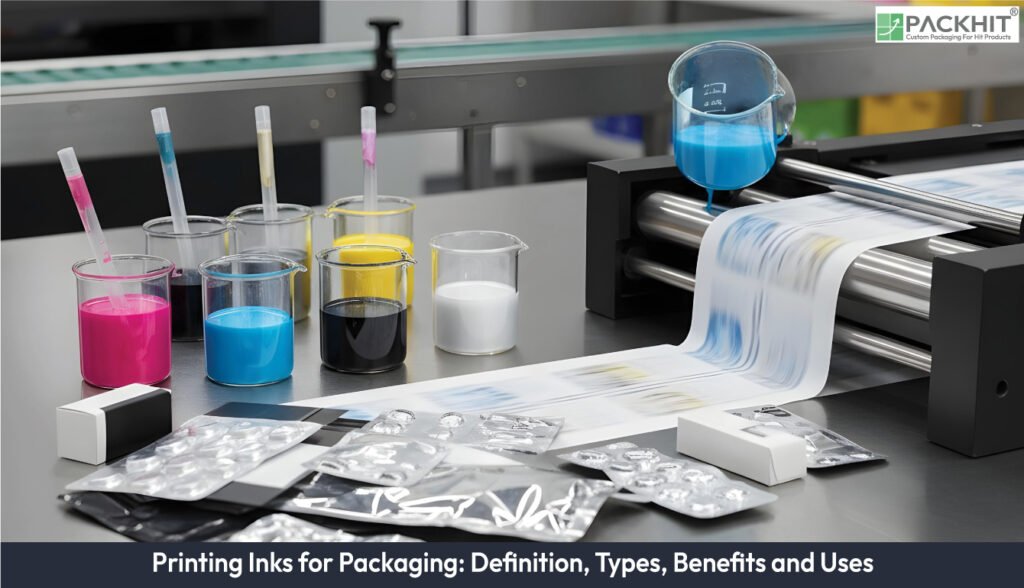
Printing inks for packaging play a critical role in how brands communicate information, ensure safety, and achieve high-quality visual impact across paperboard, films and rigid materials. Printing inks provide the colour, text, barcodes, branding and regulatory details that packaging requires, and their performance depends on the chemistry of pigments, binders and liquid vehicles used across different printing processes. Packaging converters rely on water-based, solvent-based, UV-curable and bio-derived inks, each selected for specific substrates, drying behaviour and compliance needs. Choosing the right ink system for businesses has become essential for print consistency, food-contact safety, environmental responsibility and efficient production.
- What are Printing Inks Used for Packaging?
- What are the Types of Printing Inks for Packaging?
- What are the Benefits of Choosing the Right Printing Inks for Packaging?
- Print Consistency
- Regulatory Compliance
- Environmental Impact Control
- Substrate Compatibility
- Recyclability Support
- Operational Stability
- How are Different Printing Inks Used in Packaging Production?
- Water‑based Inks in Corrugated and Carton
- Solvent‑based Inks in Flexible Packaging
- UV-Curable Inks in Rigid and Non‑absorbent Packaging
- Bio‑derived Inks in Paperboard Workflows
- How are Packaging Inks Chosen for Specific Substrates?
- What Tests and Certifications do Printing Inks Need for Packaging?
- Which Trends are Shaping Ink Choices in Printing for the Packaging Businesses?
What are Printing Inks Used for Packaging?
Printing inks for packaging are formulated mixtures used to add colour, text, and regulatory information onto paperboard, films, and rigid materials used for consumer products. They consist of a colourant, a binder, and a liquid vehicle that sets or cures after transfer. Packaging presses apply these ink systems through offset, flexographic, gravure, or digital printing methods, and each method requires inks with specific viscosity and drying characteristics. Safety regulations, including exclusion lists such as the JPIMA Negative List for food-contact applications, restrict substances that could migrate into packaged goods. Examples include acrylate oligomers in UV-curable systems and vegetable oils used in soy-based inks.
What are the Types of Printing Inks for Packaging?
The types of printing inks for packaging include water‑based inks, solvent‑based inks, UV‑curable inks, and bio‑derived inks.
Water‑Based Inks
Water‑based inks use water as the primary vehicle and suit absorbent substrates such as cardboard and corrugated board. Low VOC output aligns with food‑contact rules, and typical systems include gravure and flexographic formulations with controlled pH and viscosity. These inks reduce odour and ease wastewater handling if metering and drying capacity match press speed.
Solvent‑Based Inks
Solvent‑based inks use fast‑evaporating organic liquids to carry pigment and resin. They support print quality on non‑porous films such as PET, PVC or metallised structures, and form tough films after solvent loss. JPIMA and EuPIA exclusion lists restrict solvent classes and additives in food‑contact packaging, so specification depends on migration limits and recovery systems.
UV‑Curable Inks
UV‑curable inks contain acrylate oligomers and photoinitiators that polymerise under UV exposure. These inks suit glass, aluminium and coated films where absorption is minimal. Immediate cure improves registration on high‑speed lines, although the crosslinked film can resist standard deinking processes in recycling streams.
Bio‑Derived Inks
Bio‑derived inks include soy‑based and other renewable systems that replace petroleum feedstock. Soy‑derived inks support paper recycling because they form softer films, and they reduce VOC content compared with solvent systems. They require adjustments in pigment loading and drying control to match colour density expectations in packaging runs.
What are the Benefits of Choosing the Right Printing Inks for Packaging?
The benefits of choosing the right printing inks for packaging relate to print accuracy, compliance, environmental limits and downstream handling. These benefits shape packaging performance on paperboard, films and rigid substrates used by manufacturers in the UK.
Print Consistency
Print consistency depends on ink rheology, pigment loading and drying behaviour. Stable ink systems maintain colour density, limit dot‑gain shifts and support press repeatability on offset, flexographic, gravure and digital lines.
Regulatory Compliance
Regulatory compliance applies to inks that meet exclusion lists and food‑contact rules. JPIMA Negative List and EuPIA policies remove photoinitiators, solvents or dyes linked with migration risks, so compliant inks restrict transfer into packaged goods.
Environmental Impact Control
Environmental impact control relies on inks that reduce VOC content. Water‑based flexographic and gravure inks contain minimal organic solvents, and soy‑derived or other bio‑based inks replace petroleum feedstock to lower emissions in print rooms.
Substrate Compatibility
Substrate compatibility reflects adhesion, film formation and cure rate on paperboard, PET, PVC, PS or metallised films. Correct resin systems attach to surfaces with matching surface energy, and drying or polymerisation prevents smearing on high‑speed lines.
Recyclability Support
Recyclability support occurs when ink chemistry permits fibre recovery or film separation. Aqueous pigment films deink in paper recycling plants, unlike cured UV networks that resist detachment and complicate sorting if present on mixed streams.
Operational Stability
Operational stability concerns viscosity control, pH tolerance and solvent balance during long runs. Inks with predictable flow through anilox, gravure cells, or offset ducts shorten wash‑ups, reduce waste and maintain throughput.
How are Different Printing Inks Used in Packaging Production?
Printing inks in packaging production support substrate preparation, graphics transfer and curing steps across offset, flexographic, gravure, screen and digital lines used on paperboard, films and rigid materials in the UK.
Water‑based Inks in Corrugated and Carton
Water‑based inks support corrugated and folding‑carton production by forming pigment films through water absorption into fibres. Printers control pH, viscosity and drying rate, and these inks align with exclusion‑list limits used in food‑contact workflows.
Solvent‑based Inks in Flexible Packaging
Solvent‑based inks support PET, PVC and metallised films by depositing pigment and resin that form dense films after solvent evaporation. Operators manage solvent retention and recovery if packs sit in heat‑sealed laminates or food channels.
UV-Curable Inks in Rigid and Non‑absorbent Packaging
UV‑curable inks support glass, aluminium and coated films by polymerising acrylate oligomers under UV units. The cured surface resists abrasion on high‑speed bottling lines if converters exclude non‑compliant photoinitiators listed in JPIMA or EuPIA documents.
Bio‑derived Inks in Paperboard Workflows
Bio‑derived inks support paperboard production by using soy or other renewable carriers that produce softer films. These films ease deinking in recycling plants, if converters adjust pigment load and drying to maintain colour density on long carton runs.
How are Packaging Inks Chosen for Specific Substrates?
Packaging inks are chosen for specific substrates (materials) by matching resin chemistry, drying behaviour and regulatory limits to the surface energy, porosity and process temperature of each substrate.
- Cardboard uses water‑based pigment inks that penetrate fibres and hold density on corrugated and folding‑carton boards, if pH and viscosity stay inside flexographic control ranges.
- PET film uses solvent inks that form continuous films after evaporation, if operators monitor solvent retention and heat stability in laminates.
- PVC film uses solvent systems that attach to low‑porosity plastics and resist abrasion in flexible packs, if banned plasticisers listed in exclusion policies are absent.
- Metallised film uses solvent or UV inks that anchor to treated foil surfaces and maintain opacity under nip pressure, if surface energy rises after corona treatment.
- Glass uses UV‑curable inks that polymerise under UV units and resist washing cycles on bottles, if photoinitiators comply with JPIMA Negative List rules.
- Aluminium uses UV inks that harden into scratch‑resistant films during rigid‑pack runs, if cure intensity matches line speed.
What Tests and Certifications do Printing Inks Need for Packaging?
Printing inks for packaging require migration testing, regulatory screening against exclusion lists and process‑specific safety checks that confirm chemical limits, substrate stability and printroom compliance for food and non‑food packs.
- Paperboard packaging uses inks tested for fibre penetration, deinking response and exclusion‑list compliance on folding cartons and corrugated boards.
- Flexible film packaging uses inks screened for solvent retention, heat resistance and migration on PET, PVC or metallised laminates.
- Rigid plastics packaging uses inks checked for adhesion, abrasion tolerance and chemical stability on PS, PETG or polyolefin containers.
- Metal packaging uses inks assessed for curing behaviour, film hardness and contamination control on aluminium and steel structures.
- Glass packaging uses inks measured for UV‑cure integrity, scratch resistance and resistance to washing cycles on bottles and jars.
Which Trends are Shaping Ink Choices in Printing for the Packaging Businesses?
Trends shaping ink choices in printing for packaging businesses before production increasingly centre on sustainability, regulatory compliance, and print-process advancements. Water‑based pigment systems expand as converters cut VOC emissions and replace older solvent grades on paperboard and corrugated examples. JPIMA and EuPIA exclusion lists push brands toward compliant photoinitiators, dispersions or resin chemistries, if packs sit in food‑contact channels. Digital workflows add water‑based dispersions for corrugated and folding carton runs, while UV systems remain for PET or PVC films when abrasion resistance dominates.