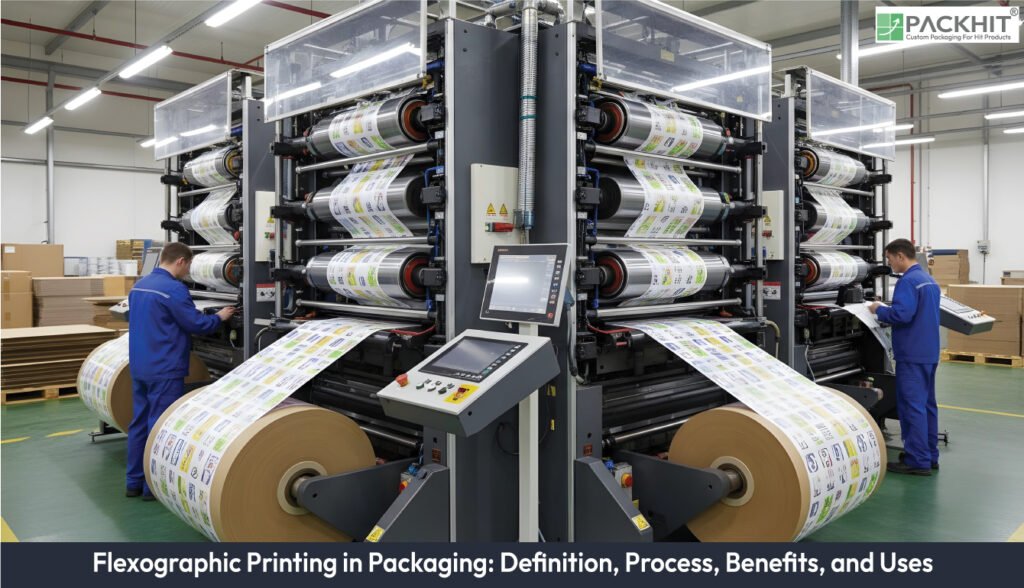
Flexographic printing is a relief-plate printing method widely used in packaging for its speed, consistency and ability to print directly onto corrugated boxes, cartons and transit packs. The flexographic printing process relies on controlled ink metering, plate transfer, and fast drying to produce stable, repeatable results across porous and uneven substrates. The benefits of flexographic printing in packaging include print consistency, substrate versatility, quick plate changes, ink efficiency and high production speeds that make it a dependable choice for large-volume packaging operations. Flexographic printing is used for shipping boxes, retail cartons, food packaging, transit packs and storage cartons more effectively than offset, digital or gravure methods. Flexographic printing remains one of the most practical and efficient printing technologies for packaging businesses.
- What is Flexographic Printing?
- How Does the Flexographic Printing Process Work?
- What are the Benefits of Flexographic Printing for Packaging?
- What are the Common Uses of Flexographic Printing in Packaging?
- How Does Flexographic Printing Differ from Other Methods?
- Why is Flexographic Printing the Right Choice for Packaging Businesses?
What is Flexographic Printing?
Flexographic printing is a relief‑plate printing method that transfers ink from raised areas of a flexible plate onto packaging substrates. The flexographic printing functions as a production tool that applies controlled ink deposits during box manufacturing, where the plate, ink unit and press frame act as the working assembly. It supports direct printing on corrugated boxes, folding cartons and transit packaging used for food, household goods and industrial components. Brands use it for clear two‑colour marks on shipping boxes, retail cartons and storage packs.
How Does the Flexographic Printing Process Work?
The flexographic printing process works in steps that move ink from a controlled metering system to a raised relief plate and then onto packaging substrates.
- Ink Preparation
- Anilox Metering
- Plate Inking
- Substrate Contact
- Drying
1. Ink Preparation
Ink preparation sets the viscosity and pigment concentration for cardboard and other packaging materials. The ink station holds the fluid in a contained reservoir and keeps it mixed if the print run uses water-based formulations.
2. Anilox Metering
Anilox metering controls ink volume. The anilox roller contains engraved cells that carry a fixed ink deposit. A doctor blade removes excess ink from the roller surface so only the calibrated cell volume reaches the plate.
3. Plate Inking
Plate inking covers the raised relief areas that define the artwork. The flexible plate receives a uniform ink film from the anilox roller and holds that film on the raised sections that form the printed image.
4. Substrate Contact
Substrate contact transfers ink to packaging materials such as corrugated sheets and cartons. The impression cylinder supports the board while the plate cylinder presses the raised, inked areas onto the surface.
5. Drying
Drying fixes the ink. Flexographic units use forced air or infrared heat to remove moisture from water-based inks so printed cartons pass to sealing or further converting stages without smudging.
What are the Benefits of Flexographic Printing for Packaging?
The benefits of the flexographic printing for packaging are print consistency, substrate range, quick plate change, ink efficiency and production speed.
Print Consistency
Print consistency comes from fixed‑volume anilox cells that meter controlled ink deposits on corrugated boards, cartons and transit packs. The controlled cell geometry holds colour density across repeat runs and across batches that use varied board grades. A calibrated anilox specification, such as a defined cell count per centimetre, restricts density drift on uncoated substrates. Drying units stabilise water‑based inks so printed areas show repeatable edges after carton sealing stages such as folding and adhesive application.
Substrate Range
Substrate range covers corrugated cardboard, folding cartons and flexible liners. Relief plates flex across uneven fibre surfaces, so printed areas retain edge definition on coarse flutes. Porous substrates absorb water‑based inks at predictable rates, which restricts blotting on single‑wall or double‑wall constructions. Boards used for storage or transit packs pass through sealing lines after printing, and consistent adhesion on sealed seams depends on inks that dry before compression.
Quick Plate Change
Quick plate change reduces downtime on packaging lines that run multiple SKUs. Relief plates mount on cylinders through clamp or adhesive‑backed systems that accept artwork swaps during shift changes. Operators reposition plate edges against register marks and press return to colour alignment without extended calibration. Shorter change intervals keep batch runs aligned with box‑measuring tasks, because packaging dimensions often vary across product variants.
Ink Efficiency
Ink efficiency results from water‑based fluids that meter through anilox cells without heavy solvent loss. Low‑VOC inks support closed‑loop ink stations that reduce waste during long runs. Forced‑air or infrared dryers remove moisture before cartons enter sealing belts, which keeps printed panels free from scuffing. Corrugated substrates absorb part of the ink film, so controlled viscosity prevents flooding on coarse liners.
Production Speed
Production speed comes from continuous‑feed systems that process large sheet counts. In‑line drying fixes water‑based inks before boards reach downstream folding, glueing or sealing machines. Standard board measurements determine sheet flow because flute depth and panel size affect press tension. Flexographic presses maintain throughput on mixed‑grade substrates, and stable ink transfer keeps pace with UK manufacturing lines that run fixed pallet quotas per shift.
What are the Common Uses of Flexographic Printing in Packaging?
The common uses of flexographic printing in packaging include shipping boxes, retail cartons, food boxes, transit packs and storage cartons that pass through printing stages.
Shipping Boxes
Shipping boxes use flexographic printing for address data, branding marks and handling instructions. The print process applies controlled ink deposits on corrugated liners, so details remain readable after compression on sealing machines.
Retail Cartons
Retail cartons use flexographic printing for product identifiers and surface graphics. The raised‑plate system prints on coated and uncoated boards, and colour density remains stable across measured carton sizes that enter shelf‑ready packaging lines.
Food Boxes
Food boxes use flexographic printing for ingredient panels and compliance marks. Water‑based inks dry fast under forced air, so printed areas avoid smudging before die‑cutting or glueing.
Transit Packs
Transit packs use flexographic printing for orientation arrows and SKU codes. Relief plates transfer ink across coarse flutes, so marks remain legible during pallet stacking and movement through distribution hubs.
Storage Cartons
Storage cartons use flexographic printing for warehouse labels and batch data. The print layer adheres to porous substrates that pass through sealing belts, and consistent drying keeps information intact during long‑term storage.
How Does Flexographic Printing Differ from Other Methods?
Flexographic printing differs from other methods, such as offset printing, digital printing and gravure printing, through plate structure, ink transfer behaviour, substrate tolerance and output consistency. The table below groups how flexographic printing differs from offset, digital and gravure systems.
| Method | Print Mechanism | Substrate (Material) Behaviour | Colour Handling | Packaging Fit (Uses) |
|---|---|---|---|---|
| Flexographic | Raised relief plate contacts the substrate under controlled pressure | Accepts corrugated board, coarse flutes and porous liners | Handles one or two colours with stable density on fibre boards | Suited to shipping boxes, storage cartons and transit packs |
| Offset | Planographic plate transfers ink through a blanket cylinder | Prefers smooth sheets such as coated cartonboard | Produces a tight register on detailed artwork with four colours | Used for folding cartons with fine surface graphics |
| Digital | Non‑contact deposition from inkjet heads | Works on coated substrates that support droplet stability | Varies colours without plate changes | Used for low‑volume cartons or variant packs |
| Gravure | Engraved cells carry ink to the substrate | Handles smooth films such as flexible laminates | Maintains continuous‑tone colour areas | Used in long‑run film packaging |
The table summarises the mechanical and substrate differences so packaging teams can match print method to board grade and printing requirements.
Why is Flexographic Printing the Right Choice for Packaging Businesses?
Flexographic printing is the right choice for packaging businesses because it maintains ink stability across corrugated substrates that pass through sealing belts. The method keeps colour density within tight tolerances on boards measured for fluting depth, if production runs shift between SKU (Stock Keeping Unit) sizes. Press units use low‑VOC inks that dry before compression stages, so printed cartons avoid smudging during pallet stacking.