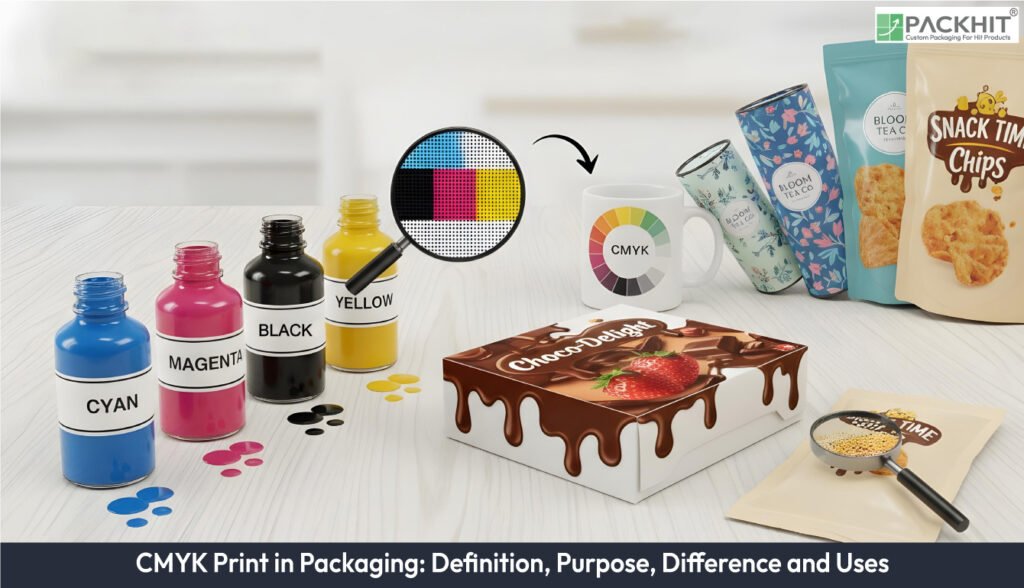
The CMYK colour model is a subtractive system using cyan, magenta, yellow and black inks to control light absorption on white substrates, allowing printers to build predictable tones for packaging. Each channel subtracts specific wavelengths, cyan removes red, magenta removes green, yellow removes blue, while black adds depth, contrast and legibility. In packaging, CMYK’s four-ink structure stabilises colour across repeated runs, helps maintain brand alignment through controlled separations and ICC profiles, and adapts to different substrates like coated board, kraft liners or films. Its efficiency lowers plate counts and waste, while the black channel ensures crisp barcodes, micro-text and neutral shadows. CMYK differs from RGB’s additive light and from spot or extended-gamut systems through its limited gamut and reliance on inked surfaces. Across packaging tasks such as photography, multi-colour layouts, promotional elements, secondary zones, offset work and large-format displays, CMYK provides consistent, repeatable colour reproduction essential for both primary and secondary packaging applications.
- What is the CMYK Colour Model?
- What is the Purpose of the CMYK Colour Model in Packaging Production?
- Process‑colour Stability for Repeated Packaging Runs
- Brand Alignment through Controlled Separations
- Application Across Primary and Secondary Packaging Surfaces
- Operational Efficiency for Long Runs
- Role of the Black Channel for Legibility and Neutral Tones
- How Does CMYK Differ From Other Colour Systems Used in Packaging?
- Subtractive Print Behaviour Compared with Additive Screen Light
- Colour‑range Limits and Tone Loss During Conversion
- Spot Inks and Extended‑gamut Channels for Brand Targets
- Black Handling and Neutral Tones
- What are the Common Uses of CMYK in Packaging?
- Photographic and Illustration Reproduction
- Multi‑colour Layouts and Background Fields
- Promotional Graphics and Secondary Zones
- Process‑colour Panels for General Print Tasks
- Promotional Graphics and Secondary Packaging Zones
- General Publishing Output Used in Packaging Contexts
- Offset Press Applications
- Large‑format and Display Workflows
- Process‑colour Efficiency Compared With Spot‑only Work
What is the CMYK Colour Model?
CMYK is a subtractive colour model used in print that specifies colour through four ink channels: cyan, magenta, yellow and key (black). It works on white substrates where pigmented ink reduces reflected light, so added ink lowers brightness and deepens tone. Each channel uses a 0–100 percentage scale, with 0 as no ink and 100 as full coverage; pure cyan appears as (100, 0, 0, 0). The black channel replaces mixes of cyan, magenta and yellow for neutral blacks, which increases contrast, lowers total ink use and keeps shadow details stable. Context from subtractive theory shows that ink absorption restricts reflected light, so predictable control depends on accurate channel values during print.
Functional Roles of CMYK in Packaging
The table below lists the four CMYK process inks and states how each channel contributes to subtractive colour formation in printed packaging
| Process ink | Abbreviation | Primary function |
|---|---|---|
| Cyan | C | Forms blues and greens when combined with magenta/yellow; subtracts red wavelengths |
| Magenta | M | Forms reds and purples when combined; subtracts green wavelengths |
| Yellow | Y | Forms greens and oranges; subtracts blue wavelengths and warms the palette |
| Black (Key) | K | Provides neutral blacks, depth, contrast and fine detail; reduces coloured ink consumption |
The above table shows CMYK inks that give manufacturers a predictable frame for colour control on paperboard, corrugated liners or film. Each colour maps directly to press behaviour, so teams can measure ink density, track drift and match proofs across repeated runs. The separation structure also reduces error during prepress because operators see how each hue depends on a specific channel mix. This clarity reduces waste on long jobs and keeps brand-critical areas close to target values.
What is the Purpose of the CMYK Colour Model in Packaging Production?
The purpose of the CMYK colour model in packaging production starts with its role as the process that prints reproducible colour across repeated runs on paperboard, corrugated grades and flexible films. The model uses cyan, magenta, yellow and black channels to generate predictable tonal structures that match brand colour requirements within agreed tolerances. Four‑channel separations keep reproduction stable across thousands of sheets, if press curves, ink densities and ICC profiles stay controlled. The subtractive build reduces reflected light rather than emitting it, which aligns with how packaging substrates behave under retail lighting.
Process‑colour Stability for Repeated Packaging Runs
CMYK maintains run‑to‑run colour stability for repeated packaging runs because the same four inks create every hue in photographic panels, text zones and shaded illustrations. Printers control density, trapping and dot gain to keep colour drift small across long or repeated jobs. RGB assets lose gamut during conversion, so prepress converts all imagery early to prevent unplanned shifts.
Brand Alignment through Controlled Separations
Controlled separations keep brand colour targets inside the printable CMYK range. ICC profiles describe press behaviour, ink density and substrate reflectance, and the CMYK values inside the profile carry that behaviour across design software, including Figma documents configured with device profiles. The mapping converts digital artwork into subtractive combinations of cyan, magenta, yellow and black, which follows the same logic seen in subtractive colour explanations where pigmented ink reduces the light reflected from the white substrate. Brand panels, ingredient blocks and front‑panel photography depend on these controlled separations because unprofiled RGB data produces out‑of‑gamut shifts.
Application Across Primary and Secondary Packaging Surfaces
Primary packs use CMYK for full‑colour product photos and gradients; secondary zones use it for specification tables, regulatory text and side‑panel graphics. Coated paperboard, metallised board, kraft liners and BOPP films all interact with CMYK in predictable ways because each substrate controls ink absorption and reflectance. Designers reference print profiles tied to these materials to keep tonal steps and dark areas consistent.
Operational Efficiency for Long Runs
Four‑colour work reduces plate count compared with multiple spot inks. This lowers setup time, reduces makeready waste and keeps ink management simple on litho, flexo and digital presses. CMYK supports wide tonal ranges without adding extra units if brand colours fall within the standard gamut. The black channel substitutes mixed CMY blacks, cutting total ink levels and stabilising shadow tones.
Role of the Black Channel for Legibility and Neutral Tones
Black (K) controls density in barcodes, micro‑text and technical diagrams because single‑channel prints avoid registration errors that appear when three colours attempt to form a fine line. K also forms neutral greys without colour casts, which CMY mixes struggle to maintain when dot gain varies across a run. Prepress uses K to anchor shadows in product photographs and to keep contrast predictable under fluorescent or LED retail lighting.
How Does CMYK Differ From Other Colour Systems Used in Packaging?
The CMYK colour model differs from other colour models in packaging in multiple ways given below:
Subtractive Print Behaviour Compared with Additive Screen Light
CMYK subtracts reflected light on paper or board, while RGB builds colour from emitted red, green and blue light on displays. CMYK starts from a white substrate; RGB starts from a black screen. This difference limits the CMYK gamut and prevents access to saturated neon‑type hues seen on screens.
Colour‑range Limits and Tone Loss During Conversion
CMYK covers a narrower colour range than RGB, especially in saturated reds, greens and blues. Conversion maps out‑of‑range pixels to printable values defined in the press profile, which shifts hue and lowers saturation. Designers check these shifts early if product photos contain precise tonal steps. Context from subtractive colour behaviour explains this loss: pigmented inks absorb reflected light, so the printed result cannot match the intensity created by emitted RGB light on screens.
Spot Inks and Extended‑gamut Channels for Brand Targets
Spot inks supply premixed pigments that achieve specific brand colours that CMYK cannot match. Extended‑gamut processes add extra inks—examples include orange, green or violet, to widen the printable range. Each addition increases plate count and setup time on packaging presses.
Black Handling and Neutral Tones
Neutral blacks in CMYK use the K channel rather than equal cyan, magenta and yellow. Black reduces total ink, cuts drying time and removes colour casts in shadow areas. Text, barcodes and fine lines depend on K to avoid registration issues that occur with three‑colour builds.
What are the Common Uses of CMYK in Packaging?
These uses describe how CMYK supports four practical print tasks in packaging, including photographic panels, multi‑colour fields, promotional elements and secondary text zones:
Photographic and Illustration Reproduction
CMYK handles photographic imagery, continuous‑tone illustrations and gradient‑rich artwork on packaging panels. These elements include product photos, lifestyle scenes and shaded vector drawings. CMYK halftone dots record tonal shifts that RGB displays create with emitted light, so conversion into CMYK with the correct profile keeps colour loss predictable.
Multi‑colour Layouts and Background Fields
CMYK drives multi‑colour backgrounds, layered textures and pattern fields on cartons, sleeves and flexible packs. These backgrounds often rely on wide tonal ranges; CMYK anchors those ranges by adjusting each channel’s percentage. Substrate absorbency and coating influence final colour, so designers match backgrounds to the target board grade.
Promotional Graphics and Secondary Zones
CMYK prints call‑outs, discount shapes and short promotional lines that sit beside the primary artwork. Barcode zones, ingredient lists and warning blocks rely on the black channel to keep edges crisp if the artwork uses small character sizes or thin strokes.
Process‑colour Panels for General Print Tasks
CMYK supports broad print tasks across cartons, wraps and film labels. These tasks include neutral fields, contrast blocks and composite illustrations. The four‑channel set keeps print stability consistent on coated board or porous liners if dot gain curves remain calibrated.
Promotional Graphics and Secondary Packaging Zones
CMYK prints promotional graphics such as banners, call‑outs and discount panels. Secondary zones, for example, side panels with ingredients or care instructions, use CMYK for consistent legibility. Black (K) supports code areas and micro‑text, if tonal neutrality matters.
General Publishing Output Used in Packaging Contexts
Magazines, brochures and posters use CMYK for process‑colour reproduction, and these formats share the same behaviour seen in packaging: narrower gamut than RGB, predictable separations and repeatable results. Folding cartons, printed sleeves, label faces and point‑of‑sale boards inherit this logic, because all rely on reflective substrates.
Offset Press Applications
Offset presses handle sheetfed carton work with CMYK plates. Offset separates artwork into four plates and prints with controlled ink densities to manage dot gain. This method supports detailed imagery, thin strokes and small text because plate stability keeps registration variance low.
Large‑format and Display Workflows
Large‑format process presses apply CMYK to display boards, corrugated signage and oversized carton components. These presses run coarser screens on porous substrates, so prepress teams adjust tonal values to prevent oversaturation. CMYK maintains colour consistency across large surface areas if ICC profiles match print conditions.
Process‑colour Efficiency Compared With Spot‑only Work
CMYK handles large‑area fills and photographic detail more efficiently than spot‑only builds because one CMYK set covers the full tonal range. Spot ink adds precision for narrow brand hues, but CMYK covers broad artwork zones without extra plates. Extended‑gamut methods add channels beyond CMYK if a specific match demands a wider gamut.