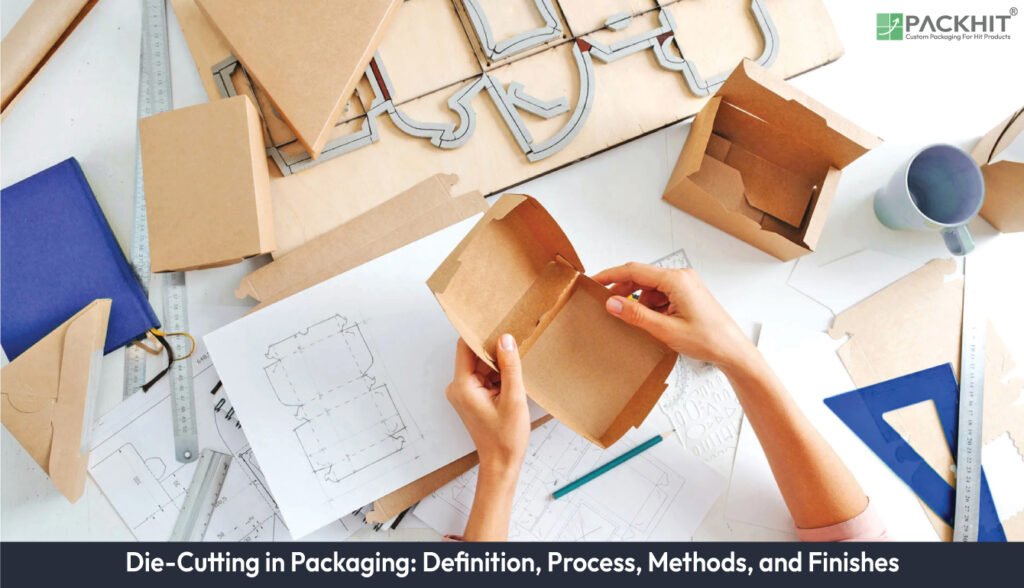
Die-cutting in packaging shapes boards, films or labels with a manufactured die so outlines, folds, and apertures match a precise dieline across repeat cycles. Die-cutting in packaging relies on shaped metal dies with hardened edges and calibrated clearances that form cuts or creases for cartons, sleeves or inserts. Die-cutting in packaging follows six sequential steps that manage material preparation, registration, cutting, creasing, stripping and inspection so dimensional accuracy stays stable. Die-cutting in packaging uses flatbed, flexible or solid rotary dies on sheet-fed or web-fed presses to cut predetermined profiles from substrates. Die-cutting in packaging forms its tools through flatbed steel‑rule construction, flexible die production or solid rotary machining shaped to the required profile. Die-cutting in packaging applies finishes such as varnish, lamination, foil, embossing, debossing, spot UV, textured layers, perforation adjustments and edge tinting for protection or contrast. Die-cutting in packaging meets quality targets with pressure control, registration checks, rule inspection, substrate verification, tooling alignment, waste‑removal tuning, cycle‑rate control and sample measurement. Die-cutting in packaging requires selecting a die that matches substrate thickness, run duration, contour detail, press type, tolerance limits, changeover needs and fibre behaviour.
- What is a Die in Packaging?
- What is Die-Cutting?
- What are the Steps in Die-Cutting Process?
- 1. Material preparation
- 2. Die registration
- 3. Cutting stroke or rotary pass
- 4. Creasing and feature forming
- 5. Stripping and waste removal
- 6. Inspection and dimensional checks
- How is a Die-Cut Made?
- What Types of Finishes are Applied During and After the Die-cutting Process?
- Varnish coating
- Lamination film
- Foil stamping
- Embossing
- Debossing
- Spot UV curing
- Textured coatings
- Perforation strengthening
- Edge tinting
- What are the Key Quality Management Strategies in the Die-Cutting Process?
- How to Choose the Right Die for Packaging?
What is a Die in Packaging?
A die in packaging is a shaped metal tool that cuts or forms a substrate according to a predefined outline. It carries distinct characteristics such as hardened steel edges, calibrated heights and controlled clearances that keep cut paths accurate across repeated cycles. The components of die in packaging include cutting rules, creasing rules and a carrier body that holds each element in position. Three principal types exist in production, including the flatbed dies for thick boards, flexible magnetic dies for rotary presses and solid rotary cylinders for long runs.
What is Die-Cutting?
Die-cutting cuts predefined shapes from substrates with a manufactured die. The process uses flatbed, flexible or solid rotary dies to form labels, cartons or inserts with repeatable dimensions. Modern packaging plants run these dies on sheet-fed or web-fed presses to create accurate outlines that match the original dieline.
What are the Steps in Die-Cutting Process?
The steps in the die-cutting process form shapes, panels and structural features by pressing a manufactured die into a sheet or web substrate so that the cutting edges shear fibres along a predefined path. The die follows a controlled sequence process that keeps outlines consistent on repeat cycles in flatbed, flexible or solid rotary systems.
- Material preparation
- Die registration
- Cutting stroke or rotary pass
- Creasing and feature forming
- Stripping and waste removal
- Inspection and dimensional checks
1. Material preparation
Material preparation sets sheet or web properties so the die cuts cleanly, and involves substrate loading, alignment to guide marks, and tension control on webs. Material preparation controls fibre‑pull and keeps coating layers intact on boards and films used in cartons, sleeves and labels.
2. Die registration
Die registration positions the die relative to printed artwork or blank sheet edges, and includes locating pins, optical marks and mechanical stops. Die registration determines whether creases, windows and cut panels fall in precise locations across multiple repeats.
3. Cutting stroke or rotary pass
Cutting stroke or rotary pass brings the die into contact with the substrate, so the rule penetrates to full depth. Cutting stroke on flatbed systems uses a vertical press action suited to thicker boards, while rotary pass uses continuous web feed for labels, tags and long‑run cartons. Cutting stroke or rotary pass reflects the die type: flatbed dies press downward by platen, flexible dies wrap a magnetic cylinder, and solid rotary dies form a hardened cutting cylinder for extended durability.
4. Creasing and feature forming
Creasing and feature forming shapes fold lines and partial cuts during the same pass, using creasing rules, matrices and perforation profiles. Creasing and feature forming introduce fold behaviour for glue flaps, side panels and structural locks and avoid fibre cracking on heavy boards.
5. Stripping and waste removal
Stripping and waste removal clear offcuts by mechanical pins, air assistance or frames that push scrap from apertures. Stripping and waste removal improve cycle speed on both flatbed and rotary presses and leave clean blanks ready for folding and glueing.
6. Inspection and dimensional checks
Inspection and dimensional checks compare cut parts against target tolerances using gauges, optical readers or sample jigs. Inspection and dimensional checks identify drift in pressure or registration if edges fray, panels shift, or crease geometry degrades across the run.
How is a Die-Cut Made?
A die-cut is made by manufacturing a shaped metal tool and forming it into a cutting profile that matches a packaging dieline. The tool follows methods that create cutting edges, creasing components and support structures suited to flatbed, flexible or solid rotary systems. Three primary methods shape the cutting tool, such as flatbed steel‑rule construction, flexible die production and solid rotary machining.
Flatbed Steel‑rule Die Construction
Flatbed steel‑rule die construction places hardened steel rules into a plywood or composite board that CNC routers cut into a detailed cavity pattern. The procedure bends each rule to match curves, slots and tabs so the cutting edge follows the carton outline without drift across repeats. Rule heights and bevels vary by substrate thickness, and compression channels sit between cutting and creasing rules when corrugated grades demand controlled crush. Flatbed steel‑rule die construction suits thicker paperboard and corrugated sheets used for transit packs or sample runs, where quick modification and rule replacement shorten changeover time. This construction links to hydraulic or mechanical flatbed presses that apply a vertical stroke, which keeps penetration depth stable on rigid materials.
Flexible Die Production
Flexible die production shapes a thin steel sheet that holds chemically etched or laser‑formed cutting edges. Burr‑free edge formation supports short bridges and micro‑perforation clusters for label stock and lightweight films. The sheet attaches to a magnetic cylinder so the die profile contacts a web substrate during each rotary pass. A flexible die runs on rotary and semi‑rotary presses, where continuous feeding maintains repeat pitch and where operators switch designs quickly through cylinder swaps. This process supports films, label laminates and paper webs used in roll‑to‑roll applications common to UK manufacturing plants producing regulated food labels or variable‑data items.
Solid Rotary Die Machining
Solid rotary die machining forms a hardened steel cylinder with permanent cutting profiles. Machining paths include contour milling, grinding and heat treatment to stabilise edge geometry for thousands of metres of continuous web feed. The rigid one‑piece body tolerates high repeat counts on pressure‑sensitive labels, medical stock or long‑run carton blanks where dimensional drift affects downstream packing lines. Solid rotary die machining suits continuous‑web applications that run at fixed tension, and operators select this die type when tooling life outweighs frequent redesign.
Die makers group these construction methods under principal die‑cutting techniques that trade cycle speed, profile flexibility and tooling cost. The table below outlines how each technique fits different production goals in packaging plants across the UK.
| Technique | Speed Characteristics | Flexibility Characteristics | Tooling Cost Characteristics |
|---|---|---|---|
| Flatbed steel‑rule | Moderate cycle rate on sheet-fed presses | High layout flexibility for curves, tabs and quick edits | Low entry cost with replaceable rules |
| Flexible rotary | Fast rotary throughput with stable repeat pitch | Medium contour flexibility with etched or laser‑formed edges | Medium cost tied to magnetic cylinder compatibility |
| Solid rotary | Fastest continuous‑web speed for long runs | Low profile flexibility because contours are permanent | High cost offset by long tool life |
The comparison clarifies how production managers match die‑cutting tools to run length, contour complexity and substrate behaviour so finished cartons, sleeves, or labels align with dimensional targets.
What Types of Finishes are Applied During and After the Die-cutting Process?
The types of finishes are applied during and after the die‑cutting process to control surface protection, visual contrast and functional performance on cartons, sleeves and labels.
Varnish coating
Varnish coating adds scuff resistance to printed paperboard by forming a thin protective film that sits over inked panels. Varnish coating uses matte, gloss or satin layers that control light reflection during folding and glueing on cartons or sleeves.
Lamination film
Lamination film fixes an OPP or PET layer to the substrate so fibres remain stable along cut edges during die‑cutting. Lamination film holds coatings in place on boxes or labels; if repeated handling risks surface abrasion.
Foil stamping
Foil stamping presses metallic foil into marked zones by using heat and pressure so reflective elements appear on borders, seals or brand marks. Foil stamping forms a controlled bond that stays aligned with the die‑cut profile.
Embossing
Embossing raises defined regions through male and female tools so logos or pattern blocks project from the sheet. Embossing adjusts relief height to avoid fibre cracking on heavy boards used in cartons or sleeves.
Debossing
Debossing compresses selected areas below the surface so recessed shapes form on rigid boxes or premium cartons. Debossing sets controlled depth so crease paths and fold lines remain stable after cutting.
Spot UV curing
Spot UV curing forms a hardened gloss layer on targeted panels, so icons or window surrounds gain sharp visual contrast. Spot UV curing uses controlled exposure so the cured zone stays clear of creases or cut paths.
Textured coatings
Textured coatings form tactile surfaces such as sand, linen or soft‑touch finishes added after die‑cutting. Textured coatings change surface friction so printed cartons gain grip or controlled handling properties.
Perforation strengthening
Perforation strengthening adjusts micro‑cuts or bridge widths so that tear paths pull evenly on opening strips or label sections. Perforation strengthening maintains repeatable tear force if web tension shifts during cutting.
Edge tinting
Edge tinting colours exposed board edges so cut lines match printed panels. Edge tinting masks raw fibres if folding exposes multiple layers along carton seams.
What are the Key Quality Management Strategies in the Die-Cutting Process?
The key quality management strategies in the die-cutting process are:
- Pressure control systems that keep rule penetration consistent on flatbed, flexible and solid rotary dies, so cut depth stays uniform across carton boards, label webs or corrugated sheets.
- Registration checks that lock die position to print artwork by using optical marks and mechanical stops, so panels, windows and crease paths match the dieline.
- Rule condition monitoring that inspects cutting and creasing rules for burrs, rounding or height drift. For example, steel‑rule dies are used on thicker boards.
- Substrate verification that confirms board grade, moisture and coating stability before loading, so fibre pull and edge shearing stay within tolerance.
- Tooling alignment audits that compare die cavities, carriers and locating pins on flatbed and rotary systems, so sheet or web feed tracks without skew.
- Waste‑removal tuning that adjusts stripping frames, pins and air assistance, so apertures clear without dragging fibres or distorting blanks.
- Cycle‑rate balancing that sets feed speed for flexible or solid rotary dies so tension stays stable on continuous webs if repeat pitch starts to drift.
- Sample‑run measurement that uses gauges or jigs to compare creases, tabs and locking features across a fixed number of repeats before full production.
How to Choose the Right Die for Packaging?
To choose the right die for packaging, match the die type to the substrate thickness, run length and contour detail so the cut profile stays stable across repeated cycles on sheet-fed or rotary presses.
- Match the die type to the substrate. For example, flatbed steel‑rule dies for corrugated or thick paperboard, where vertical stroke pressure cuts rigid fibres.
- Match the die type to the run length. For example, solid rotary dies for long runs on continuous webs, where hardened cylinders keep edge geometry stable.
- Match the die type to the contour detail. For example, flexible dies for small radii, micro‑perforation clusters and tight pitch repeats on label webs.
- Check press compatibility because flatbed systems accept board‑mounted rules, and rotary systems accept flexible sheets or solid cylinders.
- Check tolerance requirements if artwork includes windows or narrow glue flaps, because flexible and solid rotary dies hold a tighter repeat pitch.
- Check changeover limits because flatbed dies allow fast edits through rule replacement if short‑run cartons vary panel shapes.
- Check substrate behaviour by confirming moisture, coating and fibre resistance because thick boards demand raised creasing rules and controlled crush.