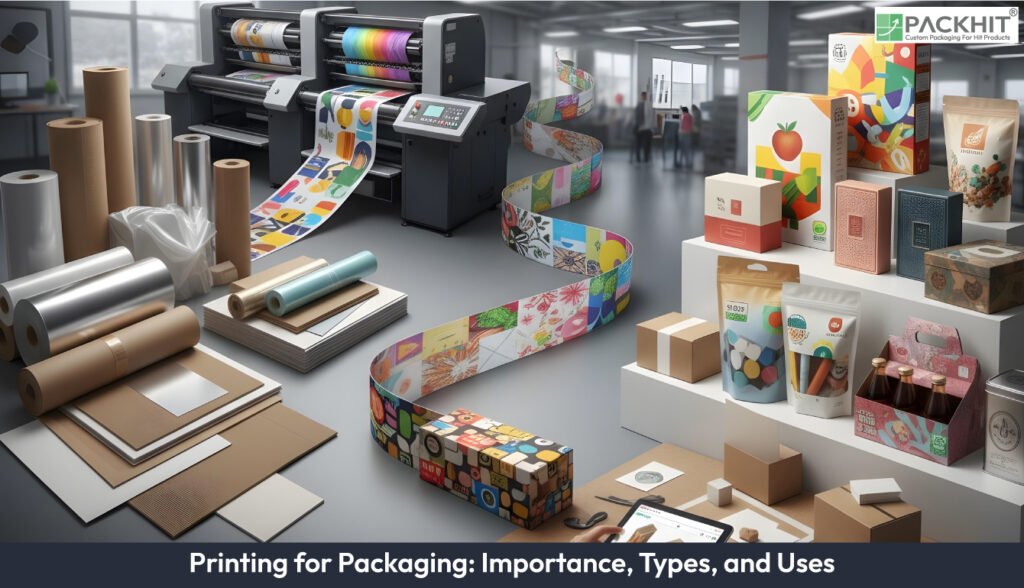
Printing for packaging adds regulated text, graphics and functional markings to cartons, films and corrugated substrates. The printing process places mandatory data blocks, brand identifiers and machine‑readable symbols in fixed positions so packs meet legal rules and stay readable during storage and transport. Types of printing methods include offset, flexographic, digital, screen and gravure systems; each method fits a defined run length, substrate category and colour‑control requirement. Printers use plate‑based units for long cartons, flexible relief units for high‑speed film lines, and data‑driven presses for short personalised batches. Web offset runs use large rolls of paper for brochures, booklets and long‑form inserts, because roll handling keeps alignment stable across thousands of impressions. Printed layers support regulatory panels, safety notes, brand panels, traceability codes, security markings, personalisation tasks and prototype checks. Process choice depends on substrate fit, image resolution targets, run length, variable‑data use, finishing layers and compliance tests.
- What is Printing for Packaging?
- Why Does Printing Matter for Packaging?
- Regulatory Function
- Protective and Technical Function
- Commercial Function
- Operational and Supply‑Chain Function
- Security Function
- What are the Types of Printing Methods used for Packaging?
- Offset (lithographic) printing
- Flexographic printing
- Digital printing
- Screen printing
- Rotogravure (gravure) printing
- What are the Primary Uses of Printing in Packaging?
- Regulatory labelling
- Usage and safety information
- Brand identity and shelf communication
- Traceability and logistics
- Security printing
- Personalisation and promotions
- Prototyping and structural testing
- How to Choose Printing Technology and Machinery?
- How do Sustainability and Personalisation Shape Printing Choices?
- What role does 3D Printing (additive manufacturing) play in packaging?
- Implementation Checklist for a Packaging Print run
What is Printing for Packaging?
Printing for packaging is the set of processes that place text, graphics and technical markings on a pack so the pack carries legal data, brand identifiers and functional instructions. Printers apply inks to paperboard, corrugated board and film in controlled layers that support legibility, abrasion resistance and colour stability. Packaging lines use offset, flexographic, digital and screen systems for this task; web offset handles some long‑run inserts made from rolls, while sheet systems handle cartons. The process covers plate preparation or data transfer, ink metering, impression, drying and quality checks. Printed components support compliance for food, cosmetics and pharmaceuticals through batch codes and ingredient panels.
Why Does Printing Matter for Packaging?
Printing matters for packaging because it carries regulatory data, protects product information during distribution and drives shelf recognition through controlled text, graphics and technical markings.
Regulatory Function
Printed packaging carries mandatory information that regulators request for food, cosmetics and pharmaceuticals. Ingredient lists, allergy statements and storage terms sit on food packs; dosage and shelf‑life instructions sit on medicines. Text size, stroke width and contrast support legibility under low light. For long‑run leaflets or booklet inserts, web offset processes apply consistent type across large rolls of paper to keep regulatory panels stable across batches.
Protective and Technical Function
Coatings and ink layers add physical resistance and keep print readable during transport. Water‑based and UV coatings limit abrasion, while low‑migration ink sets restrict chemical transfer into food or drug contents. Print weight, film thickness and curing speed influence barrier performance on cartons, pouches and corrugated boxes.
Commercial Function
Graphics guide brand recognition at the point of sale. Colour sequences, varnish combinations and metallic layers modify surface reflectance on cartons and sleeves. Screen units apply dense pigments on rigid plastics and metal tins for seasonal work. For brochures or booklets included inside packs, sheet offset processes retain colour accuracy across photographic imagery.
Operational and Supply‑Chain Function
Production teams add batch codes, date marks and machine‑readable symbols to support inspection and recall actions. Barcodes and 2D codes allow automated sorting on conveyor systems. Flexographic lines print these codes during long web runs of corrugated or film substrates, while digital presses modify item‑level data without plates.
Security Function
Security layers restrict counterfeiting in categories such as pharmaceuticals and personal care. Printers apply microtext, covert pigments and holographic patches. Serialization numbers sit on cartons and labels, and inspection cameras check code accuracy during press runs. Cylinder‑based gravure units hold tight cell geometry for repeatable patterns used in long‑volume film lines.
What are the Types of Printing Methods used for Packaging?
The types of printing methods used for packaging are offset, flexographic, digital, screen and gravure printing.
Offset (lithographic) printing
Offset printing is a plate-based lithographic printing process that reproduces images and text on a substrate by indirect ink transfer. It provides high resolution and consistent colour reproduction and is commonly employed where photographic detail and tight registration are required.
Operational notes: sheet‑fed presses use plates and require make‑ready steps, and the cost pattern favours medium or long runs once plate costs spread across the job. Finishing steps include aqueous varnish, UV varnish, foil and laminate layers. These presses also print brochures and booklets, and printers use web offset on long rolls for large batches. Typical examples: retail folding cartons, high‑quality sleeves and secondary packaging.
Flexographic printing
Flexographic printing is a relief process that transfers low‑viscosity inks via flexible plates and anilox rollers to a wide range of substrates, for example flexible films, paper and corrugated board. It is the dominant method for flexible packaging and corrugated boxes.
Operational notes: flexo runs use web‑fed lines and reach fast print speeds. The process accepts water‑based and UV‑curable inks. Plate choice and anilox volume set the tonal range. Recent plate advances cut the gap with offset. Web offset uses large rolls of paper on long jobs such as brochures or booklets, and this reinforces the link between web handling and consistent print across extended runs.
Digital printing
Digital printing reproduces image data directly on the substrate without plates and is the preferred choice for short runs, personalised packs and rapid proofing. It supports variable text and graphic content across individual items.
Operational notes: main technologies are inkjet and electrophotographic systems; ink sets include aqueous pigment, UV‑curable and specialised varnishes. Digital removes most make‑ready time, but per‑unit colour costs remain higher for very large volumes. Common examples: on‑demand labels, short‑run promotional packaging and limited‑edition personalised sleeves.
Screen printing
Screen printing deposits a thick ink layer through a stencil and is used where heavy ink laydown, high opacity or tactile effects are required. Typical substrates include rigid plastics, glass and metal cans.
Operational notes: screen printing produces vivid solids and textured finishes used on promotional or decorative packaging, for example, labels on bottles and metal tins.
Rotogravure (gravure) printing
Gravure is an intaglio process that engraves image cells into cylinders and is chosen for very long, high‑speed runs on flexible films and laminates. It yields excellent continuous‑tone reproduction and consistent ink laydown.
Operational notes: cylinder engraving costs are high but amortise over very large volumes; gravure suits long‑life, high‑fidelity runs such as multi‑colour film for snack food pouches and shrink sleeves.
This table groups the main packaging print methods and shows how each method behaves on common substrates. It helps manufacturers compare process strengths, web or sheet preferences, and the type of packs each method supports.
| Method | Strengths | Typical substrates (examples) | Best for |
|---|---|---|---|
| Offset | High image fidelity, consistent colour | Paperboard, coated board (for example retail cartons) | Medium to high runs where photographic detail matters |
| Flexography | High speed, substrate versatility | Flexible films, corrugated board, labels (for example pouches, boxes) | Flexible packaging and corrugated applications |
| Digital | Variable data, short runs, fast turnaround | Pressure-sensitive labels, cartons, treated film (for example short-run labels) | Personalisation, proofs, limited editions |
| Screen | Thick ink laydown, tactile effects | Glass, rigid plastics, metal (for example promotional cans) | Decorative and specialty applications |
| Gravure | Excellent continuous tone, consistent long runs | Flexible films and laminates (for example large volume snack film) | Very long runs where cylinder cost is justified |
Each method supports a defined production scale, substrate group and image requirement, and the set clarifies how UK manufacturers match carton, film or booklet work with offset, flexo, digital, screen or gravure lines run on sheet or web systems.
What are the Primary Uses of Printing in Packaging?
Printing in packaging supports regulatory labelling, safety instructions, brand identification, traceability codes, security markers, personalisation tasks and prototype checks, and it extends to long‑run inserts printed by web offset on large rolls of paper.
Regulatory labelling
Regulatory labelling places mandatory data blocks on a pack so the pack meets food, cosmetic or pharmaceutical rules. Ingredient lists, nutritional panels and hazard statements use fixed font sizes and contrast ratios that remain readable during storage and transport. Long‑form instructions often sit in folded leaflets printed by web offset on large rolls of paper, because web systems keep type alignment stable across thousands of consecutive impressions.
Usage and safety information
Usage and safety information records precisely worded instructions that limit handling risks. Dosage, storage temperature and disposal terms appear on medicines, cleaning agents and agricultural items. Printers select ink sets and coating layers that keep small characters intact if the pack bends, and digital lines insert batch‑specific safety notes where regulators request item‑level accuracy.
Brand identity and shelf communication
Brand identity and shelf communication support fast recognition at retail. Colour combinations, typographic hierarchy and surface effects guide attention on folding cartons, labels and sleeves. Offset presses reproduce photographic panels for front‑of‑pack areas, while screen units deposit heavy pigments for items such as metal tins in seasonal work. These elements build a consistent visual block that appears intact even under store lighting shifts.
Traceability and logistics
Traceability and logistics use machine‑readable symbols that direct goods through distribution tasks. Barcodes, 2D codes and batch numbers appear on labels, cartons and pallet markers. Flexographic lines add these codes during long web runs; digital presses change the code string for each impression if warehouse systems request serial‑level data. Scanner readability depends on line width, quiet‑zone spacing and ink density.
Security printing
Security printing embeds identifiers that restrict counterfeiting. Covert pigments, microtext and serialized numbers appear on pharmaceutical cartons and high‑risk cosmetics. Gravure cylinders hold controlled cell geometry that repeats fine patterns on long film runs, and inspection cameras confirm that each printed security element matches the reference image.
Personalisation and promotions
Personalisation and promotions place variable data or short‑run artwork on packs. Names, location references or event‑specific graphics appear on limited quantities of labels, cartons and sleeves. Digital presses print these changes without plates, and press operators switch between batches with minimal make‑ready steps if a campaign rotates messages frequently.
Prototyping and structural testing
Prototyping and structural testing create sample packs that check fit, legibility and handling. Digital presses and additive manufacturing units produce one‑off cartons, inserts or sleeves so designers check crease behaviour, code placement and artwork clarity before committing to longer runs. Web offset proofs provide longer folded samples when regulatory leaflets require multiple page checks.
How to Choose Printing Technology and Machinery?
Choose technology by matching substrate, desired image quality, run length, variable‑data needs, finishing requirements and regulatory constraints.
Selection guidance:
- Digital, if run length is short or variable data is required, for example, personalised labels or proofs.
- Offset, if photographic detail and consistent colour are required for medium runs, for example, retail folding cartons where plate costs can be absorbed.
- Flexography, if high line speed and substrate versatility are priorities, for example, flexible film pouches or corrugated board runs.
- Gravure, if extremely long runs and superior continuous tone are required, for example, multi‑million‑unit film programmes.
- Screen, if high opacity or textured varnish effects are required, for example, speciality promotional pieces.
Equipment considerations include plate and cylinder costs, anilox and dryer configuration, inline inspection and finishing options, and process controls such as colour management systems. Machinery choice must also reflect safety and compliance testing capabilities when printing for regulated products.
How do Sustainability and Personalisation Shape Printing Choices?
Sustainability shapes printing choices through ink selection, coating control and waste reduction, while personalisation shapes printing choices through short runs and variable artwork.
Sustainability uses water-based or soy-based inks, low‑impact coatings and finishes that fit recycling streams. Digital proofing cuts make‑ready waste. Web offset uses large rolls of paper for brochures or booklets if long‑run inserts require consistent print.
Personalisation uses short runs, variable text and item-level codes for targeted campaigns. Digital presses switch artwork per impression. These tasks change scheduling, inventory patterns and quality checks.
What role does 3D Printing (additive manufacturing) play in packaging?
3D printing, also called additive manufacturing, is used primarily for prototyping and limited decorative or structural elements rather than mass production of functional packaging.
Use cases: rapid prototyping of pack geometry and inserts to validate fit and cushioning; creation of unique structural samples and POS items; low‑volume decorative elements for premium short runs. The technique reduces lead time for tooling and enables iteration during design validation, but unit economics currently limit its use for high‑volume production.
Implementation Checklist for a Packaging Print run
Use this condensed checklist to align technical requirements with production choices.
- Define function: set the task for the pack with clear terms. Use regulatory text, shelf graphics, or barrier data for items such as food labels, retail cartons, or barrier pouches.
- Specify substrate: pick a material such as paperboard, corrugated board, film, or label stock. Match it with examples such as a folding carton, box, pouch, or sticker.
- Determine run length: set short, medium, or long volumes. Use digital for short runs. Use flexo or gravure for long runs. Use web offset on long rolls of paper for leaflets or booklets if the job repeats.
- Choose ink system: pick low‑migration water‑based or approved food inks for contact packs.
- Plan finishing: pick varnish, lamination, or foil. Check how each layer affects recycling.
- Validate compliance: check migration and legibility. Confirm traceability codes and test barcode or 2D code performance.
- Define quality metrics: set colour limits, code readability targets, and press acceptance terms.