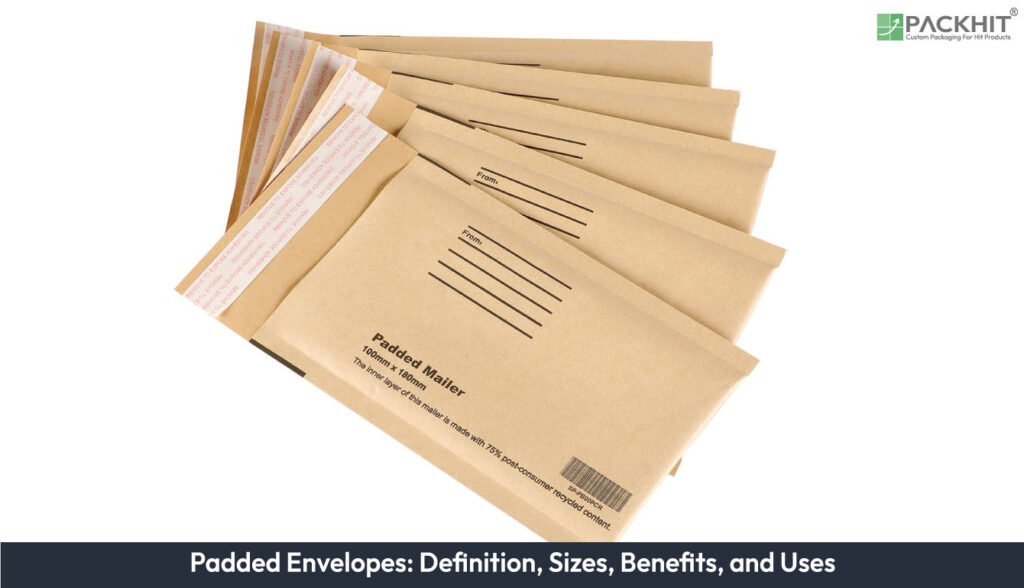
Padded envelopes are lightweight mailing enclosures with a durable outer layer and built-in cushioning that protects items from impact, compression, and friction during transit. They are important in packaging because they reduce damage while keeping shipments within standard postal weight limits and simplifying packing. Common sizes range from small formats for documents and delicate parts to medium and large options for accessories, electronics, and bundled goods. The key benefits of padded envelopes include shock absorption, low material weight, faster packing through single-piece construction, and lower shipping costs. They are widely used for jewellery, small electronics, cosmetics, and printed media, functioning as both primary packaging and transport protection.
- What are Padded Envelopes?
- What are the Common Sizes of Padded Envelopes?
- 1. Small Padded Envelopes for Documents and Flat Items
- 2. Medium Padded Envelopes for Accessories and Compact Products
- 3. Large Padded Envelopes for Bundled or Irregular Items
- What Benefits Do Padded Envelopes Provide?
- Where are Padded Envelopes Typically Used?
What are Padded Envelopes?
Padded envelopes, also known as jiffy bags, padded or cushioned mailers, are mailing enclosures with an integrated protective lining that shields contents from impact, compression, and friction during transport. The outer shell typically uses paper or polymer film, while the interior layer contains cushioning structures such as bubble film, moulded paper fibre, or honeycomb paper matrices. This dual-layer construction forms a closed protective cavity that stabilises small items without requiring secondary void fill.
Why Padded Envelopes are Important in Packaging?
Padded envelopes are important in packaging because they limit damage to fragile, lightweight items during parcel handling. The fixed cushioning layer absorbs short‑drop impacts in courier sorting, while the low material weight keeps shipments within standard postal classes. A flat, single‑piece mailer also replaces boxes and loose fill, reducing packing steps and handling errors.
What are the Common Sizes of Padded Envelopes?
Common padded envelope sizes fall into three categories: small formats from 4 in × 8 in for documents and parts, medium formats from 7 in × 10 in to 9 in × 12 in for accessories and electronics, and large formats from 10 in × 13 in to 14 in × 20 in for bundled or irregular items.
The most common sizes of padded envelopes are given below:
1. Small Padded Envelopes for Documents and Flat Items
Small padded envelopes measure between 4 in × 8 in and 6 in × 10 in. These formats carry documents, memory cards, jewellery inserts, and spare parts, for example, SIM trays and watch pins. Padding compresses to remain within letter thickness limits.
2. Medium Padded Envelopes for Accessories and Compact Products
Medium padded envelopes range from 7 in × 10 in to 9 in × 12 in. These sizes ship boxed accessories, phone chargers, cosmetic bottles, for example, glass droppers and serums, and small electronics. Internal clearance restricts lateral movement during short drops.
3. Large Padded Envelopes for Bundled or Irregular Items
Large padded envelopes span 10 in × 13 in to 14 in × 20 in. These mailers accommodate bundled components, printed kits, and soft goods, for example, manuals with accessories. Increased surface area spreads impact forces across the padding layer.
What Benefits Do Padded Envelopes Provide?
Padded envelopes reduce product damage, control shipping weight, shorten packing time, and lower total mailing cost by combining a protective cushioning layer with a lightweight, single‑piece mailer.
The padded envelopes provide the following benefits:
Damage Reduction
Padded envelopes reduce damage by absorbing mechanical shock and limiting surface contact during parcel handling. The integrated cushioning layer compresses on impact, dispersing force across a wider area and lowering peak stress on enclosed items. Bubble film traps air to slow deceleration, while paper fibre and honeycomb liners collapse in controlled zones, reducing crack initiation and edge chipping. This structure also restricts internal movement, cutting abrasion between the product and the outer shell during conveyor sorting and vehicle vibration.
Weight Control
Weight control in padded envelopes results from low‑mass construction that keeps parcels within postal weight and size limits. A bubble or paper‑padded mailer adds about 20 to 60 g, compared with 150 g or more for a small corrugated box with void fill. Flat, compressible geometry stays below dimensional thresholds, preventing billable weight increases. Consistent mailer weight stabilises per‑unit shipping costs in batch fulfilment, including subscriptions and spare‑part dispatch.
Packing Efficiency
Packing efficiency is a benefit of padded envelopes because the mailer functions as a single packaging unit with integrated cushioning. The format removes box assembly and void fill steps, reducing handling actions to loading and sealing. In fulfilment lines processing subscription orders and spare parts, this structure shortens pack time per unit and lowers packing error rates.
Cost Efficiency
Padded envelopes are cost-efficient because they replace boxes and loose fill with a single cushioned mailer, which cuts material use per shipment, for example, corrugated cartons and packing paper. Mailer weight stays between 20 g and 60 g, keeping parcels within standard postal bands and avoiding dimensional pricing applied to rigid packaging. Built‑in cushioning reduces breakage of fragile items, for example, jewellery and cosmetic containers, which lowers return rates, reshipment volume, and reverse logistics handling. In high‑volume fulfilment, the faster load‑and‑seal process also reduces labour cost per order.
These benefits scale with shipment volume. In high-frequency dispatch environments, small reductions in pack time, material use, and damage claims accumulate into measurable operational savings.
Where are Padded Envelopes Typically Used?
Padded envelopes are commonly used for shipping fragile, lightweight goods that do not require rigid containment. Frequent applications include:
- Jewellery, such as rings, necklaces, and earrings, requires surface protection and shock absorption.
- Small electronics, including cables, adapters, and compact gadgets sensitive to impact and static abrasion.
- Cosmetic items, for example, glass dropper bottles or pressed powders, where breakage leads to leakage and contamination.
- Printed media, such as discs or small booklets, that benefit from edge and corner cushioning.
In each case, the envelope functions as both primary packaging and transport protection, reducing reliance on additional outer packs.