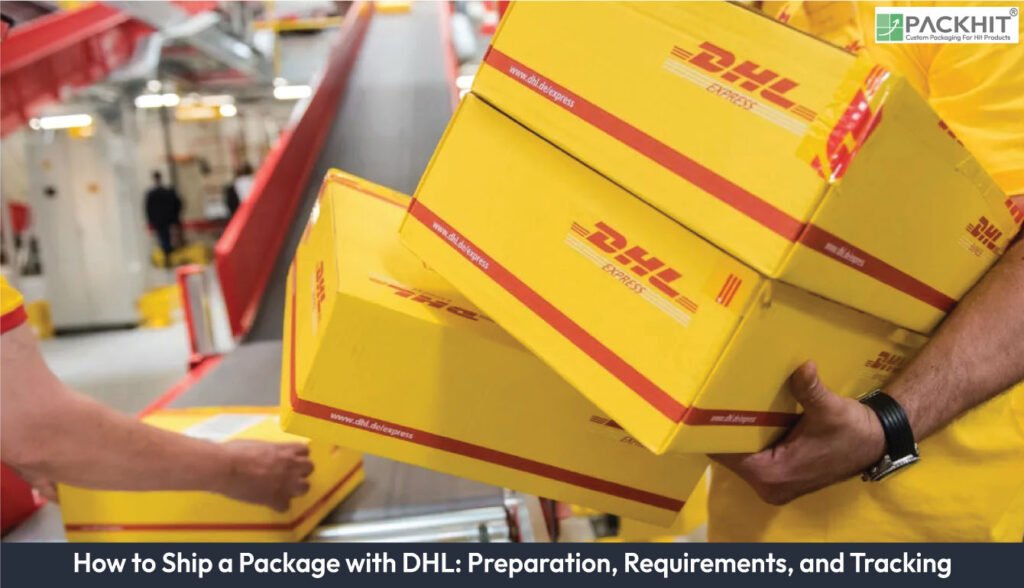
To ship a package with DHL, select the right-sized carton based on weight and dimensions, then secure the contents with proper internal cushioning to prevent movement. Liquids and sensitive items require sealed secondary containment to avoid leakage during transit. The package must be firmly sealed and labelled with a clear, scannable shipping label for automated sorting. For international shipments, accurate documentation such as commercial invoices and customs details is essential to ensure smooth clearance. DHL tracking works through a unique number that updates shipment status at each stage, from pickup to final delivery.
- What Steps are Required to Ship a Package with DHL?
- 1. Measure and Select The Outer Container
- 2. Stabilise Contents With Internal Protection
- 3. Contain Liquids and Sensitive Materials
- 4. Seal and Reinforce the Package
- 5. Label the Shipment for Automated Sorting
- 6. Verify Compliance Before Handover
- 7. Service Selection and Delivery Timeframes
- What are the Documentation and Customs Requirements for International Shipping with DHL?
- How Does DHL Tracking Work?
What Steps are Required to Ship a Package with DHL?
The steps required to ship a package with DHL are given below:
1. Measure and Select The Outer Container
Select a box that matches the item’s dimensions and weight class. DHL prices air shipments using volumetric weight, calculated from length, width, and height. Oversized cartons increase chargeable weight even with low actual mass. Corrugated fibreboard cartons with reinforced corners apply to parcels up to 70 kg. Freight above this threshold, examples being machinery or bulk components, moves on pallets or crates.
2. Stabilise Contents With Internal Protection
Immobilise the item inside the package to prevent impact damage. Internal voids increase shock exposure during air turbulence and vehicle handling. Cushioning materials include moulded pulp, polyethene foam, and corrugated inserts. Fragile goods, examples including circuit boards or optical instruments, require full edge and surface contact support.
3. Contain Liquids and Sensitive Materials
Apply secondary containment for items that can leak or react. Liquids such as cosmetics, laboratory reagents, or inks require sealed inner packaging and absorbent layers. Pressure variation during flight increases leak risk, so caps, seals, and liners remain mandatory for compliant acceptance.
4. Seal and Reinforce the Package
Close the carton using pressure‑sensitive packing tape on all seams. DHL handling involves automated sorting and manual transfers. Reinforced taping across the centre and edges reduces seam separation. Staples or string are excluded because they interfere with conveyor systems.
5. Label the Shipment for Automated Sorting
Attach one scannable DHL shipping label on the largest flat surface. Barcode readability supports routing through DHL’s automated hubs. Remove or cover previous carrier labels and obsolete barcodes, if present, to prevent misrouting during cross‑dock scans.
6. Verify Compliance Before Handover
Confirm packaging and labelling meet DHL acceptance standards before pickup or drop‑off. Non‑compliant parcels face delays or rejection at the first scan. This step reduces handling exceptions and aligns the shipment with DHL’s express and freight processing flow.
7. Service Selection and Delivery Timeframes
DHL Express services are structured around delivery deadlines rather than distance alone. Worldwide Document Express applies to paper‑based shipments such as contracts or certificates, while DHL Worldwide Parcel Express accommodates goods. Next‑day international delivery is available on selected routes, typically between major commercial hubs, subject to customs release timing.
What are the Documentation and Customs Requirements for International Shipping with DHL?
The documentation and customs requirements for international shipping with DHL are explained below:
- Commercial invoice: Lists goods descriptions, HS code where available, quantities, unit values, total declared value, country of origin, and exporter and consignee details. Customs authorities use this document to assess duties and taxes. Incomplete descriptions increase inspection frequency.
- Shipment value declaration: States the transaction value in USD for US exports. Declared value must match sales records, examples including sales invoices or pro forma invoices, to prevent valuation disputes.
- Export and import compliance data: Identifies export reason, examples being sale, repair, or sample, and includes Incoterms such as DAP or DDP to clarify tax and duty responsibility.
- Restricted and regulated goods classification: Applies to controlled items, examples including lithium batteries, chemical samples, and medical devices. Each category follows specific UN classification, labelling, and documentation rules.
- Hazardous materials approval: Requires prior acceptance by DHL for dangerous goods. Packaging must meet IATA standards, with mandatory hazard labels and shipper declarations.
- Customs disclosure and inspection access: Allows border authorities to inspect shipment contents. International shipments provide less privacy than domestic parcels due to mandatory disclosure.
- External package identification limits: Reduces visible content details on outer packaging. Regulatory information remains accessible to customs while non-essential markings stay minimal.
- Network entry to final handoff: Package enters DHL via pickup or drop‑off, receives initial scan and route assignment, passes export and import customs clearance for international shipments, and completes last‑mile delivery through DHL or regional partners based on destination coverage.
How Does DHL Tracking Work?
DHL tracking works by linking a single tracking number to every physical scan recorded across the shipment lifecycle. Each scan logs a defined event, examples including pickup confirmation, export processing, customs release, arrival at destination hub, and final delivery. Status updates show exception causes, examples being customs inspection or weather disruption, allowing shipment location and clearance stage to be verified at any time.