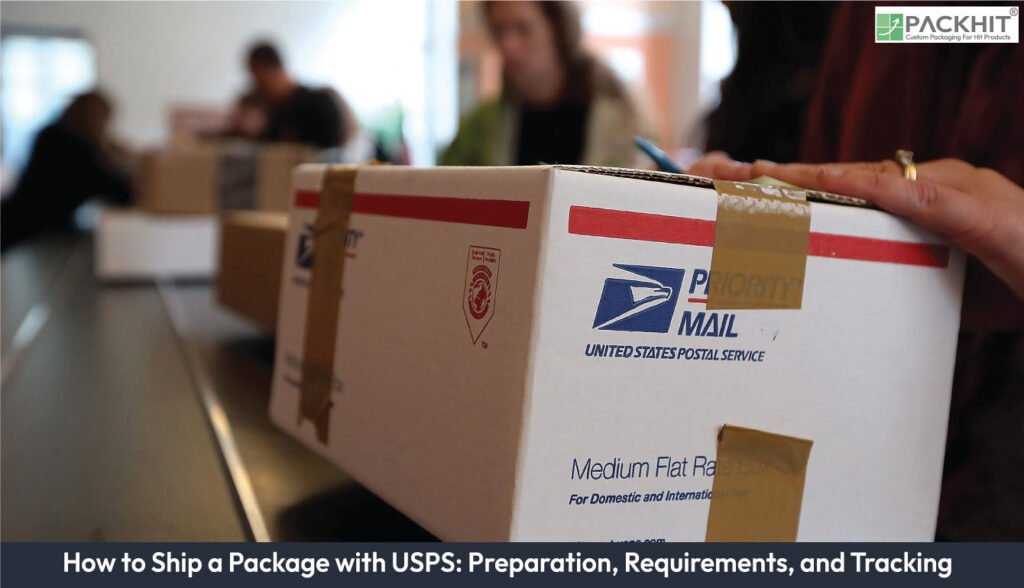
To ship a package with USPS, start by measuring the package accurately, choosing suitable packaging, and securing contents with proper cushioning to prevent damage. All openings must be sealed firmly, and a clear label with delivery and return addresses, along with correct postage, should be applied. USPS labelling rules ensure accurate routing, payment validation, and recovery of undeliverable items, while printed labels improve tracking and reduce errors. Once accepted, tracking begins with a barcode scan, followed by updates through transit hubs until final delivery.
- What are the Key Steps to Prepare a Package for USPS Shipping?
- 1. Measure Contents
- 2. Select Packaging
- 3. Prepare Internal Protection
- 4. Seal All Openings
- 5. Apply Labelling and Postage
- 6. Tender at an Acceptance Point
- What USPS Labelling and Postage Requirements Apply?
- Delivery Address Identifies Destination Endpoint
- Return Address Assigns Sender Accountability
- Postage Reflects Weight, Dimensions, and Service Class
- Stamps Apply to Lightweight Mailpieces
- Printed Labels Consolidate Payment and Tracking
- Prepaid Postage Markings
- How Does USPS Tracking Work After Shipment?
- How Does Discreet Shipping Function Within USPS Services?
What are the Key Steps to Prepare a Package for USPS Shipping?
Preparing a package for USPS shipping follows six operational steps that determine acceptance, rate classification, and tracking visibility. Each step links the packaging condition with USPS processing rules and service eligibility.
1. Measure Contents
Record the item weight on a calibrated scale and note the length, width, and height in inches. USPS checks these figures at acceptance, and incorrect entries lead to postage‑due charges or service reclassification.
2. Select Packaging
Select a box, padded envelope, or poly mailer that fits the item’s shape and weight. Corrugated boxes carry dense items such as tools or parts, while poly mailers hold soft goods such as clothing.
3. Prepare Internal Protection
Immobilise the contents with cushioning materials such as kraft paper, air pillows, or foam inserts. Loose space causes shifting during conveyor transport and increases breakage risk.
4. Seal All Openings
Seal seams and flaps with pressure‑sensitive tape in an H‑pattern. USPS does not accept string, staples, or masking tape because these materials fail during machine handling.
5. Apply Labelling and Postage
Attach a delivery address, a return address, and prepaid postage on one visible surface. Printed labels combine service type, barcode tracking, and payment data for accurate scanning.
6. Tender at an Acceptance Point
Hand the package to a retail counter, schedule a carrier pickup, or place it in a collection box, if size limits allow. The first acceptance scan activates USPS tracking inside the postal network.
Optional steps apply by service class. Priority Mail and Priority Mail Express support added insurance, except for excluded items defined in USPS claim rules. Purchased insurance replaces ordinary indemnity coverage and is unavailable for small flat-rate boxes and envelopes.
What USPS Labelling and Postage Requirements Apply?
USPS labelling and postage requirements define address accuracy, payment validation, and scan visibility. The USPS labelling requirements are mentioned below:
Delivery Address Identifies Destination Endpoint
The delivery address defines the final USPS routing endpoint and determines sortation accuracy. Each label lists the recipient’s name, street address or PO Box, city, state abbreviation, and ZIP+4, if available. Missing unit numbers, truncated ZIP codes, or handwritten corrections increase misrouting risk.
Return Address Assigns Sender Accountability
The return address links the parcel to the originating sender for recovery and compliance. USPS uses the return address for undeliverable mail, postage-due notices, and inspection holds. Omitted return addresses limit recovery options after refusal or damage.
Postage Reflects Weight, Dimensions, and Service Class
Postage corresponds to recorded weight, measured dimensions, and the selected USPS service tier. USPS verifies these values at acceptance and during automated processing. Underpaid parcels trigger postage-due assessments or delayed delivery.
Stamps Apply to Lightweight Mailpieces
Stamps cover low-weight parcels and envelopes within standard size limits. Multiple stamps may be combined to meet the required postage, but denomination stacking increases label clutter and scan failure on parcels exceeding one pound.
Printed Labels Consolidate Payment and Tracking
Printed shipping labels combine postage, service indicators, and barcode tracking in one machine-readable surface. Barcodes activate acceptance scans and tracking events across USPS facilities. Labels generated online reduce counter processing time and address transcription errors.
Prepaid Postage Markings
Prepaid postage markings confirm postage payment through licensed mailing systems. These markings encode mailer identification, transaction date, and paid value. USPS validates marking data during processing; altered or duplicated markings trigger rejection or investigation.
How Does USPS Tracking Work After Shipment?
USPS tracking activates at the first acceptance barcode scan, records movement through processing facilities and delivery units, and closes with a delivery or attempted‑delivery scan, with update frequency determined by the selected service class.
- Barcode scan: Tracking activates after the USPS barcode receives an acceptance scan at a counter, carrier pickup, or automated intake point.
- Intake status confirms network entry: The first update records custody transfer into the USPS processing system and validates postage and service class.
- Regional transit scans mark movement: Subsequent scans log passage through the sectional centre facilities and regional distribution hubs.
- Destination facility scan signals arrival: Arrival updates indicate processing at the local delivery unit serving the recipient’s ZIP code.
- Delivery scan closes the shipment: Final status records successful delivery or attempted delivery with date and time.
- Service class controls update frequency: Priority Mail Express posts higher scan density, while First‑Class and Retail Ground post milestone-based events.
- International tracking has jurisdiction limits: Updates may stop after handoff to a foreign postal authority, depending on the destination country and service agreement.
How Does Discreet Shipping Function Within USPS Services?
Discreet shipping through USPS relies on generic external presentation rather than special handling labels. Plain packaging without content descriptors minimises visibility during transit, while PO Box addressing substitutes residential endpoints with controlled-access mail receptacles.
Priority Mail, Retail Ground, and Priority Mail Express all permit discreet shipment practices. USPS does not require declaration of discreet intent; compliance rests solely on packaging neutrality and accurate addressing.
How Does USPS Compare with Private Carriers for Package Shipping?
USPS pricing remains lower in many weight and distance bands due to its public mandate and absence of volume contracts. This cost structure favours individuals and small shippers. Reliability perception varies by season and region; documented on‑time performance has exceeded 80 per cent during peak periods but fluctuates with volume load.
Unlike private carriers, USPS delivers to PO Boxes and remote addresses without surcharges, a functional distinction that influences carrier selection for residential and rural destinations.
How Do USPS Box Dimensions Affect Eligibility and Cost?
USPS pricing responds to both actual weight and dimensional weight. Rectangular boxes exceeding standard volume bands are rated under dimensional pricing rules, which raise postage independent of mass. Measurement accuracy, therefore, controls rate classification as much as scale weight.
Irregular shapes or non‑rectangular parcels introduce handling complexity and may be refused or reclassified. Consistent right‑angle geometry remains the baseline assumption in USPS automated sorting.