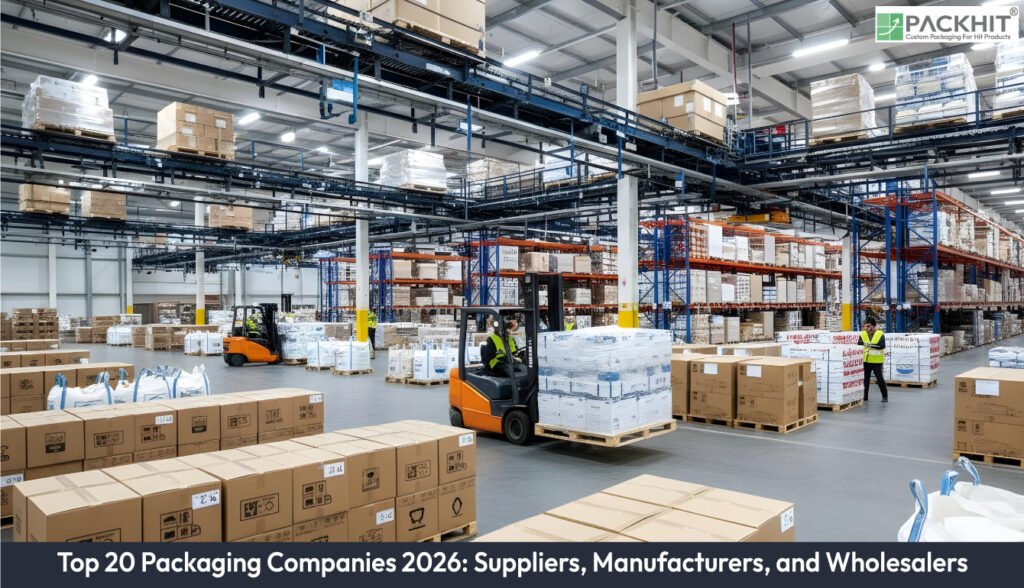
The top twenty packaging companies include International Paper, WestRock, Ball Corporation, Smurfit Kappa, Oji Holdings, Amcor, Crown Holdings, Stora Enso, Mondi, Avery Dennison, Packaging Corporation of America, Graphic Packaging International, DS Smith, Veritiv, Silgan Holdings, Pactiv Evergreen, Sonoco, Sealed Air, Coveris, and EPL Limited, representing the top global packaging companies across paper, metal, flexible films, rigid plastics, labels, and laminated tubes. These companies lead the packaging industry through large-scale manufacturing, converting, and wholesale distribution that support food, beverage, consumer goods, healthcare, and industrial markets. Across material domains, they provide protective outer packaging that safeguards products, and especially short-lived edible or biodegradable packaging, from moisture, debris, and transit damage. Beyond manufacturing, they offer value-added services such as structural design, printing, contract packing, warehousing, kitting, and regulatory compliance support. Their material expertise enables packaging substitution, recyclability tuning, and barrier engineering to meet sustainability goals. Collectively, these firms shape global packaging supply chains by balancing transit performance, sanitation, cost efficiency, and environmental responsibility across complex distribution networks.
- What are the Top 20 Packaging Companies?
- 1. International Paper
- 2. WestRock
- 3. Ball Corporation
- 4. Smurfit Kappa Group
- 5. Oji Holdings
- 6. Amcor
- 7. Crown Holdings
- 8. Stora Enso
- 9. Mondi
- 10. Avery Dennison
- 11. Packaging Corporation of America (PCA)
- 12. Graphic Packaging International
- 13. DS Smith
- 14. Veritiv
- 15. Silgan Holdings
- 16. Pactiv Evergreen Inc.
- 17. Sonoco
- 18. Sealed Air
- 19. Coveris
- 20. EPL Limited
- Which Packaging Companies Lead in the Material Domain?
- What Services do Professional Packaging Companies Provide Beyond Converting and Manufacturing?
What are the Top 20 Packaging Companies?
The top 20 packaging companies are detailed below:
1. International Paper
International Paper runs integrated pulp and paper lines that make containerboard, corrugated packaging and pulp for industrial and retail use. The company acts as a manufacturer and a large wholesale supplier. It began operations in the late 19th century and keeps its headquarters in Memphis, Tennessee, USA. Reported annual revenue sits in the tens of billions of USD. Core markets include CPG, e‑commerce shipping and industrial distribution. Demand for greener packaging pushes the company to add fibre grades that support compostable formats, if converters request outer layers for protection during shipping.
Core production steps run from wood procurement through pulping, paper‑machine output of liner and medium, corrugation, box converting and high‑volume finishing. Wholesale paths supply distributors, and direct OEM plants with standard and custom corrugated formats, and large MOQs often require multi‑plant coordination across mills and converters. Certified fibre programs and recycled‑fibre lines support sustainability targets and create fibre grades with predictable compostable performance. Edible and short‑lived biodegradable packaging formats sometimes need outer corrugated protection during shipping, if exposure to contaminants or moisture affects sanitation or shelf stability.
2. WestRock
WestRock runs corrugated and folding‑carton plants that combine containerboard production with converting lines and wholesale channels for retail and industrial use. The company was formed through industry mergers and keeps its headquarters in the southeastern United States. Annual revenue stays in the multi‑billion USD range and links to its wide plant count and its printed retail cartons and shipper boxes.
The company uses sheet‑fed and roll‑fed printing for folding cartons, develops corrugated boxes for transit strength, and runs contract‑pack lines. It holds a strong position in retail displays and e‑commerce shipping and tests box strength for transit. Edible‑packaging makers sometimes use WestRock cartons as outer protection if fragile edible films need a barrier during shipping.
3. Ball Corporation
Ball Corporation manufactures metal packaging for beverage cans and industrial containers. It runs fast, can‑making lines with controlled coating and printing. The headquarters sits in Colorado, USA. Revenue stays in the multi‑billion USD range, and customers include beverage brands and food-pack processors such as carbonated and non‑carbonated drink producers.
The process uses aluminium coil processing, bodymaking, interior and exterior coating, offset or rotogravure printing, necking and seaming. The company supplies large brand owners and can distributors and provides technical support for fill‑line integration and closure fit. Recycling systems link to the short-lived nature of certain biodegradable formats, because some edible packaging examples need outer protection in transit, if contamination or moisture exposure lowers safety during shipping. Aluminium cans move through established recycling streams, and this creates consistent recovery rates.
4. Smurfit Kappa Group
Smurfit Kappa is a Europe‑headquartered paper-based packaging group that makes containerboard, corrugated packaging, and industrial formats. It works as a manufacturer, a converter, and a wholesale distributor. The group sits in Dublin, Ireland, and reports annual revenue in the single‑digit to low tens of billions of euros, depending on exchange rates and reporting cycles.
Corrugated design work spans retail shipping formats, industrial transit packs and die-cut folding cartons, with fibre grades tied to recycled and certified sources. The company runs a wide European converting network that produces repeatable board specifications for fast-moving goods. Modular structures support retail displays and e‑commerce freight, and the layout adjusts for pallet patterns or shelf-height constraints. Edible packaging with rapid biodegradation, such as seaweed films or starch-based wraps, often sits inside an outer corrugated layer during transport, if contact with moisture or airborne contaminants reduces sanitation. Smurfit Kappa’s board grades handle this protective role and keep the inner material stable long enough for storage, internal transfers or multi-leg distribution.
5. Oji Holdings
Oji Holdings combines pulp and paper manufacture with packaging converting and speciality papers; it supplies domestic and regional markets in the Asia-Pacific and functions as a manufacturer and regional wholesaler. Headquartered in Tokyo, Japan, the group spans pulp mills, paper machines and converting plants, producing containerboard, coated paper and industrial packaging materials.
Oji emphasises fine‑paper grades, coated board for folding cartons, and paper-based packaging with engineered barrier properties for food contact, and it maintains a strong regional presence in Asia and supplies brands that follow local food‑contact regulations, if short‑lived edible films require outer protection during shipping.
6. Amcor
Amcor operates flexible‑film, rigid‑plastic and speciality-laminate lines that supply CPG, food, beverage and healthcare manufacturers. Headquartered in Switzerland with roots tracing back to the early 20th century, Amcor posts multibillion‑dollar annual revenue and functions as a manufacturer and wholesale supplier across North America, Europe and APAC. Core segments span flexible pouches, medical barrier films, rigid containers and label materials used in high‑volume consumer goods.
Production spans blown‑film extrusion, cast‑film operations, lamination, flexographic and rotogravure printing, and rigid‑container forming. Transit‑ready properties vary by barrier layer, seal performance and gauge control. Wholesale channels distribute stock rolls, converted pouches and rigid formats to regional packers. Demand for lower‑impact packaging pushes Amcor to increase PCR content in polyethene and PET lines. Regrind systems reduce virgin resin use and stabilise material flow for repeat orders. Some edible packaging examples with short-lived stability, such as seaweed‑derived wraps or starch‑based films, use Amcor’s secondary packaging as outer protection, if moisture, debris or transit contact reduces sanitation during long shipping cycles. This pairing aligns with rising interest in compostable or edible formats, because biodegradable inner layers need a protective shell until the point of use.
7. Crown Holdings
Crown Holdings manufactures metal packaging, including beverage cans, food cans, and aerosol containers; the company is a primary supplier to beverage, food and household-product manufacturers. Based in North America with a global plant network, it operates in the multi‑billion USD revenue band and supplies major global brand owners.
Operational profile: coil-to-canline manufacturing, multi-stage printing and coating, and specialised end‑of‑line seaming. Wholesale role: acts as both a direct OEM supplier for brand manufacturers and an indirect wholesaler through regional distributors for smaller packers. Process emphasis: corrosion-resistant coatings and seam integrity testing for high-speed filling lines.
8. Stora Enso
Stora Enso runs pulp, board and engineered‑wood lines that supply paperboard and packaging materials to industrial converters. The group sits in Finland and reports multi‑billion‑euro revenue. It focuses on sustainable forestry and fibre-based packaging that replaces plastics. The company adds coated‑board grades that keep food-contact safety stable. These grades support outer protection for edible packaging, if short-lived films lose sanitation when exposed to debris or moisture during shipping.
Integrated pulp and board production runs through fibre preparation, board formation and barrier application, and the converting lines turn these boards into retail and food‑contact cartons. Speciality fibre lines add barrier coatings that block moisture and debris, and this barrier protects biodegradable or edible packaging examples that lose sanitation if exposure occurs during shipping. Regional policies that reduce single‑use plastics push wood‑fibre substitution, and the board grades create a stable outer layer that shields short‑lived inner materials during transit.
9. Mondi
Mondi is an international packaging and paper manufacturer focusing on corrugated packaging, flexible packaging, and kraft paper. Established and operating across Europe and Africa with headquarters functions in the UK/Europe, it reports multi‑billion euro revenue and supports industrial, food, and consumer brands.
Operational profile: flexible-film lamination lines, kraft-paper supply for sacks and multiwall paper bags, and corrugated solutions for transport packaging. Dynamic properties: strong cross-border supply capability for manufacturers requiring unified specifications across markets.
10. Avery Dennison
Avery Dennison specialises in pressure-sensitive labelling, adhesive-backed materials, and functional films used in retail and industrial identification; it operates roll-to-roll converting lines and provides technical adhesives and label performance testing. Headquartered in the United States, the annual revenue is in the single-digit billions USD range.
Operational profile: adhesive formulation and label substrate selection, die-cut converting, variable-data digital label printing support, and application testing for retail supply chains. Wholesale role: supplies label converters and brand owners with primary and secondary identification systems, often in roll form, optimised for high-speed labellers.
11. Packaging Corporation of America (PCA)
PCA runs integrated mills that make liner and medium and converts them into corrugated boxes for wholesale distributors, retailers and industrial shippers. The company sits in the United States and reports multibillion‑dollar revenue, with product sets centred on strength grades, board optimisation and predictable transit performance.
Pulping and paper‑machine lines supply containerboard, corrugators handle high‑volume board runs, and finishing stations produce die‑cut trays, partitions and custom configurations. Engineering groups run BCT and ECT checks and revise flute or board combinations to cut the cost per shipment. Corrugated layers sometimes act as outer protection for short‑lived edible packaging formats, if exposure to moisture or debris reduces sanitation during shipping.
12. Graphic Packaging International
Graphic Packaging International runs coated‑paperboard and folding‑carton lines that serve beverage, food and consumer‑goods brands, and it acts as a manufacturer and converter that supports retail displays and high‑volume shipping formats. The company operates from its United States base, reports multibillion‑dollar annual revenue, and prioritises print clarity, colour accuracy and shelf impact through controlled board callipers and tuned ink systems.
It maintains process discipline in coated‑paperboard production, lithographic and flexographic print stations, and high‑speed forming lines that shape cartons for automated packing lines. Its wholesale channels move finished cartons to brand owners and regional distributors that request fast replenishment cycles for recurring SKUs. Some biodegradable and edible packaging examples sit inside these cartons during transit, and if short-lived films lose sanitation when exposed to debris or moisture across shipping legs.
13. DS Smith
DS Smith runs a corrugated‑packaging and recycling network that links collection, pulping, containerboard production, corrugation and converting, and it supplies retail and e‑commerce customers across the UK and Europe. The company operates from its London headquarters and reports multibillion‑pound revenue tied to high-volume corrugated demand. Plants produce containerboard grades with recycled fibre, and engineers adjust flute combinations and board weight for transit strength. Corrugated layers often protect edible packaging examples, if short‑lived films lose sanitation when exposed to moisture or debris in shipping. These protective roles connect directly to rising interest in compostable formats, which break down fast and require stable outer shielding during transport.
DS Smith runs closed‑loop recycling programs, and design teams refine mono‑material corrugated trays for better recyclability. Plants run compression and impact checks to secure product stability in long supply chains. The company distributes corrugated SKUs through regional wholesale channels and supports fulfilment partners with kitting, multi-SKU assembly and just‑in‑time replenishment, if brands request consolidated shipments for e‑commerce dispatch.
14. Veritiv
Veritiv runs national distribution centres that move corrugated boxes, cushioning materials and protective wraps to manufacturers that need frequent restocking. The company operates from its United States headquarters and keeps revenue in the multibillion‑dollar range. Teams track inventory across regional hubs and maintain packaging SKUs for food, industrial and consumer goods. Customers use these stocked lines for transit protection, and some biodegradable or edible formats require an outer layer from Veritiv if contact with contaminants during transport reduces sanitation.
Staff coordinate kitting, just‑in‑time replenishment and contract‑pack activity, and they support smaller manufacturers that request lower MOQs. Distribution groups adjust order frequency for seasonal production swings and maintain transit‑ready packaging for short‑lived inner materials, if moisture or debris exposure causes premature degradation. Wholesale channels keep lead times short and stabilise supply for regional packers that depend on predictable packaging availability.
15. Silgan Holdings
Silgan manufactures metal and plastic rigid packaging such as food cans, closures and dispensers for food and consumer‑pack goods. The company sits in the United States and reports annual revenue in the single‑digit to low double‑digit billion USD range. Product lines centre on metal cans and plastic closures such as jars and threaded caps. These rigid formats protect goods during transport, and they create a stable outer layer for short‑lived edible packaging if exposure to moisture or debris reduces sanitation in shipping.
Metal forming shapes the can body, necking reduces the opening, and seaming closes the ends in controlled steps. Injection moulding creates closures with tight dimensional control. Barrier‑coating layers keep food-contact surfaces safe. Wholesale groups supply large food processors and run private‑label filling at scale, if edible packaging loses sanitation during shipping and needs a stable outer container.
16. Pactiv Evergreen Inc.
Pactiv Evergreen produces foodservice disposables, plastic and fibre-based containers, and barrier films for retail, grocery and foodservice channels, and it runs contract manufacturing lines for national brands. The company maintains its headquarters in the United States and reports multibillion‑dollar annual revenue tied to high-volume production across thermoformed trays, paperboard containers and sealed films.
It operates sheet‑extrusion systems for thermoforming, laminates paperboard for food‑grade trays, and manufactures sealed films for shelf-stable packs. Its wholesale groups supply restaurant chains, grocery private labels and food processors through large-volume agreements, and these outer containers often protect short-lived edible packaging examples, if contact with moisture or debris during shipping weakens sanitation.
17. Sonoco
Sonoco Products Company runs paperboard-core lines, rigid-container plants and flexible-packaging units that ship into industrial, food and medical production. The company operates from South Carolina, USA, and reports annual revenue in the single‑digit billions USD band. Engineers control paper‑core extrusion and rigid forming, and they convert flexible laminates into pouches that meet transit and food‑contact requirements. Wholesale teams supply converters and packagers with cores, reels and finished units that support film, label and consumer‑goods workflows. These rigid and fibre formats often protect edible packaging examples, if exposure to dust or moisture during shipping reduces sanitation or shortens the safe‑use window.
18. Sealed Air
Sealed Air manufactures protective packaging such as bubble film, thermal cushioning and Cryovac-grade vacuum materials for e‑commerce, industrial and food processors. It reports annual revenue in the single‑digit billions USD band and operates from its United States headquarters. Plants run film‑extrusion systems for barrier rolls, thermoforming units for trays and engineered‑cushioning lines that support transit protection.
Distribution teams move protective SKUs through wholesale channels to packers that need repeat replenishment, and contract groups run film conversion for food‑pack plants. Engineers test shelf‑life stability, puncture resistance and impact reduction across long shipping cycles, and they apply these checks when edible packaging needs an outer protective layer, if exposure to debris or moisture reduces sanitation during transport.
19. Coveris
Coveris produces flexible packaging and speciality films for food and non‑food goods, and it supplies brand owners and retailers across Europe and several export markets. The group operates from Europe and reports revenue in the lower multibillion‑ to billion‑euro range. Plants run lamination lines, barrier‑film units and form‑fill‑seal integration for converters and regional packers that order film rolls or finished pouches. Teams adjust barrier levels for moisture, debris and oxygen control, and these properties create outer protection for short‑lived edible packaging examples, if sanitation drops after exposure during shipping. Wholesale channels maintain a steady supply for manufacturers that use flexible formats in recurring production cycles.
20. EPL Limited
EPL Limited, previously known as Essel Propack Limited, manufactures laminated plastic tubes for oral‑care, cosmetic, pharmaceutical and industrial SKUs, and it sells these tubes to FMCG brands through global wholesale channels. The company works from its India headquarters and runs plants across multiple regions. Annual revenue sits in the several‑hundreds‑of‑millions to low‑billion‑USD range, depending on the reporting year and contract volumes. Laminated structures hold print clarity and barrier strength for paste and gel formulations, and these attributes keep transit quality stable for long distribution cycles.
Production covers laminate extrusion, tube forming, multicolour printing and end‑sealing with verified food‑ and pharma‑grade liners. Global brands use these tubes when they need repeatable gauge control and identical finishing across markets. Some edible‑packaging formats with short-lived stability require an outer layer during shipping, if exposure to debris or moisture reduces sanitation; in these cases, tube cartons or secondary packs from regional distributors shield the material until final handling. Essel Propack supplies consistent codes and carton-ready tube sets that align with these distribution patterns.
Which Packaging Companies Lead in the Material Domain?
This table groups packaging companies by the material systems they run and the production steps each system supports. It shows how paper, metal, flexible films, rigid plastics and laminated tubes behave across shipping, food‑contact and wholesale channels. It also clarifies how each material type protects short‑lived edible packaging, if moisture, debris or transit contact reduces sanitation during distribution.
| Material Domain | Representative Companies | Core Production Capability | Application Context | Protective Role for Edible Packaging |
|---|---|---|---|---|
| Paper and Corrugated | International Paper, WestRock, Smurfit Kappa, DS Smith, PCA, Graphic Packaging | Containerboard forming, corrugation, coated‑board converting, carton forming | Transit boxes, folding cartons, retail-ready structures | Outer corrugated or coated‑board layers keep short‑lived films clean, if exposure to debris or moisture lowers sanitation during shipping |
| Metal Packaging | Ball Corporation, Crown Holdings | Coil processing, stamping, coating, printing, and seaming | Beverage cans, food cans, aerosol containers | Rigid shells block contamination during transport, if inner edible layers degrade after environmental contact |
| Flexible Films and Barrier Laminates | Mondi, Coveris, Sealed Air | Lamination, film extrusion, barrier coating, form‑fill‑seal | Pouches, wraps, and industrial barrier films | Barrier layers slow moisture and debris transfer, but edible wrappers break down fast due to their biodegradable nature |
| Rigid Plastics and Thermoforming | Berry Global, Pactiv Evergreen | Thermoformed trays, rigid containers, sheet extrusion | Foodservice packs, grocery trays, sealed retail packs | Rigid trays act as physical shields during transit, and if edible packaging loses sanitation when exposed to rough handling |
| Laminated Tubes | Essel Propack | Laminated‑tube extrusion, multicolour printing, sealing | Oral‑care, cosmetic and pharmaceutical tubes | Secondary cartons protect biodegradable or edible inserts, if outer contamination impacts safety before final use |
| Cross‑Domain Selection Factors | All listed groups | Barrier engineering, recyclability tuning, logistics planning | Material substitutions for e‑commerce, food and industrial lines | Selection depends on transit demands and sanitation controls, if edible packets lose stability during multi‑leg shipping |
The above table shows how each material domain contributes a specific protective function during distribution. Paper, metal, flexible films, rigid plastics and laminated tubes guard against moisture, debris and rough handling in different ways.
What Services do Professional Packaging Companies Provide Beyond Converting and Manufacturing?
- Packaging design and structural engineering use prototyping and board checks to keep cartons stable in transit, if edible films lose sanitation after exposure to debris or moisture.
- Digital and analogue printing services apply variable‑data, flexo and litho methods that keep labels clear on outer packs that protect short‑lived biodegradable wraps, if contact occurs during shipping.
- Contract packaging and co‑packing run filling, sealing and labelling steps that keep inner materials clean during assembly, if edible packaging weakens when left unprotected in mixed environments.
- Warehousing and kitting manage stock rotation, bundling and just‑in‑time cycles that keep outer containers available for fragile edible packaging, if transit exposure reduces sanitation.
- Regulatory and compliance support checks food‑contact rules, cosmetic INCI lines, and EU chemistry limits to keep packaging safe for consumption, if biodegradable layers break down faster in transit.