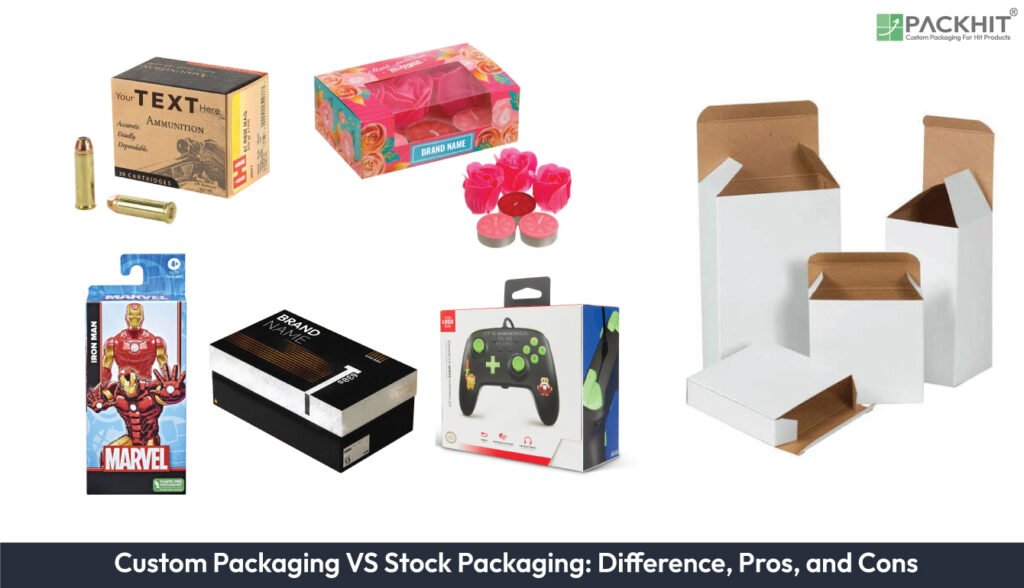
Custom packaging delivers precise product fit, tailored protection, and premium branding through specified substrates, print, and finishing. Stock packaging offers immediate availability with standard sizes and limited visual options. Material type, structure, and print method influence protection, fibre recovery, and container‑level recyclability. Lead time, production steps, warehouse planning, and SKU (Stock Keeping Unit) counts shape cost and fulfilment speed. Total cost of ownership incorporates setup, run pricing, return frequency, and unboxing impact. Prototype checks, transit tests, and cost break-even thresholds guide selection based on fragility, volume, brand intent, and sustainability targets.
- What is Custom Packaging?
- What is Stock Packaging?
- How Does Custom Packaging Differ from Stock Packaging?
- How Do Materials Differ Between Custom and Stock Packaging?
- How Do Printing Capabilities Differ Between Custom and Stock Packaging?
- How Do Design Options Differ Between Custom and Stock Packaging?
- Which Packaging is Right for my Product?
- Manufacturing Workflow and Lead-Time Considerations
- Cost Comparison: Custom Versus Stock Packaging
- Sustainable Choices for Custom and Stock Packaging
- Custom vs. Stock Packaging: Effects on Operations and Inventory
- Step-by-Step Method to Choose Custom vs. Stock Packaging
What is Custom Packaging?
Custom packaging is packaging manufactured to exact product and brand specifications, including geometry, substrate, printing, and finishing, rather than selected from pre-made stock options. Personalised packaging offers precise fit, full-bleed printing, and special finishes like foil or embossing, affecting protection, cost, MOQ (Minimum Order Quantity), and lead time. Types include folding cartons, rigid boxes, and poly pouches; materials range from single- to double-wall boards; finishes include foil, embossing, and soft-touch. Common uses of custom packaging are branded unboxing for DTC (direct‑to‑consumer) products, protection for fragile items, and high-volume e-commerce SKUs where right-sized packaging lowers shipping costs.
What is Stock Packaging?
Stock packaging is pre-made, standard-size packaging with fixed shapes and limited print or finish options. Common types include RSC boxes, pre-sized mailers, poly mailers, and blister clamshells. Stock packaging uses standard dimensions, wall grades, and simple visual treatments like kraft, white, black, or single-spot printing, and offers immediate availability, no tooling costs, and quantities from single units to full pallets. Typical uses of stock packaging include short-run sampling, trade shows, prototypes, and emergency restocks. Limitations include poor fit, restricted branding, and higher dimensional weight when product sizes differ from standard packs.
How Does Custom Packaging Differ from Stock Packaging?
Custom packaging is engineered for product fit, protection, and brand presentation, while stock packaging prioritises availability and lower initial costs.
The following table compares the principal selection criteria and operational consequences for the two approaches.
| Criterion | Custom Packaging | Stock Packaging |
|---|---|---|
| Dimensional fit | Exact fit to part geometry; allows inserts and minimal void (examples: dielined inserts, moulded pulp trays) | Fixed sizes; void fill often required (examples: loose fill, bubble wrap, corrugated dividers) |
| Branding & print | Full-bleed, multicolour, special finishes, Pantone matching (examples: foil, emboss, soft-touch) | Limited colour/finish choices; branding via labels or stickers (examples: pre-printed kraft, adhesive label) |
| Protection & structure | Selectable board grade, flute type, internal supports (examples: single-wall E-flute for retail, double-wall for heavy loads) | Standard protection levels may not match fragile or heavy items (examples: RSC single-wall only) |
| Cost structure | Higher setup cost (tooling, prepress); lower incremental cost at high volumes (examples: plate and die costs) | No tooling; lower per-unit cost at small quantities (examples: single-unit purchase) |
| Lead time & MOQ | Longer lead time; MOQs vary by process (examples: digital low-MOQ, offset high-MOQ) | Immediate availability; MOQs as low as single units (examples: local distributor stock) |
The comparison shows that fit, print range, and material control create distinct performance gaps between custom and stock packaging, and gaps drive the economic and operational impact of each option.
How Do Materials Differ Between Custom and Stock Packaging?
Custom packaging allows specification of substrate, board grade, fluting profile, and barrier layers to meet protection and regulatory requirements. Stock packaging is limited to common substrates and standard grades. Materials such as corrugated board, folding carton, and flexible films affect protection, weight, and sustainability. Personalised packaging allows choices like C-flute for cushioning, E-flute for high-graphics cartons, adjusted crush or burst strength, moisture barriers, and specialised films such as metallised PET (polyethene terephthalate) or polyethene laminates. Stock packaging uses standard single- or double-wall corrugated boards with fixed flutes and set moisture resistance.
Custom packaging can include recycled content such as 100% recycled kraft or FSC-certified fibre. Stock items offer limited eco-options such as kraft mailers. Mono-material constructions in custom packaging simplify recycling and curbside acceptance. Layered laminates in stock packaging improve barrier performance but make separation and disposal more difficult.
How Do Printing Capabilities Differ Between Custom and Stock Packaging?
Custom packaging offers a wide range of printing and finishing options, including full-bleed CMYK, spot Pantone matching, foil, embossing, and varnish. Stock packaging remains limited to standard colours or applied labels. Printing methods such as digital, flexography, offset, and gravure vary in setup cost, run efficiency, colour fidelity, and substrate compatibility. Digital printing handles short runs of 50-2,000 units and variable data like personalised inserts. Flexo and offset printing reduce unit costs for larger runs.
Custom packaging allows digital overprints or branded tape, while stock rarely includes foil, soft-touch finishes, or embossing. Prepress requirements for custom runs include vector dielines, bleed, colour-managed PDFs, and approved press proofs. Digital printing remains cost-effective for small runs, while offset and flexo are economical for higher volumes. Stock packaging uses standard templates, minimal prepress, and predictable printing costs.
How Do Design Options Differ Between Custom and Stock Packaging?
Custom design enables structural and visual features such as die-cut windows, internal inserts, tamper seals, and multiple panels of copy that align with product requirements. Stock design is constrained to pre-formed structures with optional labelling. Structural and protective options differ between custom and stock packaging. Custom packaging offers integrated features like tuck-end mailers, auto-lock bottoms, and die-cut windows, along with purpose-fit inserts (moulded pulp, foam trays, or corrugated partitions), reducing packing time, labour, and transit damage. Stock packaging uses fixed geometries (RSC boxes or pre-sized mailers) and requires additional void-fill, such as bubble wrap, air pillows, or dividers. Custom visual options support full-bleed print, integrated barcodes, regulatory panels, and multi-panel marketing. Stock artwork relies on applied labels or single-colour preprints.
Which Packaging is Right for my Product?
Select custom packaging when branding requirements, protection needs, or logistics savings justify tooling and minimum runs. Choose stock packaging when quantities are small, timelines are short, and product geometry matches standard sizes.
Decision checklist (examples given after each criterion):
- Order volume (one-off samples, pilot runs, or high-volume production)
- Product fragility (glassware, electronics requiring inserts)
- Channel and presentation needs (retail shelf, e-commerce direct-to-consumer, wholesale bulk pallet shipments)
- Time-to-market (immediate sample fulfilment, seasonal launch with fixed deadlines)
- Budget for tooling and inventory (available CAPEX for dies/plates, warehouse space for finished packaging)
Financial method: Calculate the per-unit cost of custom packaging as (setup cost/quantity) + production cost per unit, and compare it to the stock unit cost.
Example: If setup cost = $2,000, custom unit cost = $0.50, and stock unit cost = $0.80, the break-even quantity is: 2000/Q + 0.50 = 0.80 → Q ≈ 6,667 units.
For orders above ~6,700 units, custom packaging becomes cheaper per unit.
Manufacturing Workflow and Lead-Time Considerations
Production sequence and lead time depend on packaging type. Custom packaging requires longer prepress, tooling, and die-cut fabrication. Digital print runs finish fastest with minimal setup. Stock packaging uses standard sizes and templates for rapid production. Workflow steps include specification and brief, structural engineering with dieline creation, prepress and proofing, production with printing and finishing, quality inspection, flat-packing, and logistics to fulfilment centres. Custom packaging takes 2–6 weeks, depending on complexity; stock packaging completes in days. Pre-production tests differ by type. Custom packaging undergoes drop, ISTA, compression, and environmental tests. Stock packaging requires simpler tests due to standard dimensions and materials.
Cost Comparison: Custom Versus Stock Packaging
Custom packaging incurs setup and design fees, but can lower per-unit cost at scale and reduce shipping or returns through right-sizing. Stock packaging minimises fixed setup costs but may increase per-unit logistics and return costs if fit is poor. Primary cost components for custom packaging include material such as speciality board and laminates, print and finishing, including plates, ink, and foil, tooling like dies and moulds, conversion labour for cutting, folding, and glueing, quality control, and inbound and outbound freight. Stock packaging costs mainly involve material such as kraft or single-wall corrugated, labels, lower conversion labour, and freight affected by dimensional weight and palletisation.
Sustainable Choices for Custom and Stock Packaging
Material selection and construction affect recyclability and end-of-life processing for both custom and stock packaging. Custom packaging allows single-material corrugated boards, mono-poly films, and disassemblable parts to simplify recycling. Stock packaging typically uses standard boards or films, which may include multi-layer laminates or metallised coatings that complicate recycling. Custom runs can increase recycled fibre content to 30–100%. Right-sizing and minimising air in transit reduce lifecycle transport impact for both packaging types.
Custom vs. Stock Packaging: Effects on Operations and Inventory
Custom packaging increases SKU-specific inventory needs and requires careful lead-time planning. Stock packaging reduces SKU (Stock Keeping Unit) expansion and enables faster fulfilment, but occupies more warehouse space per product due to inefficient packing. Inventory considerations include finished packaging levels, safety stock to cover lead time, and SKU variant counts. Operational adjustments involve reorder point calculations that account for custom production lead time. Vendor-managed inventory or warehousing-as-a-service helps reduce delays for custom packaging.
Step-by-Step Method to Choose Custom vs. Stock Packaging
Define core product specs, set brand print needs, estimate order volume, compare stock and custom formats, run prototypes, test transit performance, then pick the packaging path that best matches protection targets, cost limits, and operational timing.
- Document requirements such as weight, fragility, regulatory copy, and channel, noting where custom fits exact needs and stock follows fixed formats.
- Estimate volumes and frequency to see where custom becomes economical and where stock supports small or irregular runs.
- Review stock availability and lead times alongside custom production timelines to compare speed and planning needs.
- Request stock pricing and custom quotes with tooling and tiered unit costs to map cost differences at multiple quantities.
- Prototype and test custom samples and verify stock options to confirm protection and handling performance.
- Calculate break-even and factor in non-monetary gains such as branding or compliance to balance cost and value for both choices.
- Use testing and cost results to select stock for rapid, low-volume needs and custom for scale, fit, or presentation advantages.
Custom and stock packaging meet different needs. The best option emerges once performance, cost, and timeline align with the product’s actual requirements.