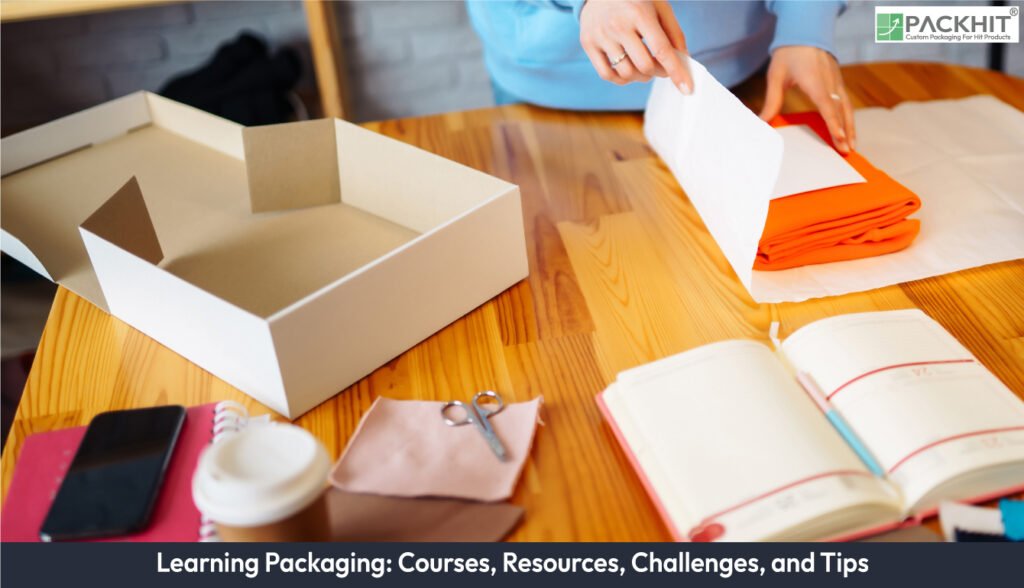
Learning packaging effectively combines formal education, practical resources, and strategic hands-on practices. Degree programmes, from undergraduate to postgraduate and vocational courses, provide structured exposure to materials science, structural design, manufacturing processes, and regulatory frameworks. Access to reference materials and manufacturer data supports informed decision-making, and simulated or low-fidelity testing helps overcome limitations in laboratory or converting facilities. Navigating conflicting objectives, such as balancing barrier performance with recyclability, highlights the need for clear performance metrics and systematic evaluation. Building a structured project portfolio, incorporating measured outcomes from mock-ups and pilot trials, reinforces learning and demonstrates competence across structural design, material selection, and functional testing, bridging the gap between classroom study and industrial application.
- What is Packaging?
- How to Learn Packaging?
- Which Packaging Courses are Available?
- 1. Undergraduate Packaging Degrees
- 2. Postgraduate Packaging Specialisations
- 3. Vocational Diplomas
- 4. Short Technical Modules
- 5. In-Company and Supplier-Led Training
- What are the Common Modules Across Packaging Courses?
- What Resources are Available to Learn Packaging?
- Technical Handbooks and Reference Guides
- Manufacturer Datasheets
- Software Tools and Tutorials
- Testing Equipment and Laboratory Resources
- Open-Source Templates and Sample Kits
- Professional Networks
- How to use Resources When Access is Limited?
- Which Challenges Commonly Arise While Learning Packaging?
- Limited Equipment Access
- Conflicting Performance Requirements
- Interdisciplinary Breadth
- Complex Regulatory and Compliance
- Unpersistent Variability
- What Practical Tips Speed Competence in Packaging?
What is Packaging?
Packaging is the designed structure that holds a product, protects it, and communicates information. Packaging operates at three levels: primary packaging touches the product, secondary packaging groups units for retail, and tertiary packaging supports transport and storage. Each level influences material choice, shape, and protection needs.
Common materials include paperboard, corrugated board, plastics, glass, and metals. Each material offers different strengths, stacking ability, and barrier performance. Packaging functions include holding the product, protecting it from damage and environmental exposure, providing labels and legal details, and improving ease of use, such as dispensing or resealing.
Packaging formats are classified as rigid or flexible, single-material or multi-layer, and aseptic or non-aseptic. Performance is evailuated through tests such as drop tests, compression tests, barrier measurements for oxygen and moisture, and seal checks. Design decisions significantly impact results; for example, multi-layer films enhance barrier protection but compromise recyclability.
The packaging life cycle encompasses design and dieline development, printing, forming, filling, sealing, distribution, and disposal. Designers, converters, fillers, and logistics operators each influence cost, efficiency, and product damage rates.
How to Learn Packaging?
To learn packaging, follow a staged progression: acquire fundamentals, apply with tools and prototypes, then validate through test methods and production exposure.
- Build fundamentals: Learn core theory, including packaging materials and failure modes, basic structural principles such as folds and scores, and standard manufacturing steps like printing, die-cutting, and lamination.
- Apply through tools and prototypes: Develop practical skills in CAD-based structural design, pre-press and artwork preparation, and prototyping using hand mock-ups, laser cutting, or 3D printing.
- Validate through testing and scale-up: Gain experience in planning and running performance tests, applying basic statistics for repeatability and acceptance limits, and supporting pilot runs and tooling adjustments.
- Combine learning methods throughout: Use formal courses, short skill modules, supplier-led training, and mentored industry placements, supported by iterative prototyping to connect theory with practice.
Which Packaging Courses are Available?
Course provision typically groups into undergraduate degrees, postgraduate specialisations, vocational diplomas, short technical modules and in-company training.
1. Undergraduate Packaging Degrees
Undergraduate programmes introduce packaging through accredited engineering or applied science degrees. Teaching combines lectures, laboratories and project work. Core coverage includes materials science, structural packaging design, processing and converting technologies, and packaging law and regulation. Graduates gain foundational knowledge and supervised practical exposure.
2. Postgraduate Packaging Specialisations
Postgraduate courses focus on advanced and analytical topics. Typical coverage includes high-performance materials, barrier technologies, life-cycle assessment, sustainability metrics and research methods. Learning is assessed through advanced coursework and an applied project or dissertation that addresses real packaging problems.
3. Vocational Diplomas
Vocational and apprenticeship routes emphasise practical competence. Training centres on press operation, die-cutting, sealing equipment, quality control and workplace safety. Assessment is usually workplace-based, ensuring learners can operate machinery and follow production procedures.
4. Short Technical Modules
Short courses target specific skills within packaging. Common subjects include CAD (Computer‑Aided Design) for structural design, pre-press and artwork workflows, packaging testing methods and sustainability assessment. These modules are brief and skills-focused, supporting rapid upskilling.
5. In-Company and Supplier-Led Training
In-company programmes and supplier courses address operational needs. Coverage includes machine setup, new material specifications, process optimisation and production troubleshooting. Training is closely linked to current equipment and materials in use.
What are the Common Modules Across Packaging Courses?
Most course types repeat a core set of subjects. Materials science covers polymer behaviour, paper properties and barrier mechanisms. Structural design addresses dielines, folding mechanics and closures. Manufacturing modules explain printing and converting processes. Testing and standards focus on performance testing and regulatory compliance. Sustainability modules cover recyclability, recycled content and life-cycle assessment principles.
What Resources are Available to Learn Packaging?
Resource classes to learn packaging include technical handbooks, manufacturer literature, software tools and tutorials, laboratory equipment and community networks.
Technical Handbooks and Reference Guides
Technical handbooks provide design tables, formulas, and empirical data used in packaging development. Typical content includes box compression values, material thickness guidelines, burst strength charts, and conversion factors that support early design decisions.
Manufacturer Datasheets
Material suppliers publish datasheets that define certified properties and processing limits. Common information includes film barrier performance, paper grammage and stiffness, seal temperature ranges, and compatibility with printing or converting processes.
Software Tools and Tutorials
Software resources support digital packaging design and validation. Structural CAD tools enable 2D dieline creation, 3D modelling software visualises pack geometry, and artwork applications manage vector and raster files. Tutorials and templates guide the correct setup and export.
Testing Equipment and Laboratory Resources
Testing resources range from simple drop and stacking rigs to calibrated laboratory machines. Standard equipment includes compression testers, drop testers, and permeability analysers used to measure mechanical strength and barrier performance.
Open-Source Templates and Sample Kits
Template libraries and open-source repositories provide ready-made dielines, mock-up guides, and prototyping references. Supplier sample packs allow hands-on evaluation of surface finish, stiffness, and barrier behaviour.
Professional Networks
Industry associations, standards bodies, and trade publications offer guidance on best practices and compliance. These resources provide testing methods, regulatory frameworks, and updates on materials, technology, and sustainability trends.
How to use Resources When Access is Limited?
Use low-cost prototypes, remote trials and digital calculations to replicate basic packaging tests when laboratory or converting access is restricted.
- Low-cost prototyping: Use kraft board and foam core for fit and shock checks (examples: folding carton mock-ups, insert prototypes).
- Remote testing alternatives: Run controlled postal trials and visual damage surveys (examples: standard parcel drops from fixed heights, vibration table substitutes using vehicle transport runs).
- Digital validation: Use finite-element or thickness-based calculators for initial stress estimates (examples: compression prediction, corner crush approximation).
Which Challenges Commonly Arise While Learning Packaging?
Learners typically encounter equipment access, conflicting performance requirements, interdisciplinary breadth, regulatory complexity and scale-up variability.
Limited Equipment Access
Restricted access to the laboratory or converting equipment slows hands-on trials and validated testing. Supplier data often differs from in‑house conditions. A practical response is to schedule shared lab days through external centres, which run intake cycles mid-year and permit controlled access to basic rigs for learners who book ahead.
Conflicting Performance Requirements
Design trade-offs arise when meeting barrier, strength or recyclability targets; multilayer films raise oxygen resistance but reduce recycling yield. Mitigation comes from ranking each target numerically and running small test sets that compare one variable at a time when specifications drift.
Interdisciplinary Breadth
Packaging spans materials, structures, production and compliance; gaps in one area increase downstream faults. Learners reduce this risk by pairing theory with short technical modules or IPSA (Institute of Packaging South Africa) training blocks that cover single subjects in concentrated sessions.
Complex Regulatory and Compliance
Food-contact and region-specific rules impose documentation, migration tests and material restrictions; such constraints shift design scope. A simple corrective step is to build a regulation checklist early and update it after each test cycle, if new findings affect materials.
Unpersistent Variability
Tooling tolerances, machine speed and operator settings cause prototypes to behave unpredictably in production. A controlled response is to run a 10-30 unit pilot on the intended machine and record drift against nominal values, if variation seems persistent.
What Practical Tips Speed Competence in Packaging?
Developing proficiency in packaging requires a structured approach that combines hands-on prototyping, measurable performance evaluation, and thorough documentation. Following practical strategies helps learners accelerate skill acquisition while avoiding common errors and inefficiencies.
Prioritise Structure-First Prototyping
Start by creating low-fidelity mock-ups to test geometry, folding, and closure functionality before committing to expensive tooling. Materials such as corrugated blanks, scored paperboard, or foam core allow quick iterations and help visualise how designs behave under real handling conditions. Early prototyping exposes potential structural weaknesses and informs design adjustments before costly production.
Define Acceptance Metrics
Set explicit performance targets for all critical criteria, including mechanical strength, drop resilience, compression limits, and seal integrity. Quantitative metrics, such as drop from a specified height or compression to a measured force, provide objective benchmarks for evaluating design success and support consistent comparison between iterations.
Read and Extract from Datasheets
Manufacturer datasheets contain reliable information on material properties, processing windows, and recommended handling practices. Extracting key data such as coating temperatures, tensile strength, seal dwell times, or barrier performance ensures that designs respect material limits and helps predict performance under operational conditions.
Document Tests Systematically
Maintain detailed records of each test, including setup, environmental conditions, repeat counts, and raw measurement data. Systematic documentation enables reliable analysis, comparison between design iterations, and defensible evidence for regulatory or internal reporting.
Maintain a Costed BOM (Bill of Materials)
A bill of materials (BOM) with materials, suppliers, and unit costs allows evaluation of design decisions in economic terms. Tracking cost per square meter, glue consumption, or unit packaging price supports budgeting, price sensitivity analysis, and informed trade-offs between performance and expense.
Build a Measured Project Portfolio
Compile 6-10 projects that demonstrate structural design, material selection, prototyping, and performance testing. Include a variety of formats, such as retail cartons, blister packs, or transit-ready outer boxes that show practical competence and provide a reference library of tested solutions for future projects.
Learn Key Software Workflows
Proficiency in software is essential for modern packaging. Practice exporting print-ready files and dielines with correct bleed, fold, and registration marks. Understanding vector and raster file handling, PDF/X standards, and colour management ensures designs can be produced accurately without errors during pre-press and printing.
Use Rapid Feedback Loops
Iterate designs based on frequent testing rather than only on theoretical review. Small-batch trials, handling simulations, or limited in-market sample runs provide actionable insights and allow adjustments before full-scale production. Continuous feedback improves design robustness and reduces the risk of failure.
Prioritise Regulatory Files
Collect and organise all relevant material declarations, compliance certificates, and test reports for food-contact or hazardous-product applications. Maintaining up-to-date regulatory documentation ensures designs meet legal requirements, avoids delays, and supports internal or client audits.