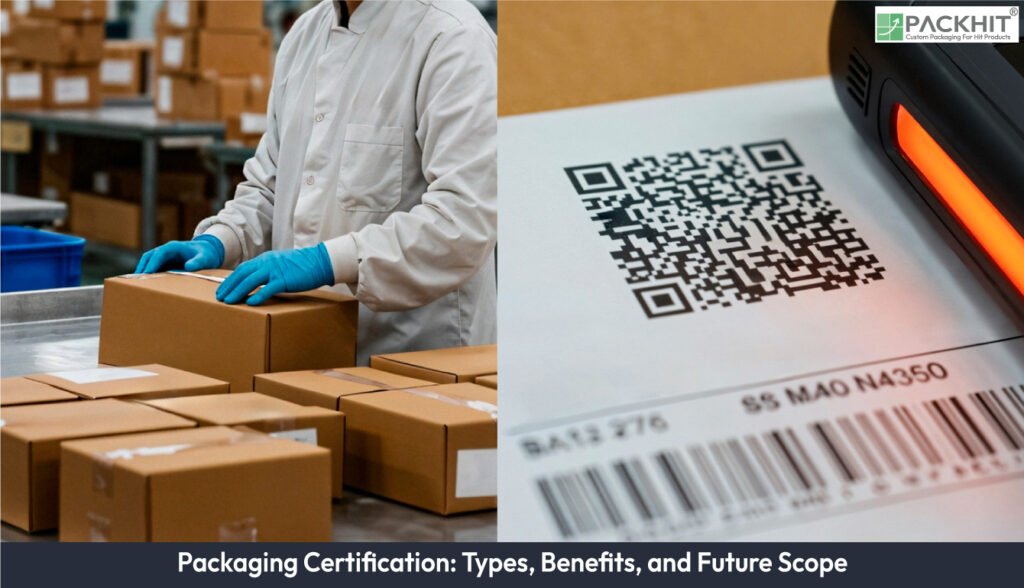
Packaging certification provides independent verification that materials, designs, and packaging systems meet established technical, environmental, and regulatory standards. Beyond regulatory compliance, certification helps brands communicate trust and sustainability claims credibly while supporting efficient supply chain management. Different types of certifications address material safety, recyclability, compostability, and other functional attributes, offering targeted assurance for specific packaging needs. The benefits extend from reduced operational risk to stronger consumer confidence and market access. The scope of packaging certification is evolving with digital traceability, multi-attribute assessments, and more frequent monitoring, positioning it as a strategic tool rather than a mere formality.
- What is Packaging Certification?
- How Does the Packaging Certification Process Work?
- Which Types of Packaging Certifications are Commonly Applied?
- 1. Food Packaging Certifications
- 2. Sustainable Packaging Certifications
- 3. E-Commerce and Logistics Packaging Certifications
- 4. Hazardous Materials (Hazmat) Packaging Certifications
- 5. Regulatory Compliance Certifications
- 6. Religious and Cultural Compliance Certifications
- What are the Benefits of Certified Packaging?
- Improved Regulatory Compliance
- Enhanced Product Safety and Quality
- Increased Brand Credibility and Consumer Trust
- Access to New Markets and Competitive Advantage
- Operational Efficiency and Cost Savings
- Stronger Sustainability and Environmental Performance
- Clear and Defensible Claims
- How Does Packaging Certification Influence Consumer Trust and Supply Chains?
- What are the Limits of Packaging Certification?
- How is the Future Scope of Packaging Certification Evolving?
What is Packaging Certification?
Packaging certification is an official confirmation that a packaging material or product meets a defined standard under tested conditions. It is not a built-in feature of the material. It results from audits, laboratory testing, and document checks carried out by an independent certification body. The purpose is to prove conformity, not to claim performance beyond the tested scope.
Most certification schemes remain valid for a fixed period and apply only to a specific formulation, supplier, or production site. Any change to polymer blends, fibre sources, coatings, or adhesives triggers re-evaluation. Certification represents a time-bound record of verified compliance, limited by technical specifications and process controls.
How Does the Packaging Certification Process Work?
The packaging certification process follows a structured sequence of steps to ensure materials and production meet regulatory and sustainability standards.
- Submit a formal application detailing material composition, intended use, and applicable standards.
- Conduct laboratory testing for properties such as biodegradation rate, heavy metal content, or recycled material percentage.
- Perform document audits to verify traceability, quality control systems, and chain-of-custody integrity.
- Evaluate results and issue approval upon meeting all criteria.
- Implement ongoing monitoring, including periodic re-testing and surveillance audits, to ensure continued compliance.
- Suspend or withdraw certification if the packaging fails to maintain required standards.
Which Types of Packaging Certifications are Commonly Applied?
Packaging certifications cluster around material origin, environmental behaviour, functional performance, and logistics compatibility. Each type addresses a discrete risk or claim category and is interpreted narrowly within its defined scope.
1. Food Packaging Certifications
Food packaging certifications ensure that packaging materials are safe for direct or indirect contact with food. Examples include:
- BRCGS Packaging Materials Standard (UK & Global): Covers safety, quality, and legality of packaging for food and consumer goods.
- FDA Food Contact Certification (US): Ensures materials meet U.S. regulatory standards for food safety.
- Safe Quality Food (SQF) Certification: Validates compliance with food safety management systems.
2. Sustainable Packaging Certifications
Sustainable packaging certifications validate environmental impact, responsible sourcing, and recyclability:
- Forest Stewardship Council (FSC®): Ensures paper and fibre come from responsibly managed forests.
- Programme for the Endorsement of Forest Certification (PEFC): Confirms controlled sourcing of timber and fibre.
- Cradle to Cradle (C2C): Assesses recyclability, biodegradability, and overall environmental performance.
- BPI Compostable Certification: Confirms packaging materials are certified compostable.
3. E-Commerce and Logistics Packaging Certifications
E-commerce packaging certifications ensure packaging can withstand shipping, handling, and fulfilment processes:
- Amazon Frustration-Free Packaging (FFP), Ships in Own Container (SIOC), Prep-Free Packaging (PFP): Focus on durability, minimal waste, and consumer usability.
- ISTA Testing Standards (1A, 3A, 6 Series): Simulate drops, vibration, compression, and distribution hazards for parcel and bulk shipping.
4. Hazardous Materials (Hazmat) Packaging Certifications
Hazmat packaging certifications ensure safe containment and transport of hazardous goods:
- UN Packaging Certification: Confirms packaging meets international regulations for hazardous materials.
- Regulated Medical Waste Packaging (UN 3291): Specific to medical waste handling and transport compliance.
5. Regulatory Compliance Certifications
Regulatory compliance certifications verify adherence to legal labelling, weight, and safety standards:
- UK Weights & Measures / ℮ Mark: Ensures average quantity compliance for packaged goods.
- ISO 9001 (Quality Management): Demonstrates consistent production and quality control.
- ISO 14001 (Environmental Management): Validates environmental stewardship and regulatory compliance.
6. Religious and Cultural Compliance Certifications
Religious Certifications ensure packaging materials and processes meet dietary or cultural standards:
- Halal Certification: Confirms products and packaging are free from prohibited substances.
- Kosher Certification: Ensures compliance with Jewish dietary laws for packaged goods.
What are the Benefits of Certified Packaging?
Certified packaging reduces regulatory risk, substantiates environmental and safety claims through third-party testing, improves supply-chain acceptance by standardising specifications, and increases buyer confidence at retail and logistics checkpoints, including programmes such as Amazon’s Frustration-Free Packaging certification.
Improved Regulatory Compliance
Certified packaging helps ensure materials and processes meet local and international regulations, reducing the risk of fines, recalls, or legal challenges. Certification gives objective evidence that packaging conforms to safety and performance standards.
Enhanced Product Safety and Quality
Third-party certification verifies that packaging meets rigorous quality and hygiene criteria, which improves product safety during production, storage, and transport. Certified systems help prevent contamination and defects.
Increased Brand Credibility and Consumer Trust
Certification signals a commitment to quality and responsibility, making it easier for customers to trust packaging claims. ECO-labels and sustainability marks reassure eco-conscious buyers and build long-term loyalty.
Access to New Markets and Competitive Advantage
Many retailers, international buyers, and institutional customers require certified packaging suppliers. Certification can open doors to new contracts, export opportunities, and preferred supplier status.
Operational Efficiency and Cost Savings
Certification processes often drive internal improvements, reduce waste, and streamline production practices. Better efficiency can lower costs in material use, process variability, and quality failures.
Stronger Sustainability and Environmental Performance
Environmental certifications (such as compostable or chain-of-custody standards) promote responsible material sourcing, reduced waste, and lower environmental impact, aligning packaging with corporate sustainability goals.
Clear and Defensible Claims
Certified packaging strengthens claim defensibility by basing assertions on third-party testing and audit results, which reduces exposure to greenwashing allegations and enhances credibility with regulators and customers.
How Does Packaging Certification Influence Consumer Trust and Supply Chains?
Packaging certification increases consumer trust because claims are checked by an independent body. Trust comes from audits and test results, not from the label alone. In supply chains, certified packaging simplifies buying decisions by setting clear acceptance rules for suppliers, converters, and brand owners. In daily operations, certification supports supplier approval and contract control. Certified specifications act as fixed references in quality agreements. Disputes drop when materials change or are reformulated.
What are the Limits of Packaging Certification?
Packaging certification has specific limits that affect where, how, and under what conditions certified materials can be used or accepted.
- Limited compatibility: Certification does not guarantee acceptance by all recycling or composting systems.
- Infrastructure dependency: Certified compostable packaging may be rejected by facilities without proper processing.
- Recyclability constraints: Recycled content certification does not ensure compatibility with every municipal program.
- Scope restriction: Certification applies only to the specific material and configuration tested.
- Change sensitivity: Minor modifications in pigment, coating, or material grade can invalidate prior certification.
- Contextual limitations: Differences in local infrastructure, not certification standards, can affect compliance.
How is the Future Scope of Packaging Certification Evolving?
The future scope of packaging certification is evolving toward multi-attribute verification and more frequent monitoring. Certification is moving beyond single-claim approvals to combined assessments that evaluate material origin, environmental impact, and functional performance within a single audit framework.
Digital traceability is becoming increasingly important, with batch-level data capture and real-time compliance monitoring supplementing traditional periodic audits. As sustainability regulations tighten globally, packaging certification is shifting from an optional validation to a core operational infrastructure, helping brands maintain compliance, demonstrate responsibility, and streamline supply chain management.