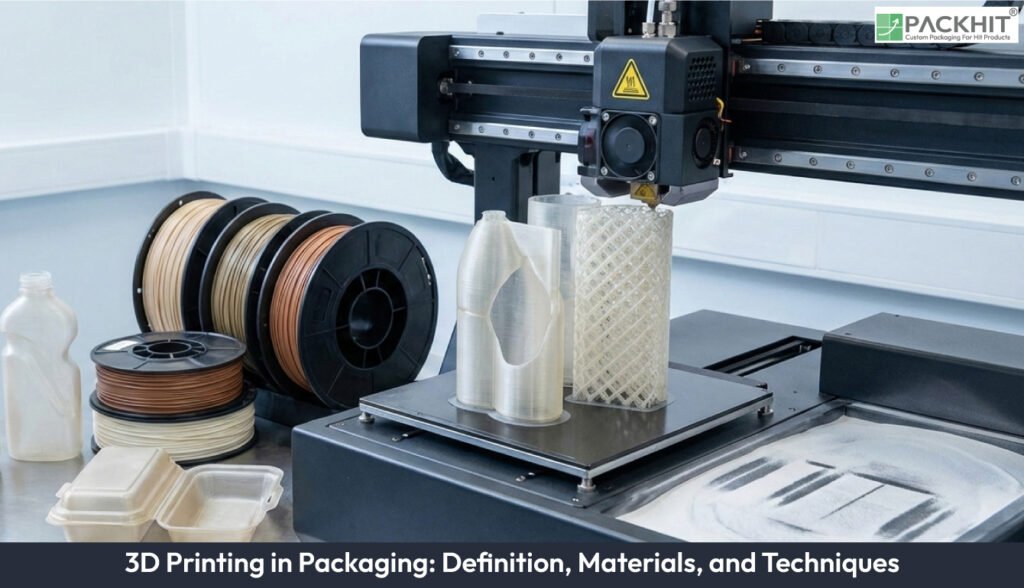
3D printing in packaging introduces additive manufacturing as a layer-by-layer approach for developing packaging components beyond conventional forming methods. Additive processes support prototyping, tooling, and limited production where flexibility and speed matter. Material selection for 3D printing in packaging shapes performance, as polymers, resins, and powders determine strength, thermal behaviour, and barrier capability. Manufacturing techniques define materials converting into usable forms, with different printing systems influencing accuracy, surface quality, and functional reliability. Together, definition, materials, and techniques outline how additive manufacturing fits into packaging design decisions, performance expectations, and practical use boundaries.
- What is 3D Printing in Packaging?
- Which Materials are Used for 3D Printing in Packaging?
- Which 3D Printing Techniques Apply to Packaging?
- 1. Fused Deposition Modeling (FDM)
- 2. Stereolithography (SLA)
- 3. Selective Laser Sintering (SLS)
- 4. Multi-Jet Fusion (MJF)
- 5. Binder Jetting
- What are the Key Steps and Considerations in 3D Printing for Packaging?
- What Sustainability and End-of-Life Issues Must be Considered for 3D Printed Packaging?
- How Much Does 3D Printing Packaging Cost?
- What Design Constraints are Specific to 3D Printed Packaging?
- What Post-Processing and Surface Treatments are Used to Meet 3D Printed Packaging Requirements?
- What are the Quality Assurance Procedures for 3D Printed Packaging?
- When is 3D Printing not the Right Choice for Packaging?
What is 3D Printing in Packaging?
3D printing in packaging is the fabrication of packaging parts, production tooling and integrated components by adding material in discrete layers rather than removing material from a blank. Applications of 3D printing range from single-piece prototypes and short-run decorative boxes to mould inserts, caps, internal supports and embedded sensors; designers use it where geometry, customisation or time-to-market drive decisions away from forming processes. As a manufacturing approach, 3D printing is classified by deposition mechanism (extrusion, vat, powder fusion, jetting), by feedstock state (filament, liquid resin, powder, inks) and by intended function (structural, barrier, decorative or electronic).
Which Materials are Used for 3D Printing in Packaging?
Polymers play a central role in packaging because they offer a balance of cost, processability, and barrier performance. Common materials include thermoplastics like PLA, PETG, and PP, photopolymer resins, and nylon powders. Key specifications include oxygen and water vapour barrier properties, thermal stability such as glass transition and heat deflection temperatures, tensile and puncture strength, surface energy for sealing and coating, and recyclability or compostability. Designers evaluate layer adhesion and mechanical strength, thermal compatibility for hot-fill or sterilisation, and permeability to ensure shelf-life requirements are met. The prominent materials
Thermoplastics
Thermoplastics used in extrusion-based systems are polymers that melt and re-solidify under heat; common examples are PLA, PETG, ABS and polypropylene. PLA provides ease of printing and a tensile strength typically in the 40–70 MPa range, with a glass transition near 55–65 °C. PETG yields higher impact resistance and a Tg around 70–85 °C. Polypropylene offers chemical resistance and low density, but requires specialised adhesion strategies. Engineering polymers such as PEI or PEEK serve for tooling and short-run mould inserts where heat resistance above 120 °C is necessary, for example, conformal-cooled injection-moulding cores. Wall thickness guidelines for extrusion parts usually sit between 0.6 mm and 3.0 mm, depending on nozzle diameter and desired stiffness.
Photopolymer Resins
Vat photopolymerisation resins cure under specific wavelengths of light and provide high surface resolution and fine feature reproduction; common resin types include standard, toughened, flexible and engineering grades. Layer resolution commonly ranges from 25 μm to 100 μm, which permits sealing surfaces and thin decorative detail, but cured resins often display lower elongation at break and lower thermal tolerance compared with semi-crystalline thermoplastics; residual monomer content presents migration risks for food-contact parts unless the formulation and post-cure process are validated. Post-curing and solvent washing are routine to raise cross-link density and reduce extractables.
Powder Materials
Powder bed fusion systems use polymer powders such as PA12 (nylon 12), PA11 and TPU powders; these materials yield parts with balanced mechanical performance and relative isotropy. Typical layer thicknesses are 60 μm to 150 μm; parts have inherent surface roughness and internal porosity that often require sealing or infiltration to meet barrier demands. Powder reuse is common in additive manufacturing. Replenishment rates depend on build density and part geometry, with usable powder fractions frequently ranging between 30% and 80% per batch cycle.
Functional Materials and Multi-Material Inks
Functional feedstocks include conductive inks, dielectric pastes, antimicrobial additives and barrier coatings formulated for additive deposition, such as silver- and carbon-based conductive inks for printed NFC antennas, water-based barrier inks for inner linings, and polymer blends containing antimicrobial agents. These materials are applied either directly within the build (multi-material jetting, co-extrusion) or as post-process layers; integration requires compatibility testing for adhesion, curing and migration.
Which 3D Printing Techniques Apply to Packaging?
The main techniques used in packaging are fused filament deposition (FDM/FFF), vat photopolymerisation (SLA/DLP), powder bed fusion (SLS) and material or binder jetting; each technology trades resolution, throughput, material range and post-processing complexity. Choice is a function of part size, required surface finish, mechanical and barrier performance, and unit cost constraints.
1. Fused Deposition Modeling (FDM)
Fused filament deposition extrudes molten polymer layer by layer. Nozzle diameter and extrusion temperature affect dimensional accuracy and inter-layer adhesion. Heated beds and enclosures reduce warpage on larger faces. FDM suits prototypes, low-cost functional parts, and short-run containers.
2. Stereolithography (SLA)
Vat photopolymerisation cures liquid resin layer by layer to produce high-resolution surfaces. Support structures require removal and surface finishing. Post-curing improves cross-link density and mechanical properties. SLA/DLP works for high-detail prototypes, sealing surfaces, and aesthetic parts.
3. Selective Laser Sintering (SLS)
Powder bed fusion consolidates powder locally, producing parts without supports. Surface roughness and internal porosity affect barrier performance. Solvent smoothing, polymer infiltration, or thin-film deposition improves sealing. SLS is suitable for durable caps, functional prototypes, and complex geometries.
4. Multi-Jet Fusion (MJF)
Material jetting deposits photopolymers in layers, allowing multi-material builds and fine detail. Minimal post-processing is needed. PolyJet enables the creation of multi-material prototypes and simulated overmolds.
5. Binder Jetting
Binder jetting applies a liquid binder to powder to form green parts that require post-processing. Layer thickness and infiltration influence the final mechanical properties. The process supports full-colour prototypes, sand moulds, and low-strength parts.
The table below summarises the main 3D printing techniques used in packaging. Each technique is compared by layer thickness, material options, and typical packaging applications to support informed process selection.
| Technology | Layer Thickness | Common Materials | Packaging Applications |
|---|---|---|---|
| Fused Filament Deposition (FDM/FFF) | 100–400 μm | PLA, PETG, ABS, PP filament | Prototypes, short-run containers, functional parts |
| Vat Photopolymerisation (SLA/DLP) | 25–100 μm | Standard, tough, flexible resins | High-detail prototypes, sealing surfaces, aesthetic parts |
| Powder Bed Fusion (SLS) | 60–150 μm | PA12, PA11, TPU powders | Durable caps, functional prototypes, complex geometries |
| Material Jetting / PolyJet | 16–50 μm | Photopolymers in multiple shore ranges | Multi-material prototypes, simulated overmoulds |
| Binder Jetting | 100–300 μm | Powders with binder liquids | Full-colour prototypes, sand moulds, low-strength forms |
The comparison highlights how each technology serves different packaging needs. Technique selection should align with required surface quality, mechanical performance, barrier function, and production scale to achieve reliable and cost-effective packaging outcomes.
What are the Key Steps and Considerations in 3D Printing for Packaging?
A standard workflow progresses from CAD modelling and DfAM optimisation through slicing, fabrication, post-processing and validation; each stage alters geometry or material state and requires controls to preserve functional requirements.
- CAD Modelling: Create parametric models and assembly representations for packaging components, e.g., closures or containers.
- DfAM Optimisation: Adjust geometry for layerwise fabrication, including wall thickness, fillets, and overhang modifications.
- Slicing: Set layer height, infill pattern, support structures, and build orientation to control surface finish, mechanical properties, and support volume.
- Fabrication: Execute the build on additive manufacturing equipment while monitoring temperature, material feed, and chamber conditions for dimensional accuracy.
- Post-Processing: Remove supports, clean surfaces, perform curing or coating, and apply barrier treatments such as parylene or epoxy lining.
- Validation: Inspect dimensions, conduct leak and migration tests, and perform accelerated shelf-life trials to ensure functional performance.
Orientation choice during slicing affects surface roughness, support volume and mechanical behaviour: orient sealing surfaces vertically to avoid support marks that compromise contact faces, or orient to reduce build height when throughput is the priority. Use lower layer heights if surface finish and sealing integrity are critical.
What Sustainability and End-of-Life Issues Must be Considered for 3D Printed Packaging?
Sustainability for 3D-printed packaging depends on material choice, recyclability, and scrap management. Mono-material designs, such as PETG or polypropylene, recycle more easily than multi-material assemblies, while compostable polymers like PLA require industrial composting and can contaminate recycling streams if mixed. Powder-based processes allow reuse of unused powder but produce a fraction of fused or thermally aged material, often requiring blending with virgin powder to maintain properties. Life-cycle assessments compare reductions in tooling waste and transport with the higher energy demands of additive manufacturing per unit.
How Much Does 3D Printing Packaging Cost?
The cost of 3D-printed packaging depends on materials, machine investment, labour, and post-processing. Filament materials range from £20–£40 per kg, photocurable resins cost £40–£120 per litre, and engineering powders range from £30–£120 per kg. Industrial 3D printers, such as SLS systems, can cost from tens to several hundred thousand pounds, depending on build volume and automation. Labour for operating machines, handling post-processing, and applying surface treatments adds to the overall cost. Additive manufacturing becomes economical for prototypes and short production runs up to a few thousand units, while high-volume packaging remains cheaper using traditional tooling-based methods.
What Design Constraints are Specific to 3D Printed Packaging?
Design constraints for 3D-printed packaging focus on wall thickness, sealing surfaces, closure tolerances, stackability, and surface quality. Thin walls below process limits can cause build failures, with typical ranges of 0.6–2.0 mm for FDM, 0.4–1.5 mm for SLA, and 0.8–3.0 mm for SLS. Dimensional tolerances vary by technology; for example, SLA achieves ±0.05–0.2 mm for small features, SLS ±0.2–0.5 mm, and FDM ±0.3–1.0 mm for general geometries. Critical surfaces, such as sealing faces and datum references, require tighter tolerances than secondary decorative features to ensure proper fit, functionality, and stackability.
What Post-Processing and Surface Treatments are Used to Meet 3D Printed Packaging Requirements?
Post-processing transforms 3D-printed parts into functional packaging by improving surface finish, reducing permeability, and adding decorative or protective layers. Solvent vapour smoothing refines thermoplastic surfaces, while epoxy or acrylic infiltration fills internal porosity. Plasma or corona treatments increase surface energy to enhance adhesion of coatings or labels. Parylene deposition creates thin conformal barriers, and metallisation adds tactile appeal or additional barrier properties. Coating thickness varies from sub-micron vapour-deposited films to tens of microns for liquid-applied layers, depending on desired barrier performance, mechanical flexibility, and functional requirements.
What are the Quality Assurance Procedures for 3D Printed Packaging?
Quality assurance for 3D-printed packaging focuses on dimensional accuracy, structural integrity, barrier performance, and regulatory compliance. Dimensional verification uses coordinate measuring machines, optical scanners, and micro-CT scanning to assess external geometry and internal porosity, with optical methods detecting deviations down to tens of microns for SLA parts. Barrier and leak performance testing employs dye penetration, vacuum, pressure decay, or helium mass spectrometry, selected based on the smallest defect size critical to product safety. Statistical process control monitors repeatable batches by tracking build density, powder reuse, and machine thermal profiles to ensure consistent production quality.
When is 3D Printing not the Right Choice for Packaging?
3D printing is unsuitable for very high-volume production where unit costs must be extremely low. It is also inappropriate for applications requiring ultra-thin, uniform barrier films over large surfaces or where regulatory standards mandate certified material histories and forming processes. Additive manufacturing should be avoided for commodity blister packs, high-speed thermoforming lines, or packaging that relies on multi-layer film structures with adhesion-driven functionality.