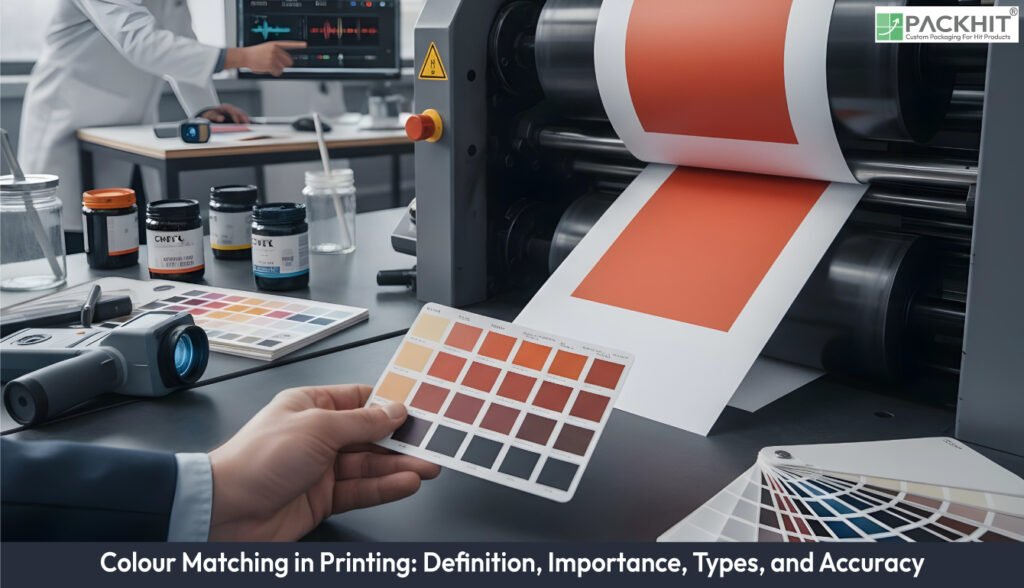
Colour matching in packaging is the controlled process of defining and reproducing a target hue so brand colours appear consistent across formats, suppliers and print runs. It matters because accurate colour alignment strengthens brand recognition, prevents production errors and ensures repeatability on shelf. Packaging typically uses three colour-matching approaches: spot Pantone (PMS) for fixed, high-importance brand colours; process CMYK for photographic or gradient-heavy artwork; and hybrid workflows supported by digital calibration. Accuracy depends on multiple variables, including spot-ink formulation, CMYK conversion, device profiling, press conditions, substrate behaviour and finishing effects. Choosing the right method means balancing brand priority, artwork content and production limits, often combining PMS for logos with CMYK for images. A clear design-to-print workflow, shared swatch references and calibrated devices reduce variation and help maintain consistent colour across suppliers and production stages.
- What is Colour Matching in Packaging?
- Why is Colour Matching Important for Packaging?
- What are the Main Types of Colour Matching Used in Packaging?
- How Accurate is Colour Matching for Packaging?
- How to Choose the Right Colour Matching Type for Product Packaging?
- What Practical Factors guide the Colour‑Matching Choice?
What is Colour Matching in Packaging?
Colour matching in packaging is the controlled process of defining, transmitting and reproducing a target hue so that packaging across formats and vendors presents the same visible colour. The Pantone Matching System is a standardised colour system whose primary function is to specify precise hues with named swatches; its principal role in packaging is to standardise colour communication between designers and printers and to anchor brand colour reliability across print runs. Designers use PMS codes directly in artwork; printers reference the same swatches or convert them into process inks when spot inks are not available, which changes the reproduction pathway and the expected result.
Why is Colour Matching Important for Packaging?
Colour matching keeps brand colour consistent and blocks misinterpretation during production. The PMS system uses exact swatches, and this single reference raises alignment between the specified hue and the printed result. In packaging work, where design, labelling and shelf presentation meet, this alignment supports brand recognition and the repeatability of print runs across printers and substrates.
What are the Main Types of Colour Matching Used in Packaging?
Packaging workflows use three principal approaches to colour matching, and each approach controls hue reproduction through a different mechanism, as mentioned below:
Pantone Matching System (PMS)
Pantone Matching System (PMS) sets colour through fixed ink formulas that anchor each hue to a measured pigment ratio. PMS sets a single reference point for printers, because every swatch, such as PMS 1788, carries defined density values and substrate notes. PMS sets consistent reproduction across presses by relying on pre‑mixed inks that avoid interpretive shifts created by CMYK builds. PMS sets a stable result on long runs if the operator measures ΔE against the physical guide and adjusts ink keys during make‑ready. PMS sets stronger reliability on coated boards than uncoated fibres, because pigment sits on the surface and reduces absorption‑based dulling. PMS sets repeatable brand colour across multiple suppliers by giving artwork teams, prepress operators and press crews one target that does not change with calibration curves or dot gain.
CMYK
CMYK printing builds colour from cyan, magenta, yellow and black inks that form a controlled dot pattern across the substrate. CMYK printing sets hue through four-channel separations that shift with calibration curves, ink density targets or plate wear during long runs. CMYK printing suits layouts that carry photographs or tonal gradients, if the artwork accepts a ΔE shift against a fixed swatch. CMYK printing records stronger stability on coated boards because dot gain stays lower than on porous fibres. CMYK printing keeps predictable output on presses that run scheduled maintenance and controlled humidity, if operators verify density at fixed intervals.
RGB
RGB controls colour on screens through red, green and blue light values that convert into a device‑dependent mix with a wider gamut than CMYK. RGB conversions shift when packaging artwork moves into print, because printers translate each channel into a reduced CMYK range. RGB sets accurate previews for digital displays, if designers calibrate monitors and assign embedded profiles before export. RGB introduces variation in packaging workflows when colours fall outside printable limits, so teams check soft‑proofs and replace out‑of‑gamut hues before production.
Combined Approach
The combined approach ties PMS references and CMYK builds to a single calibrated profile, and this profile keeps colour behaviour close across analogue and digital presses. The method corrects tone curves, ink limits and substrate shift, and it reduces ΔE drift on mixed workflows. The approach holds brand colour steadier when a PMS logo sits beside CMYK images, if jobs move between litho, flexo and digital devices.
How Accurate is Colour Matching for Packaging?
Colour accuracy in packaging depends on five controllable sources of variation that include spot‑ink, process-conversion, digital device, press condition, substrate dependant and finishing stage.
Spot Ink
Spot‑ink accuracy depends on fixed ink formulas that reproduce the target hue with limited drift across presses. Spot‑ink accuracy holds its position because the ink manufacturer controls pigment ratios and drying behaviour, and printers compare output against a physical swatch. Spot‑ink accuracy drops if substrate absorption changes the perceived hue, especially on kraft, coated boards or textured laminates.
Process Conversion
Process‑conversion accuracy shifts when a named swatch is translated into CMYK values that vary with density, calibration and dot gain. Process‑conversion accuracy changes again when the press runs different ink sets, for example, conventional, low‑migration or UV‑curing inks. Process‑conversion accuracy benefits from tighter control of ink limits and linearisation curves if the operator measures patches throughout the run.
Digital Device
Digital‑device accuracy depends on device profiling, gamut limitations and substrate coatings. Digital‑device accuracy rises when profiles are created for each specific substrate, because the printer can map the intended hue to the closest achievable colour. Digital‑device accuracy still shows small variance because each device handles tone reproduction, head temperature and ink laydown differently.
Press Condition
Press‑condition accuracy relies on environmental stability such as humidity, ink temperature and blanket condition. Press‑condition accuracy changes if rollers wear or if drying time shifts during long runs. Press‑condition accuracy holds closer alignment when operators measure ΔE values during make‑ready and adjust ink keys at short intervals.
Substrate Dependent
Substrate‑dependent accuracy reflects how coatings, whiteness levels and fibre composition alter colour appearance. Substrate‑dependent accuracy decreases on porous or recycled boards because ink penetrates unevenly and lowers saturation. Substrate‑dependent accuracy improves on coated materials because pigments sit on the surface and retain the intended hue.
Finishing Stage
Finishing‑stage accuracy changes when coatings, laminates or foils shift surface gloss and perceived density. Finishing‑stage accuracy falls when matte varnish scatters light, which reduces chroma. Finishing‑stage accuracy improves when gloss coatings stabilise surface reflection, if the printer verifies colour after coating rather than before it.
How to Choose the Right Colour Matching Type for Product Packaging?
To choose the right matching method, check the packaging priority and the production limits. Use a swatch-based system such as PMS for exact colour replication across suppliers and materials. Use process CMYK for continuous‑tone images or full‑colour photographs if spot inks create limits. Use a hybrid method that keeps PMS for logos and brand elements and uses process inks for images, and add digital calibration to reduce variation between devices.
Design-to-Print Workflow that Improves Reproducibility
Designers pick a named swatch and add its code to the artwork. Printers read the same swatch and use the stated spot ink or a calculated process mix. This shared code removes guesswork and keeps colour stable across suppliers. The workflow stays simple: the designer states the code, the printer interprets it, and the print run is checked against the reference. This sequence cuts drift between runs and keeps brand colours steady.
What Practical Factors guide the Colour‑Matching Choice?
Four production factors direct the colour‑matching choice, given below :
- Brand priority: Set a swatch code for identity colours that repeat on cartons, sleeves or labels across print runs.
- Artwork content: Pick a process build for layouts that carry photographs, gradients or mixed‑tone images.
- Supply chain: Insert the swatch code in each job file so printers in separate plants print toward the same reference.
- Digital readiness: Apply calibrated device settings on digital and analogue presses if one swatch appears in both workflows.