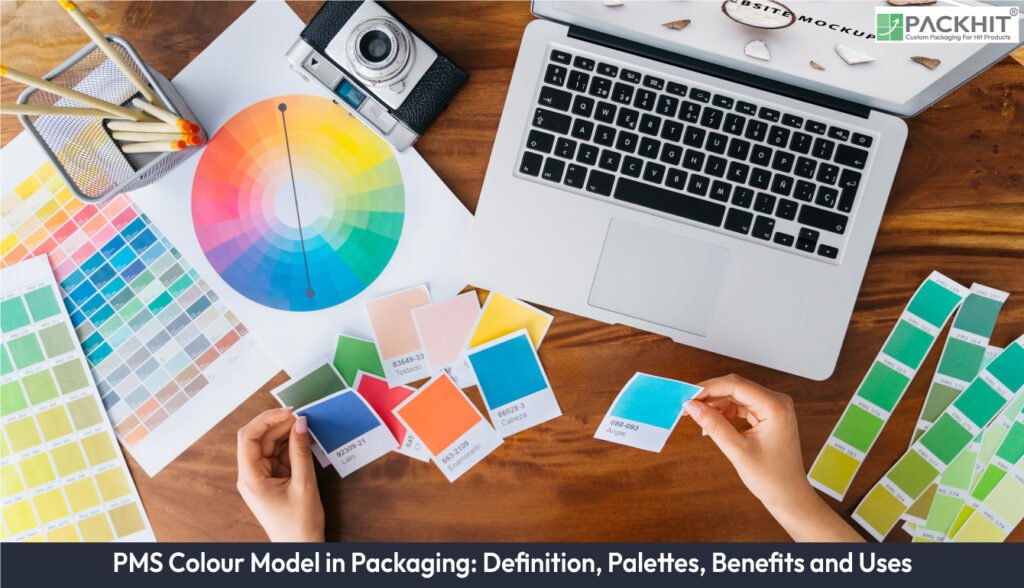
The PMS colour model provides a standardised system for achieving consistent spot colours in packaging, ensuring brand accuracy and visual cohesion across substrates and print runs. Premixed palettes support predictable colour reproduction and help optimise cost and workflow efficiency for limited-colour designs. PMS use in packaging strengthens brand identity, simplifies specification, and accommodates logos, solid graphics, and variant coding. The Pantone Matching System (PMS) interacts with process printing, substrates, and finishes, and careful planning ensures consistent, high-quality results across production runs.
- What is the PMS Colour Model?
- What is the Importance of the PMS Colour Model in Printing and Packaging?
- Which Palettes Does PMS Provide for Packaging?
- What are the Steps of the PMS Workflow in Packaging?
- What are the Uses of the PMS Colour Model in Packaging?
- For Brand Marks
- For Product Differentiation
- On Decorative Solids
- For Packaging Support Materials
- In Custom Packaging Systems
- For High-Quality Labels and Stickers
- In Sustainable Packaging
- What are the Disadvantages of the PMS Colour Model?
- How Does PMS Affect Cost and Production in Packaging?
- What is the Difference Between PMS and CMYK Printing?
What is the PMS Colour Model?
PMS (Pantone Matching System) is a standardised catalogue of spot colours used to specify exact pigments for print production. The system assigns discrete, named references to individual pigments so designers, converters and brand custodians refer to the same physical colour rather than relying on visual matching. Inherent features of the PMS colour model include a palette of spot colours, a workflow that prints each spot with its own ink film, and an expectation that each spot typically requires one to two press plates for reproduction.
What is the Importance of the PMS Colour Model in Printing and Packaging?
The importance of the PMS (Pantone Matching System) in printing and packaging lies in predictable colour output across substrates, presses, and production sites. PMS guides maintain standardised ink formulas that control hue, saturation, and density with high precision. Colour accuracy supports brand recognition because logos, accents, and product identifiers appear identical in every run. PMS spot inks reduce variation that often occurs with CMYK builds, especially for vibrant, deep, metallic, and fluorescent tones. Production efficiency improves because operators match swatches quickly, reduce make-ready waste, and shorten approval cycles. Packaging quality increases because PMS inks deliver consistent colour areas on corrugated, folding cartons, labels, rigid boxes, and flexible films even under challenging surface conditions.
Which Palettes Does PMS Provide for Packaging?
PMS supplies a controlled set of spot‑colour references applied according to a small number of palette strategies.
- Single‑spot palette: a single PMS ink used alone (example: a product carton printed in the brand’s primary hue).
- Limited multi‑spot palette: a small selection of two or three spot inks combined for solids and accents (example: logo plus accent colour on a label).
- Hybrid palette: spot inks specified for brand elements combined with process colour for photographic or continuous‑tone elements, employed when exact hues must coexist with full‑colour imagery (example: a branded sleeve with a logo in a PMS hue and a photographic backdrop reproduced via process printing).
What are the Steps of the PMS Workflow in Packaging?
Specification and implementation of PMS in packaging follow a clear, repeatable workflow that ensures consistent colour from design to final production. The typical steps in this workflow include:
- Colour Selection: Choose the required PMS spot colours for the design.
- Artwork Integration: Assign PMS references to design elements within the artwork files.
- Plate and Film Preparation: Allocate separate plates or films for each PMS spot colour.
- Ink Mixing: Prepare the exact PMS pigment formulations for printing.
- Printing: Apply PMS spot inks to substrates according to the allocated plates or films.
- Colour Verification: Compare printed output with PMS standards to ensure accuracy.
- Repeat Production: Use the same PMS references for subsequent runs to maintain consistent colour across batches.
What are the Uses of the PMS Colour Model in Packaging?
Pantone Matching System is used in the packaging centre for accurate colour reproduction for brand elements, variant differentiation and high-impact solids. Spot inks deliver stable, repeatable hues across substrates and print vendors, supporting strong visual identity and efficient production.
PMS colour model in packaging is used:
For Brand Marks
For brand marks, PMS ensures exact reproduction of logos, icons, and signature tones. Stable spot colours keep front-of-pack elements consistent across labels, cartons, sleeves, and shippers, reinforcing recognition and maintaining a unified brand presence.
For Product Differentiation
For product differentiation, PMS provides precise colour cues that distinguish SKUs, flavours, and seasonal editions on the shelf. A fixed PMS reference prevents drift between variants, and this clarity helps shoppers pick the correct product without relying on graphic elements alone.
On Decorative Solids
On decorative solids, PMS achieves smooth, saturated panels and crisp accents. High-density spot inks remove banding and keep small blocks, badges, seals, and callouts visually strong even on challenging substrates.
For Packaging Support Materials
For packaging support materials, PMS mirrors the colours used on primary packs. POS displays, inserts, shelf talkers, and leaflets align visually with the main packaging for cohesive in-store communication.
In Custom Packaging Systems
Through custom packaging systems, PMS aligns every component with formal colour guidelines. Strict adherence across multi-facility production keeps tone, personality, and hierarchy stable for global packaging lines.
For High-Quality Labels and Stickers
For high-quality labels and stickers, PMS achieves vibrant, durable colours that stay consistent across films, foils, papers, and laminates. Spot inks enhance clarity and help premium labels stand out with cleaner edges and richer solids.
In Sustainable Packaging
In sustainable packaging and eco-driven, PMS maintains colour accuracy on recycled, unbleached, or low-impact substrates. Stable pigment recipes ensure that eco-conscious materials still meet brand colour standards without compromise.
What are the Disadvantages of the PMS Colour Model?
The limitations of PMS arise from factors that affect colour consistency despite using premixed spot inks. Substrate, ink formulation, and finishing processes influence the final appearance and must be specified alongside PMS references.
- Substrate Effects: The same PMS pigment can look different on coated, uncoated, or textured stocks. Including stock type in specifications ensures closer visual matching.
- Ink and Finish Interaction: Metallic inks, varnishes, or lacquers can shift perceived hue. Proofs should be checked under the same finishing conditions intended for production.
- Design Scope Limitations: PMS is best for solid colours and limited palettes. Photographic images or highly graded designs require process (CMYK) workflows for accurate reproduction.
How Does PMS Affect Cost and Production in Packaging?
Pantone Matching System affects cost and production planning by influencing ink usage, plate requirements, and setup efficiency. Each declared spot colour typically requires a separate ink film and plate, which directly impacts material and makeready expenses.
For limited-colour packaging, PMS usually reduces total ink inventory, plate count, and setup time compared with multi-separation process printing. Smaller palettes benefit from lower makeready waste and faster press runs, making PMS cost-effective for short runs, promotional SKUs, and single-colour logos.
PMS standardisation also improves production planning by providing fixed pigment references. Consistent colour communication reduces trial-and-error matching, ensures repeatability across print and digital workflows, and allows packaging teams to control both brand accuracy and operational costs efficiently.
What is the Difference Between PMS and CMYK Printing?
The difference between PMS and CMYK lies in their colour reproduction. PMS delivers exact brand colours using premixed spot inks, while CMYK creates tones and gradients by mixing cyan, magenta, yellow, and black inks.
The following table summarises the key differences between PMS (Pantone Matching System) and CMYK printing, highlighting ideal applications, colour reproduction methods, and operational considerations:
| Feature | PMS (Pantone Matching System) | CMYK (Cyan, Magenta, Yellow, and Key/Black) |
|---|---|---|
| Colour Reproduction | Uses premixed inks for exact colours | Mix cyan, magenta, yellow, and black to create colours |
| Best Use | Solid colours, logos, brand marks | Photographs, gradients, full-colour images |
| Plate Requirements | One plate per spot colour | Four plates for CMYK separations |
| Setup Time | Lower for limited colours | Higher for colour approximation |
| Consistency | High across runs and locations | Can vary due to ink mixing and press conditions |
| Cost | Cheaper for short runs or small palettes | Efficient for full-colour or photographic work |
The comparison between Pantone Matching System and CMYK shows that PMS provides precise, repeatable colour for limited-palette designs, while CMYK printing is better suited for complex, continuous-tone images.