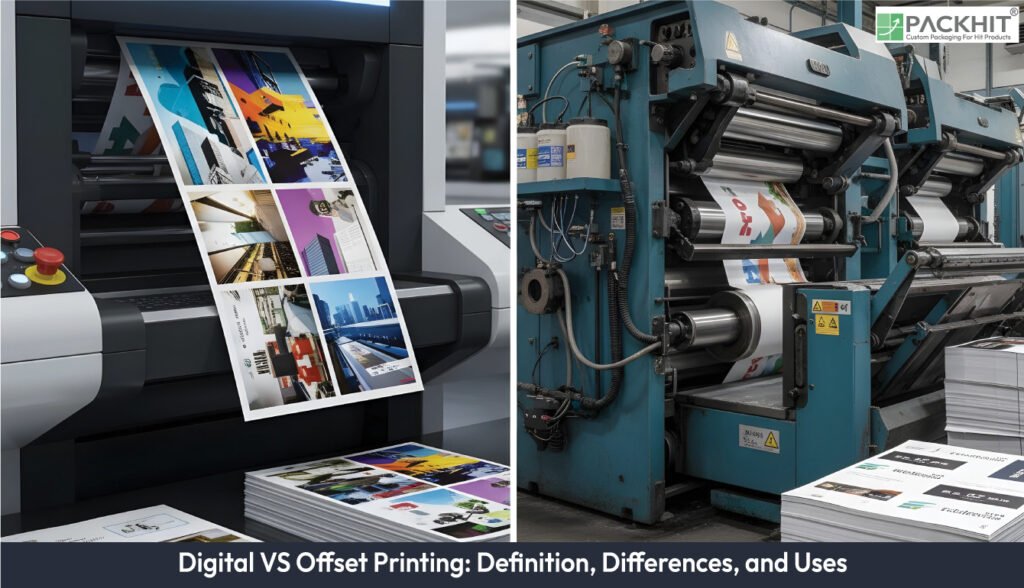
Digital and offset printing represent the two primary printing methods used in modern packaging, each offering distinct advantages in image formation, colour control, cost behaviour and substrate handling. Understanding the difference between these methods is essential for manufacturers, especially when balancing short-run flexibility with long-run efficiency. Digital printing supports rapid changeovers, variable data and small batches with minimal setup, making it ideal for prototypes, seasonal designs and frequent artwork updates. Offset printing delivers plate-based stability, consistent spot-colour accuracy and lower unit costs at scale, which suit high-volume cartons, sleeves and labels. By comparing their processes, quality methods, run-length behaviour and finishing compatibility, businesses can choose the most efficient and cost-effective printing option for their packaging needs.
- What is Digital Printing?
- What is Offset Printing?
- What are the Differences Between Digital Printing and Offset Printing?
- What are the Uses of Digital Printing and Offset Printing?
- How Digital Printing Differs from Offset Printing in Substrate Compatibility and Finishing Choices?
- How do the Manufacturing Processes of Digital Printing and Offset Printing Differ?
- Which Printing Option to Choose: Digital Vs. Offset Printing?
What is Digital Printing?
Digital printing is a non-impact printing method that transfers raster image data directly onto a substrate without the need for plates. Using electrophotographic or inkjet engines, the process sends a digital file to a print head or imaging unit that deposits toner or ink in a single pass or via an intermediate transfer layer. Core technologies include toner-based laser and LED systems, liquid electrophotography, continuous and drop-on-demand inkjet, and dye-sublimation for photographic output. Digital presses require minimal make-ready, support variable data on a per-sheet basis, and allow rapid colour verification through a digital RIP. Resolutions typically range from around 600 dpi on entry-level machines to 2,400 dpi on advanced inkjet engines, using FM or multi-level AM screening to reduce moiré and deliver smooth tonal transitions. Many presses also integrate inline steps like digital varnish or UV/IR curing. Digital printing is used for short-run brochures, personalised mail, transactional documents, photo books and proofs where fast turnaround and page-to-page variation matter.
What is Offset Printing?
Offset printing is a lithographic, indirect transfer process in which metal printing plates and a rubber blanket apply ink to a substrate in controlled halftone patterns. The method relies on the chemical separation of image and non-image areas on the plate, such as hydrophobic regions that accept ink and hydrophilic regions that repel it. During printing, the plate transfers the inked image to a rubber blanket cylinder, which then prints it onto paper or board. Offset systems fall into sheetfed offset, which handles individual sheets, and web offset, which prints from large rolls of paper. Each type uses different makeready times, speeds and finishing configurations. Key production factors include aluminium plate material, screening method and tonal resolution (typically 150–300 lines per inch), and ink formulations that range from CMYK to spot, metallic and specialised varnish inks. Prepress workflows involve computer-to-plate imaging and contract proofing, while pressroom tasks include plate mounting, ink-water balance, densitometric control and makeready waste management. Offset printing supports high-volume catalogues, magazines, packaging and projects that require precise spot colours, heavier substrates or advanced coatings.
What are the Differences Between Digital Printing and Offset Printing?
Digital printing and offset printing differ in quality, speed, cost and colour matching. The key differences between digital printing and offset printing are given below:
Quality
Digital engines form images through toner particles or inkjet droplets that sit near the surface of the sheet. Droplet placement, charge behaviour and fusing temperature shape edge profile, micro‑texture and gloss. Inkjet units change droplet volume in up to four or six increments, which affects highlight smoothness. Toner systems depend on particle size, transfer charge and fusing pressure; these traits create sharp text lines but shift when developer units age or humidity rises. Digital solids show banding if a print head requires cleaning, and the surface film influences coating grip.
Offset printing uses plate‑based halftone dots between 150 and 300 Lines per inch (LPI). These dots follow predictable dot‑gain behaviour because plate chemistry controls hydrophilic and hydrophobic regions. Blanket pressure, ink viscosity and ink‑water balance stabilise after makeready, which sets consistent tonal ramps on coated boards. Offset inks penetrate fibres or form thin films; this action fixes the matte or gloss character common on packaging stocks. Repeatability comes from densitometric control, plate curve calibration and stable ink density. Offset retains colour stability if operators maintain water balance and ink temperature.
Speed
Digital presses reach print‑ready status within minutes because RIP data drives imaging directly. Electrophotographic engines print between 1,000 and 6,000 A4 sheets per hour, while continuous inkjet lines run in the tens of thousands, depending on head width and drying energy. Throughput decreases if heavy coverage raises drying load on synthetic substrates.
Offset presses sustain higher mechanical speeds once makeready ends. Sheetfed systems run between 3,000 and 15,000 sheets per hour, and web presses run at 40,000–80,000 impressions per hour on lighter stocks. Setup involves plate mounting, blanket wash‑up and ink‑key alignment; these steps can take 30–120 minutes. Offset throughput stays consistent on long jobs because impression cylinders hold steady pressure through the run.
Cost Efficiency
Digital printing removes plate cost and reduces fixed waste. Toner or ink consumption, engine maintenance and substrate limits define its economic pattern. Each sheet carries a stable unit cost because consumable use scales with coverage. Cost shifts with fusing load and head wear if long runs increase thermal demand.
Offset printing introduces plate and makeready costs, which spread across the run. A £300 setup and £0.05 unit cost against a £0.30 digital unit cost create a break‑even point near 1,200 sheets. Pressrooms report 500–5,000 because colour count, substrate stiffness and coating steps shift totals. Long runs lower the per‑unit figure due to predictable ink use and consistent crew time.
Colour Matching
Digital colour originates from CMYK or CMYK+OGV sets. Profiles map image values into the engine’s gamut, which controls hue accuracy but limits metallic and fluorescent reproduction. Stability depends on profiling cycles, spectral behaviour of consumables and head alignment. Delta E colour difference metric (ΔE) values rise if a toner lot changes or a print head drifts.
Offset colour comes from mixed spot inks or four‑colour CMYK films. Ink formulations set hue strength, viscosity and tack, while densitometry and spectrophotometry hold targets during the run. Delta E colour difference metric (ΔE) values under 2 remain possible because the press lays down a direct film of ink rather than mapping colours through a gamut. Metallic, fluorescent and high‑density colours reach full strength through dedicated ink sets.
The table below sets out the same four categories, such as quality, speed, cost efficiency and colour matching, in a compact reference format for manufacturers that compare print paths for cartons, sleeves or labels.
| Category | Digital Printing | Offset Printing |
|---|---|---|
| Quality | Toner or inkjet droplets sit near the surface; droplet volume steps shape highlights; toner particle size and charge influence line work; surface film affects coating adhesion. | Plate‑based halftone dots at 150–300 lpi; predictable dot gain; ink‑water balance sets tonal ramps; ink films penetrate fibres or form thin layers that shape finish. |
| Speed | Print‑ready within minutes; 1,000–6,000 sheets per hour; throughput drops with heavy coverage on synthetic materials. | High speeds after makeready: 3,000–15,000 sheets per hour on sheetfed; 40,000–80,000 impressions per hour on web presses; setup takes 30–120 minutes. |
| Cost Efficiency | No plate cost; predictable cost per sheet; unit cost shaped by toner or ink use, fusing load and head wear on long runs. | Plate and makeready costs spread across run; break‑even near 1,200 sheets; low per‑unit cost on long jobs due to stable ink use. |
| Colour Matching | CMYK or CMYK+OGV; colour accuracy depends on profiling cycles and consumable consistency. Colour difference rises if heads drift or toner lots change. | Spot or CMYK films; densitometry holds targets. Colour difference below 2 is achievable; metallic and fluorescent colours are printed through dedicated ink sets. |
Digital printing gives rapid changeovers and variable content on short runs, while offset printing gives colour stability, substrate range and lower cost on long runs. These differences guide packaging workflows where count, substrate stiffness and colour targets determine the press path.
What are the Uses of Digital Printing and Offset Printing?
Digital printing supports short-run packaging, and offset printing supports long-run packaging with fixed artwork. The table sets out the main uses across cartons, sleeves and labels.
| Process | Primary Uses | Examples |
|---|---|---|
| Digital Printing | Short-run cartons, small batches with artwork changes, variable-data packaging, prototype packs, personalised labels | QR-coded cosmetic cartons; flavour-specific beverage sleeves; batch-coded supplement labels |
| Offset Printing | Long-run cartons, stable artwork series, colour-critical packaging, high-volume labels, multi-colour board packaging | Folding cartons for FMCG; multi-SKU cereal boxes; metallic-ink confectionery sleeves |
The above table shows how digital printing assists quick proof cycles when artwork shifts, and offset printing maintains colour targets on coated and uncoated boards in high counts.
How Digital Printing Differs from Offset Printing in Substrate Compatibility and Finishing Choices?
Digital printing processes handle coated, uncoated and synthetic substrates through engine-specific limits on heat, surface energy and sheet thickness, while offset printing manages a broader substrate range through plate chemistry, fountain solution control and ink-water balance. Digital toner systems depend on fusing temperature and surface charge, so plastics, textured boards and heavier materials may require primers or adhesion promoters; high-speed inkjet uses surface treatments to stabilise pigment density and prevent dot spread. Offset plate and blanket interaction supports coated, uncoated and heavier paperboard grades without primers, and litho inks form stable films that anchor on packaging boards. Finishing behaviour diverges: digital prints can mark under friction because fused toner forms a surface layer, which changes how lamination, foil stamping or varnish bond; offset ink films accept aqueous coating, UV varnish, embossing and die-cutting at scale with predictable curing and adhesion. These contrasts influence packaging workflows where scratch resistance, coating holdout and substrate stiffness govern press choice.
How do the Manufacturing Processes of Digital Printing and Offset Printing Differ?
Digital creates images through direct file-to-engine steps, while offset relies on plate imaging, ink-water balance and mechanical transfer through cylinders. Digital completes manufacturing with RIP processing, toner or inkjet deposition, fusing or curing and optional inline coating. Each action occurs inside a closed engine, and substrates pass once through print heads or toner stations before final cooling or curing. Offset follows a multi-stage path that includes CTP plate exposure, plate mounting, inking and dampening setup, blanket transfer, impression, drying and post-press coating. Press operators adjust density, ink-water balance and registration during makeready. This process supports long runs on coated and uncoated boards because plate behaviour stabilises after initial setup.
Which Printing Option to Choose: Digital Vs. Offset Printing?
Digital suits short-run packaging, while offset suits long-run packaging with fixed artwork. The table lists the run-length patterns, cost behaviour and reasons that guide print selection for manufacturers that produce cartons, sleeves or labels.
| Printing Option | Why to Choose | Cost Pattern |
|---|---|---|
| Digital Printing | Short-run packaging with frequent artwork changes; variable data for batch codes; quick proof cycles; colour stability through periodic calibration; substrate limits defined by heat and surface-energy behaviour. | No plate cost; higher unit cost; predictable break-even at 500–1,200 units; cost rise tied to toner or inkjet consumption. |
| Offset Printing | Long-run packaging on coated or uncoated boards; consistent spot-colour reproduction; stable halftone behaviour at 150–300 lpi; wide substrate range without primers. | Plate and makeready cost; low unit cost at scale; break-even after 1,200–5,000 units; cost tied to ink film density and plate count. |
Manufacturers pick digital for speed and variable content; they pick offset when colour targets, substrate stiffness or high counts require plate-based stability.