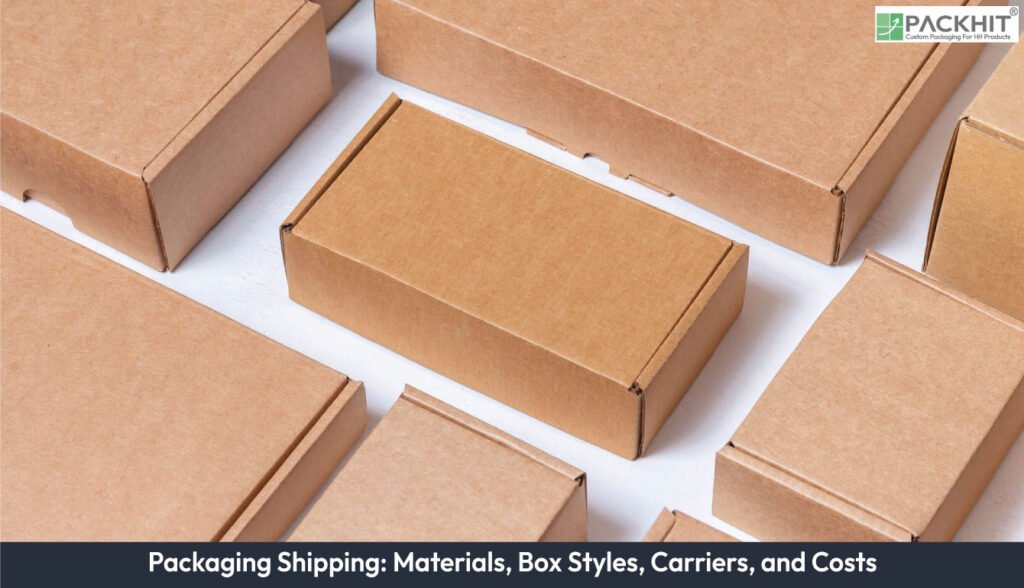
Packaging for shipping involves selecting the right materials, box styles, carriers, and cost considerations to ensure products move safely and efficiently through distribution networks. Packaging for shipping must protect items from impact, vibration, compression, and handling damage while also meeting carrier requirements for weight, size, and stacking performance. Common materials used in shipping packaging include corrugated cardboard, bubble wrap, foam inserts, kraft paper, and air pillows, which provide structural support and cushioning during transit. Understanding how box styles affect handling, which carriers such as DHL, UPS, FedEx, and USPS, are used for delivery, and what factors influence packaging costs helps businesses design efficient and reliable shipping packaging systems.
- What Materials are Commonly Used in Packaging for Shipping?
- How do Box Styles Affect the Handling and Stacking of Packaging for Shipping?
- Load Distribution
- Edge Compression Strength
- Panel Rigidity
- Stacking Alignment
- Automation Compatibility
- Seal Integrity
- Which Shipping Carriers are Commonly Used for Packages?
- UPS (United Parcel Service)
- FedEx
- USPS (United States Postal Service)
- DHL Express
- Regional Parcel Carriers
- LTL Freight Carriers
- What Factors Contribute to Packaging Costs for Shipping?
What Materials are Commonly Used in Packaging for Shipping?
Materials used in packaging for shipping include corrugated fiberboard, paperboard, moulded pulp, plastic films, foam cushioning, and pallets, chosen to limit impact damage, withstand carrier sorting and stacking loads, and control dimensional weight charges across parcel and freight networks.
Bubble Wrap
Bubble wrap provides excellent cushioning for fragile items. It protects products by absorbing impacts during shipping, preventing cracks, scratches, and breakage. Its lightweight nature helps reduce overall shipping costs, and its flexibility allows it to wrap items of various shapes and sizes.
Packing Peanuts
Packing peanuts fill empty spaces inside boxes to prevent items from shifting. They act as a buffer, reducing the risk of damage from bumps or drops during transit. Biodegradable options are available, making them an eco-friendly choice for sustainable packaging.
Foam Inserts
Foam inserts offer custom support for delicate or irregularly shaped items. They hold products securely in place inside the box, absorb shocks, and prevent movement. Precision-fit foam is especially useful for electronics, glassware, and speciality items.
Corrugated Cardboard
Corrugated cardboard provides strong structural protection for shipping boxes. It resists crushing and adds rigidity, making it ideal for heavier or multiple items. It is also recyclable and widely available, making it a practical and environmentally friendly option.
Kraft Paper
Kraft paper cushions items and fills gaps inside boxes. It can be used to wrap individual items or crumpled to prevent movement and absorb minor impacts. Kraft paper is biodegradable and recyclable, supporting sustainable packaging practices.
Air Pillows
Air pillows create a lightweight protective barrier around items. They prevent shifting, absorb shocks, and add minimal weight to shipments. Many air pillows can be reused or recycled, combining convenience with sustainability.
How do Box Styles Affect the Handling and Stacking of Packaging for Shipping?
Box styles affect the handling and stacking of packaging for shipping by controlling load distribution, edge compression strength, and compatibility with automated carrier systems. Structural geometry, panel continuity, and closure method determine how cartons move through sorting equipment and how safely they stack under static and dynamic loads.
Load Distribution
Load distribution spreads vertical force across panels and corners, reducing point stress during stacking. Regular slotted containers distribute weight through four vertical edges, lowering the risk under palletised compression.
Edge Compression Strength
Edge compression strength resists vertical stacking pressure from adjacent cartons and pallets. Double-wall and reinforced edge designs increase measured ECT values, maintaining box shape during long dwell times in carrier hubs.
Panel Rigidity
Panel rigidity limits bowing and surface deformation under conveyor pressure. Full overlap slotted cartons add a layered board on top and bottom panels, stabilising cartons during high-speed sortation.
Stacking Alignment
Stacking alignment keeps cartons square and level across pallets and rolling cages. Uniform box footprints align corners vertically, reducing lean, overhang, and load shift during truck braking.
Automation Compatibility
Automation compatibility supports barcode scanning, dimensioning, and routing accuracy. Rectangular box styles with uninterrupted faces maintain scan rates and reduce manual handling exceptions in parcel networks.
Seal Integrity
Seal integrity maintains closure under vibration and drop forces. Self-locking and taped centre-seam designs prevent flap lift, protecting internal contents during repeated handling cycles.
Which Shipping Carriers are Commonly Used for Packages?
Common shipping carriers include national parcel networks, postal services, international express operators, regional couriers, and LTL freight providers, each imposing distinct limits on weight, size, and packaging design that affect carton strength, void fill volume, and pallet configuration.
UPS (United Parcel Service)
UPS operates ground and air parcel systems across the United States with a 150 lb per-package limit and a 165-inch length-and-girth maximum. Cartons typically use 32 ECT to 48 ECT corrugated board to resist conveyor drops and stacking pressure. Dimensional weight pricing based on external box size increases costs for oversized packaging.
FedEx
FedEx separates Ground and Express networks, each applying drop, vibration, and compression criteria. Non-conveyable or oversized cartons incur handling surcharges. Packaging commonly uses right-sized corrugated boxes with moulded pulp or foam inserts to control movement and reduce billable dimensional weight.
USPS (United States Postal Service)
USPS supports flat-rate, weight-based, and zone-based pricing up to 70 lb per package. Compact boxes, paperboard mailers, and poly mailers dominate to remain within cubic pricing thresholds. Flat Rate cartons cap transport cost but restrict usable internal dimensions.
DHL Express
DHL Express focuses on international air shipments priced by the greater of actual or volumetric weight. Rigid, tightly packed cartons limit chargeable volume. Export packaging often uses double-wall corrugated boxes to manage stacking loads during air and ground transfers.
Regional Parcel Carriers
Regional carriers such as OnTrac and LaserShip operate within defined delivery zones. Standardised carton sizes support route density and batch sorting. Reduced transit distance lowers damage risk, but inconsistent box sizing slows processing efficiency.
LTL Freight Carriers
LTL freight carriers move palletised loads rather than individual parcels. Pricing depends on freight class, weight, and pallet footprint. Packaging centres on 48×40-inch pallets, stretch wrap containment, and corner boards to control load shift during cross-docking.
What Factors Contribute to Packaging Costs for Shipping?
Factors contributing to packaging costs in shipping include material selection, box dimensions, protective components, labour inputs, carrier pricing rules, and compliance requirements.
- Material cost: Corrugated board grades, plastic films, moulded pulp, and foam density set the unit price. Double-wall corrugated boxes and anti-static foam increase per-box cost compared to single-wall kraft board.
- Box size and dimensional weight: External length, width, and height determine billable weight under parcel carrier formulas. Oversized cartons raise shipping charges even if the physical weight is low.
- Protective inserts and void fill: Inserts such as foam blocks, air pillows, and paper fill add material volume and packing time. Fragile products, such as glass or electronics, require a higher insert density.
- Labour and packing time: Manual assembly, taping, labelling, and quality checks add cost per unit. Complex pack-outs with multiple components increase handling time.
- Carrier surcharges: Residential delivery, fuel, non-conveyable handling, and oversized fees increase the total cost. Irregular box shapes may trigger manual processing fees.
- Damage and return risk: Inadequate packaging increases breakage, replacement, and reverse logistics costs. Reinforced cartons and proper inserts reduce loss rates.
- Regulatory and labeling requirements: Hazmat markings, lithium battery labels, and international documentation add material and compliance expenses.
- Palletisation and freight configuration: Pallets, stretch wrap, corner boards, and load containment affect LTL and freight costs. Inefficient pallet layouts reduce trailer utilisation.