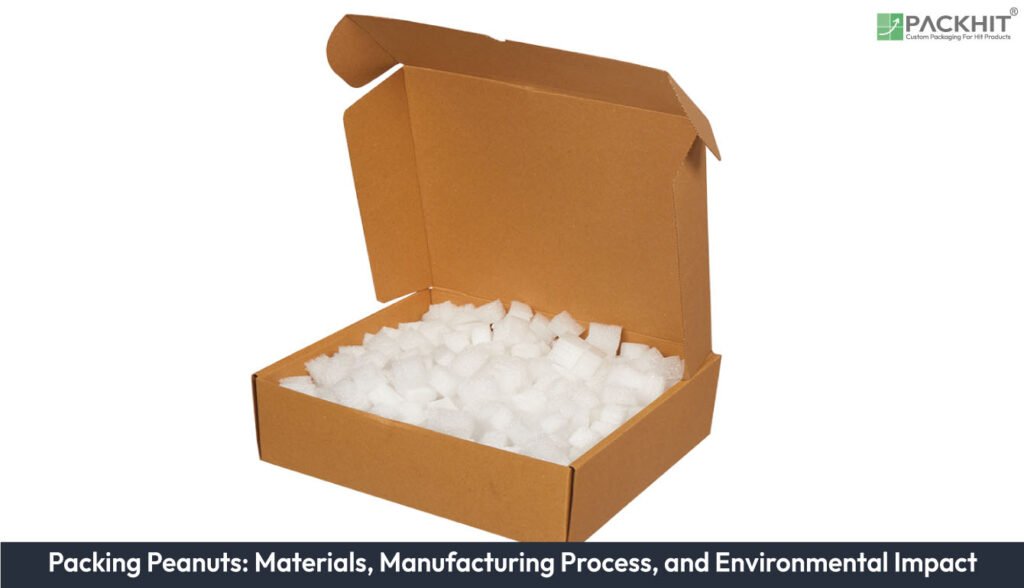
Packing peanuts are lightweight, loose-fill packaging materials used to cushion and stabilise products during shipping, storage, and handling. Typically made from expanded polystyrene (EPS) or biodegradable starch-based materials, packing peanuts fill empty spaces inside cartons to reduce product movement and absorb shock from impact or vibration. The main purpose and benefits of packing peanuts are to provide efficient void fill, distribute pressure around packaged items, and protect fragile goods from damage during transportation. Businesses commonly use packing peanuts for protective cushioning, void filling, product separation, and movement control when shipping electronics, glassware, ceramics, cosmetics, and other delicate items.
- What are Packing Peanuts?
- What is the Historical Development and Material Evolution of Packing Peanuts?
- Why Packing Peanuts Matter in Packaging?
- What is the Material Composition and Structural Behaviour of Packing Peanuts?
- What are the Different Types of Packing Peanuts?
- 1. Polystyrene packing peanuts
- 2. Biodegradable packing peanuts
- 3. Cornstarch‑based packing peanuts
- 4. Recycled paper packing peanuts
- What are the Benefits of Packing Peanuts?
- What are the Common Uses of Packing Peanuts?
- How are Packing Peanuts Applied During Packaging?
- What are the Performance Considerations and Limitations of Packing Peanuts in Packaging?
What are Packing Peanuts?
Packing peanuts are small, free‑flowing packaging inserts used to fill space around and between shipped items, limiting movement and dispersing mechanical stress during handling. The geometry of foam popcorns allows them to interlock under compression, creating a semi‑stable matrix that supports irregular shapes such as glassware, electronics, or moulded components.
As a packaging type, packing peanuts belong to the loose fill category. They differ from moulded inserts in that they adapt to the container geometry rather than enforcing a fixed shape. This behaviour explains their continued use in mixed‑item cartons, secondary packaging, and low‑volume fulfilment operations.
What is the Historical Development and Material Evolution of Packing Peanuts?
Early packing peanuts were made of expanded polystyrene, selected for low density, moisture resistance, and tolerance of temperature fluctuations. These properties reduced breakage rates during long‑distance freight and warehousing, where condensation and thermal cycling were common.
Material evolution of packing peanuts followed disposal and waste‑management pressures. Starch‑based formulations, typically derived from cornstarch or wheat, entered commercial use as alternatives that degrade through microbial action or dissolve in water. The change kept the same job of filling space and absorbing shocks, but it changed how the material is handled after use and how it gets disposed of.
Why Packing Peanuts Matter in Packaging?
Packing peanuts are critical for stabilising contents in cartons with unused internal volume, a frequent condition in shipping irregular or mixed products. By occupying voids, they reduce kinetic energy transfer when cartons are dropped or tilted, lowering the probability of surface abrasion and fracture. The low mass of foam popcorn contributes to shipping efficiency. Added weight remains minimal compared with paper‑based fillers, while moisture resistance protects contents such as electronics or coated metals during transit through humid environments.
What is the Material Composition and Structural Behaviour of Packing Peanuts?
Two material families dominate commercial use. Polystyrene peanuts rely on closed‑cell foam structures that resist compression and moisture ingress. Biodegradable peanuts use starches—commonly cornstarch and wheat expanded into cellular forms that mimic foam behaviour under load.
Starch‑based peanuts differ structurally in their response to water. Contact with moisture initiates dissolution rather than swelling, a property that permits disposal through water systems or composting. This solubility does not alter cushioning performance under dry conditions but defines storage and handling constraints.
What are the Different Types of Packing Peanuts?
Packing peanuts appear in several forms, each defined by material and disposal pathway. The following distinctions describe functional rather than cosmetic differences.
1. Polystyrene packing peanuts
Polystyrene packing peanuts resist moisture and temperature variation and retain shape under repeated compression. The closed‑cell foam structure limits water absorption and preserves cushioning during long transit cycles, while low density keeps added shipment weight below 1% in most small‑parcel cartons. Disposal remains the primary limitation because the material does not biodegrade and accumulates in waste streams.
2. Biodegradable packing peanuts
Biodegradable packing peanuts dissolve in water and decompose through microbial action in compost environments. Starch polymers replace petroleum feedstocks, reducing persistence after disposal while maintaining void‑filling behaviour under dry conditions. Moisture exposure during storage initiates breakdown, which defines handling and shelf‑life constraints.
3. Cornstarch‑based packing peanuts
Cornstarch‑based packing peanuts use expanded plant starch as the primary structural material. The expansion process forms a cellular matrix that cushions impact loads up to common parcel drop heights, typically 0.8 to 1.2 meters. Renewable sourcing and water solubility distinguish this subtype within biodegradable loose fill.
4. Recycled paper packing peanuts
Recycled paper packing peanuts cushion products through compressed and folded fibre geometry rather than foam cells. The material absorbs shock by deforming under load and adds 2 to 3 times more mass than foam alternatives, examples include moulded paper curls and shredded paper forms. Moisture absorption limits use in humid shipping conditions.
What are the Benefits of Packing Peanuts?
Packing peanuts reduce product damage by filling empty carton space, absorbing impact energy, and limiting item movement during handling and transport.
- High cushioning efficiency per unit mass absorbs drop and vibration forces while adding minimal shipping weight. Examples include glassware, circuit boards, and moulded plastic parts.
- Void stabilisation for irregular shapes fills empty carton space and limits lateral movement around non‑uniform items, examples include mixed SKUs (Stock Keeping Units), spare parts, and bundled components.
- Interlocking load distribution spreads point pressure across multiple contact surfaces under compression; examples include corner impacts, edge drops, and stacked parcels.
- Fast packing throughput pours directly into cartons without cutting or fitting, reducing manual handling time in low‑ to mid‑volume packing lines.
- Lower material and tooling costs avoid die‑cut moulds and custom inserts; examples include short production runs and variable box sizes.
- Compact storage efficiency ships compressed in bulk sacks and expands at the point of use, reducing warehouse floor space compared with rigid fillers.
- Moisture resistance in foam variants maintains cushioning performance in humid transit conditions, examples include coastal shipping routes and non‑climate‑controlled trucks.
Benefits specific to biodegradable packing peanuts
Biodegradable packing peanuts reduce landfill persistence by dissolving in water, decomposing through microbial action, sourcing from renewable starches such as cornstarch, and maintaining cushioning performance under dry shipping conditions.
- Renewable material sourcing uses plant‑based starches such as cornstarch and wheat, reducing dependence on petroleum inputs.
- Water‑soluble disposal pathway dissolves on contact with water, allowing drain disposal or composting under household conditions.
- Reduced landfill persistence decomposes through microbial action rather than fragmenting into long‑term waste.
- Comparable cushioning under dry use maintains void‑filling and shock absorption during standard parcel handling, examples include e‑commerce shipments and catalogue fulfilment.
- Lower static accumulation generates less cling to products and work surfaces than polystyrene in dry environments.
What are the Common Uses of Packing Peanuts?
Packing peanuts cushion fragile items, fill empty carton space, stabilise irregular shapes, reduce impact and abrasion during transit, and support mixed or variable shipments. Examples include glassware, electronics, machine parts, and bundled retail orders.
- Protecting fragile products during shipping cushions breakable items by absorbing drop and vibration forces, examples include glassware, ceramic parts, and electronic components.
- Filling empty space inside cartons stabilises products by preventing internal movement in oversized boxes. Examples include mixed retail orders and bundled SKUs.
- Supporting irregularly shaped items conforms to non-uniform geometries without custom inserts. Examples include machine parts, tools, and moulded plastic items.
- Creating buffer layers in secondary packaging suspends an inner box within a larger carton to reduce impact transfer; examples include medical kits and laboratory instruments.
- Reducing surface abrasion during transit separates product surfaces from box walls and adjacent items, examples include painted components and coated metal parts.
- Handling variable product assortments adapts to changing order compositions without retooling. Examples include e‑commerce fulfilment and spare parts distribution.
How are Packing Peanuts Applied During Packaging?
Packing peanuts are applied by placing a base layer in the carton, centring the product, and filling all surrounding voids until movement stops, if the box is lightly shaken. Effective use starts with a base layer of packing peanuts spread evenly across the bottom of the carton. Place the product in the centre, then add more peanuts on all sides and on top until the item stays in place when the box is lightly shaken. Correct fill level matters. Too many peanuts increase material use without improving protection, while too few allow the product to shift. Keep biodegradable peanuts dry before packing; if moisture contacts them early, they begin to dissolve and lose structure.
What are the Performance Considerations and Limitations of Packing Peanuts in Packaging?
Packing peanuts work best in closed cartons with minimal air exchange, where they effectively cushion items and fill voids. However, starch-based biodegradable peanuts can degrade in high humidity, while polystyrene peanuts may build static electricity and cling to surfaces. Despite these limitations, they remain a cost-effective, lightweight, and adaptable cushioning solution, especially for products with irregular shapes where custom inserts are impractical.