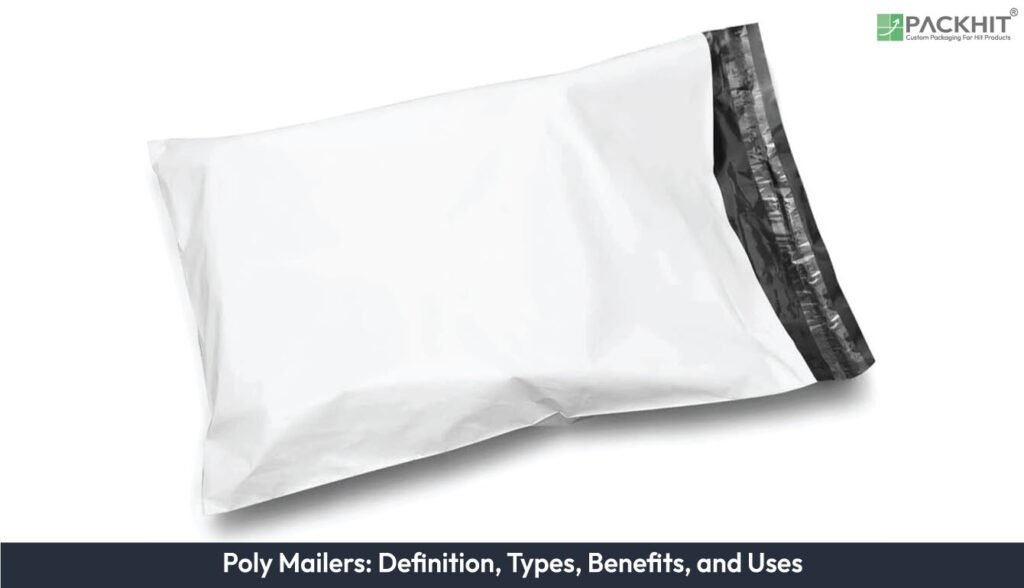
Poly mailers are lightweight polyethene shipping envelopes used in e-commerce logistics to deliver soft and non-fragile products efficiently. Made from durable plastic film, poly mailers provide a flexible, moisture-resistant packaging solution that reduces shipping weight and storage space compared to rigid cartons. The main purpose and benefits of poly mailers are to protect goods from moisture, dust, and minor handling damage while lowering shipping costs and improving packing efficiency. Businesses commonly use poly mailers for apparel, textiles, documents, and small retail items, where compact packaging, quick sealing, and scalable fulfilment operations are required.
- What are Poly Mailers?
- Why Poly Mailers Matter in Modern Packaging Systems?
- What is Material Composition and Structural Behaviour?
- What are the Types of Poly Mailers?
- 1. Flat Poly Mailers
- 2. Bubble-Lined Poly Mailers
- 3. Gusseted Poly Mailers
- 4. Custom or Branded Poly Mailers
- What are the Benefits of Poly Mailers?
- What are Poly Mailers Used for in E-commerce and Different Industries?
- Can Poly Mailers be Customised for Branding?
- What are the Limitations of Poly Mailers?
- Are Poly Mailers Better Than Corrugated Boxes for Shipping?
What are Poly Mailers?
Poly mailers are flexible shipping envelopes made from polyethene film and sealed on three sides with pressure-sensitive or permanent adhesive closures. Polyethene film provides tear resistance and moisture protection while maintaining low package weight. Poly mailers occupy a packaging category between paper envelopes and rigid boxes, combining envelope-level mass with improved durability. Opaque white or grey film conceals contents during transit, while clear and tinted variants are also available. Size ranges extend from small document formats to large apparel mailers, enabling close product fit and reduced excess volume, which supports dimensional-weight parcel shipping systems.
Why Poly Mailers Matter in Modern Packaging Systems?
Poly mailers play a key role in e-commerce packaging due to compatibility with cost-sensitive, high-volume fulfilment operations. Individual mailer weight remains significantly lower than corrugated boxes, reducing postage in weight-based and zone-based pricing models. Flat mailer storage increases warehouse density, allowing thousands of units to occupy the footprint required for a few hundred assembled cartons. Growth in online retail, particularly in apparel, accessories, and soft goods, has increased the adoption of poly mailers. Product categories with compression tolerance and minimal edge protection requirements align with polyethene envelope packaging. The resulting packaging format supports faster packing lines, lower material costs, and consistent transit performance.
What is Material Composition and Structural Behaviour?
Poly mailers are manufactured from polyethene film, commonly low-density polyethene (LDPE) or linear low-density polyethene (LLDPE). Polymer structure provides flexibility under load, water resistance, and tolerance to minor puncture or abrasion during sorting. Film thickness varies by load requirement, with heavier gauges used for footwear or bundled goods. Seams are heat-sealed to form continuous joints that resist tensile splitting. Closure strips use pressure-activated adhesive that forms a permanent seal and produces visible damage if opened, providing tamper evidence in parcel delivery networks.
What are the Types of Poly Mailers?
Poly mailers fall into four main types: flat poly mailers for low-profile soft goods, bubble-lined poly mailers for small items requiring light cushioning, gusseted poly mailers for bulkier textiles, and custom printed poly mailers for branded outbound and return shipments.
1. Flat Poly Mailers
Flat poly mailers use single-layer polyethene film for low-profile products. Construction excludes gussets or expansion folds, maintaining uniform thickness during transit. Apparel, documents, textiles, and folded soft goods fit closely, reducing air volume and dimensional-weight charges. Film gauges typically range from 50 to 70 microns, balancing tear resistance with low package mass. Flat storage supports high-density warehouse layouts.
2. Bubble-Lined Poly Mailers
Bubble-lined poly mailers combine polyethene outer film with internal air-cell cushioning. Bubble layers typically measure 3–5 mm cell height. Structure absorbs minor impact and protects items such as jewellery, phone accessories, or cosmetic tools from abrasion and short drops. Weight remains lower than corrugated boxes, while moisture resistance exceeds paper padded envelopes.
3. Gusseted Poly Mailers
Gusseted poly mailers expand internal volume through side or bottom folds. Expansion panels increase cubic capacity without increasing flat storage space. Bulky soft goods such as hoodies, footwear without boxes, or bundled garments compress into gusset areas. Heat-sealed seams maintain tensile strength along fold lines during automated sorting.
4. Custom or Branded Poly Mailers
Custom poly mailers feature printed exterior surfaces for identification and brand recognition. Printing occurs after film extrusion and cutting using flexographic or digital methods. Logos, colour fields, and handling instructions appear on the outer surface without affecting seal strength. Branded mailers are used in direct-to-consumer shipments and return packaging.
What are the Benefits of Poly Mailers?
Poly mailers reduce shipping costs through low material weight, resist moisture through polyethene film barriers, save storage space through flat stacking, and protect non‑fragile goods such as apparel, textiles, and plastic accessories during parcel transit. Bubble‑lined variants add impact buffering for small items, including jewellery and phone accessories, without shifting to boxes.
- Lower shipping costs due to low package weight and a compressible structure that reduces dimensional weight charges.
- Moisture resistance from polyethene film protects contents from rain and high-humidity transit conditions.
- Space-efficient storage through flat stacking that increases warehouse density and simplifies packing station replenishment.
- Consistent material performance without softening in wet conditions, unlike paper envelopes.
- Compression tolerance that prevents collapse under minor pressure during handling and sorting.
- Operational reliability for high-volume fulfilment centres shipping nonperishable goods.
What are Poly Mailers Used for in E-commerce and Different Industries?
Poly mailers are used to ship lightweight, non-fragile goods such as apparel, textiles, accessories, documents, and small consumer products across e-commerce, retail, publishing, cosmetics, electronics, and accessories, and reverse-logistics workflows.
- Apparel and Fashion: Shipping clothing items such as T-shirts, jeans, hoodies, and soft accessories.
- Footwear Retail: Delivering shoes or sandals without rigid retail boxes.
- Textile Industry: Packaging towels, bedsheets, scarves, and fabric products.
- E-commerce Fulfilment: Outbound parcel shipping for lightweight, non-fragile products.
- Cosmetics and Beauty: Shipping small beauty tools, makeup accessories, and skincare samples.
- Electronics Accessories: Mailing items such as phone cases, cables, and chargers.
- Publishing and Media: Sending catalogues, magazines, books, and printed marketing materials.
- Subscription Services: Delivering monthly apparel, lifestyle, or accessory subscription products.
- Corporate Marketing: Sending promotional kits, branded merchandise, and campaign materials.
- Reverse Logistics: Managing customer returns using dual-seal poly mailers.
Can Poly Mailers be Customised for Branding?
Yes, poly mailers can be customised with printed branding without affecting structural performance. Printing is applied after envelope manufacturing, allowing logos, colour blocks, and variable information to appear on the exterior surface. Custom printed poly mailers help businesses strengthen brand recognition in e-commerce shipments and return packaging. Branded mailers create a consistent visual identity across outbound deliveries and customer returns. Customisation may increase unit cost and can affect recycling processes, but branded poly mailers improve package visibility and marketing impact during transit and delivery.
What are the Limitations of Poly Mailers?
Poly mailers provide limited impact and puncture protection, lack a rigid structure, and therefore restrict use to lightweight, non-fragile products such as apparel, textiles, and soft accessories.
- Limited impact protection compared to rigid corrugated boxes.
- Minimal resistance to sharp or pointed objects inside the package.
- Not suitable for fragile items such as glassware, ceramics, or delicate electronics.
- Poor containment for liquids or products that may leak during transit.
- Lack of rigid structure for items requiring fixed alignment or edge protection.
- Better suited for lightweight, non-fragile products where flexibility, low weight, and moisture resistance are primary requirements.
Are Poly Mailers Better Than Corrugated Boxes for Shipping?
Poly mailers are better than corrugated boxes for shipping lightweight, non‑fragile goods because they reduce package weight, storage volume, and packing time, while corrugated boxes remain preferable for fragile or crush‑sensitive products requiring rigid protection. The comparison below highlights operational differences between poly mailers and corrugated boxes.
| Factor | Poly Mailers | Corrugated Boxes |
|---|---|---|
| Weight | Very lightweight, reducing shipping costs | Heavier, increasing postage and freight charges |
| Storage | Flat storage allows high warehouse density | Require more storage space when assembled |
| Packing Speed | Faster packing with fewer materials | Slower packing due to box assembly and void fill |
| Protection Level | Limited impact and crush protection | Strong edge protection and structural rigidity |
| Suitable Products | Apparel, textiles, soft goods, plastic items | Fragile, high-value, or crush-sensitive products |
| Dimensional Efficiency | Flexible film conforms to the product shape | Fixed box geometry may create unused space |
| Cost Efficiency | Lower material and shipping costs | Higher material and freight costs |
Poly mailers support lightweight, compressible products and high-volume fulfilment. Corrugated boxes remain necessary for fragile or structurally sensitive items that require rigid protection.