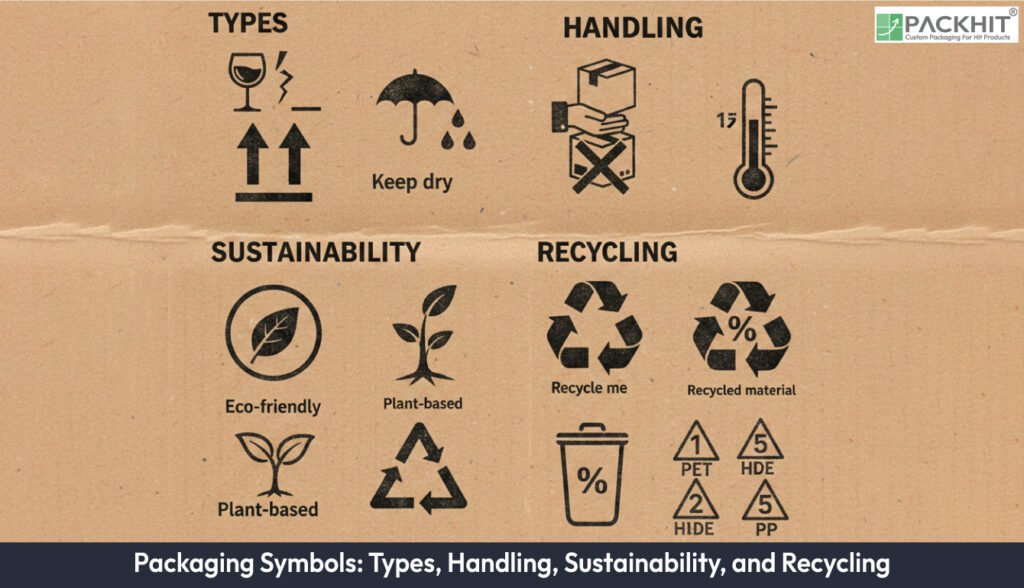
Packaging symbols form a shared visual language that helps packages move safely through supply chains, informs users about material and product risks, and signals how items should be treated after use. Their role extends beyond logistics into consumer guidance and environmental communication, linking physical handling requirements with broader sustainability and recovery systems. As packaging travels from manufacture to disposal, symbols act as quick decision tools for handlers, regulators, and end users, while evolving standards and design practices continue to shape how clearly and consistently those messages are understood.
- What are Packaging Symbols?
- How are Packaging Symbols Organised?
- What are the Different Categories of Packaging Symbols?
- 1. Recyclable Symbols
- 2. Food Symbols
- 3. Shipping Symbols
- 4. Warning Symbols
- 5. International Packaging Symbols
- 6. Eco‑Friendly Symbols
- 7. Sustainable Symbols
- 8. Compostable Symbols
- Where are the Most Common Symbols Placed?
- Primary‑Pack Placement
- Outer‑Carton Placement
- Print‑Ready Artwork Preparation
- Quality‑Control Verification
- How do Packaging Symbols Promote Sustainability?
- Improves Recycling Accuracy and Material Recovery
- Enables Composting and Organic Waste Routing
- Reinforces Verified Environmental Claims
- How are Packaging Symbols Applied in Production?
- What Measurable Effects do Packaging Symbols Have?
- Which Regulations and Standards Control Packaging Symbol Use?
What are Packaging Symbols?
Packaging symbols use simple pictograms that state handling, safety and environmental instructions. Examples include fragile, keep dry and recyclable. The packaging marks act as symbols or packaging labels that state the required information for consumers and regulators. Each icon uses a high‑contrast colour, such as black, and appears as a scalable vector graphic, which keeps edges clear on small and large packs. The symbols guide safe handling, storage and disposal, state material identity, and confirm regulatory compliance. These functions reduce handling errors and help users choose the correct end‑of‑life route. Short infographics found in packaging guides, such as those referenced in design boards or symbol charts, often show the same icons with brief meanings to support quick reading.
How are Packaging Symbols Organised?
Packaging symbols fall into four groups: shipping and handling, safety and hazard, recycling, and regulatory or product marks such as certification or allergen notices. Each group includes subtypes like food‑contact marks, such as tableware and BPA‑Free, cosmetic symbols, such as batch codes, and eco marks, such as recyclable and compostable. The structure keeps reading simple for logistics staff and consumers, and manuals and on‑pack charts repeat the same grouping to match training steps and disposal instructions.
What are the Different Categories of Packaging Symbols?
Packaging symbols are categorised into types that address protection, safety, material identity and environmental impact; common types are outlined below with defining characteristics and operational roles.
1. Recyclable Symbols
Recyclable symbols state that packaging material enters a recycling stream or contains recycled content. Seven recycling marks appear on boxes, for example, the general recycle loop and material‑specific codes. Each symbol states the end‑of‑life route and the material family, so waste managers and consumers sort items correctly. The communication role stays high because these icons direct disposal and keep municipal recycling steps clear. Confusion occurs when symbols look similar to decorative marks, as shown in many packaging infographics that group icons with short meanings. Short text and clear placement cut this confusion. Vector artwork, minimum size rules and strong contrast keep symbols readable by scanners and by users.
2. Food Symbols
Food packaging symbols state food‑contact suitability, allergen information and storage instructions. Examples include tableware marks and allergen warnings, such as nut‑allergen icons and BPA‑Free. Food symbols support product safety through clear limits on reuse, identification of materials of concern and direct storage guidance. Designers place them near ingredient listings, on lids and on inner liners for quick reading during handling and consumption. Short text sits beside these icons in many guides, including infographic boards that group tableware marks or allergen warnings, if a risk of misreading exists. This pairing reduces ambiguity and keeps health‑critical actions consistent.
3. Shipping Symbols
Shipping and handling symbols give direct instructions to carriers and warehouse staff. Examples include fragile, this side up, and keep dry. Shipping icons form the main symbol group on cartons and pallets and support transport speed and damage control. Use rises above 90% of global shipments, and ISO rules define many of the shapes seen in cross‑border routes. Placement on several carton faces and clear sizing support quick reading on conveyors and loading points. Infographic guides, including those referenced in design boards that group symbols with short meanings, help users recognise these marks faster because they show each symbol with a simple label.
4. Warning Symbols
Warning and hazard symbols state clear risks such as flammability or chemical hazard. Examples include flammability indicators and corrosion warnings. Warning symbols direct safe storage, handling and disposal by triggering specific procedural steps. Many marks carry regulatory status that sets minimum size, contrast and placement rules. Manufacturers pair a pictogram with short text when the mark identifies a regulated hazard, so the exact risk appears beside the symbol. Infographic guides from design boards often show the same icons with simple meanings, which helps users read them fast and avoid confusion with decorative graphics.
5. International Packaging Symbols
International packaging symbols use simple pictograms that work across markets and state package type or handling action. Examples include basic handling icons and internationally used recycling marks. Pictograms rely on clear shapes and direct imagery, so carriers and customs staff read them fast. Cross‑border use stays consistent because the symbols avoid language and depend on visual recognition. ISO rules cover several handling icons from 2015, and the push toward common shapes reduces regional variation. Some marks still follow local practice, so a short text or a brief note supports correct reading. Infographic guides, such as design boards that group symbols with short meanings, help users understand each icon because they show a side‑by‑side visual and a simple label.
6. Eco‑Friendly Symbols
Eco‑friendly symbols state environmental traits such as recyclability, biodegradability or recycled content. Examples include recyclable marks, compostable marks and recycled‑content marks. Eco-friendly symbols highlight end‑of‑life performance and guide purchase choices. Clear artwork and verified claims support accurate reading. Many guides, including infographic boards that group icons with short meanings, pair each symbol with a short label or certification text so users avoid confusion with decorative marks.
7. Sustainable Symbols
Sustainable symbols state design or material changes that cut environmental impact. Examples include recycled‑content indicators and marks that show reduced material use. Sustainable symbols act as clear benefit statements on the pack, and brands sometimes adjust colour or layout to match existing artwork. Qualifying text sits beside these marks to show the claim scope and measurement, for example, the percentage of recycled content. Infographic guides, such as design boards that group symbols with short meanings, repeat these icons with simple labels so users read them without confusion.
8. Compostable Symbols
Compostable symbols state that packaging enters a composting process and follows a composting route at the end of life. Examples include industrial and home compostability marks. Compostable symbols form an eco‑mark subtype and carry clear disposal limits. Incorrect disposal, such as landfill or mixed recycling, cancels the intended environmental effect. Clear consumer instruction reduces errors, and a consistent definition of compostability keeps reading simple. Infographic guides from design boards that group symbols with short meanings, including compostable icons, support quick recognition and prevent confusion with recycling marks.
Where are the Most Common Symbols Placed?
Symbols are placed on primary packs, outer cartons and print‑ready artwork panels to give disposal, handling and safety instructions at the points where consumers, carriers or inspectors read them first.
Primary‑Pack Placement
Primary‑pack placement fixes symbols on box faces, label panels and inner liners because these surfaces sit closest to consumer handling. Primary‑pack placement places vector pictograms where readers expect disposal, safety or handling instructions, and the clear zone around each mark keeps edges legible on curved or flexible substrates. Short text sits beside the icons, if misreading risk appears on crowded artwork; infographic boards that list symbol meanings, such as the packaging‑symbol charts referenced in design guides, support this pairing because they show the same icons with short labels.
Outer‑Carton Placement
Outer‑carton placement positions marks on transport boxes, pallet cartons and protective sleeves because carriers scan these surfaces during loading and sorting. Outer‑carton placement relies on repeated symbols across two or three faces so orientation, storage and hazard instructions stay visible at a distance. Vector artwork avoids distortion on fluted board, and contrast values remain fixed so warehouse lighting does not obscure the icon. Short descriptors accompany regulated marks if regional disposal or hazard rules apply.
Print‑Ready Artwork Preparation
Print‑ready artwork preparation inserts verified vector files into the layout and fixes minimum dimensions and isolation space. Print‑ready artwork preparation sets black or strong‑contrast colours because scanners and human readers identify these tones quickly on mixed substrates. Clear‑space rules keep icons distinct from decorative graphics; symbol guides in infographic boards underline the same rule by showing each pictogram inside a clean frame.
Quality‑Control Verification
Quality‑control verification checks symbol accuracy before dispatch by measuring size, colour, orientation and placement. Quality‑control verification compares printed marks to master files, and missing or distorted icons are corrected at the press‑check stage. Short text is read against the symbol set if regulated content appears. Infographic guides help staff confirm meaning because these reference sheets display common packaging pictograms with concise explanations.
How do Packaging Symbols Promote Sustainability?
Packaging symbols promote sustainability by guiding disposal behaviour, improving material recovery, and supporting circular-economy systems. Clear symbols communicate how packaging should be handled at the end of life, reducing contamination and unnecessary landfill disposal.
Packaging symbols promote sustainability by guiding disposal behaviour, improving material recovery, and supporting circular-economy systems. Clear symbols communicate how packaging should be handled at the end of life, reducing contamination and unnecessary landfill disposal.
Improves Recycling Accuracy and Material Recovery
Recycling symbols guide disposal behaviour by directing materials into defined collection streams. Recycling symbols increase correct sorting rates for paper, glass, metals, and compatible plastics because each mark identifies the material family through a coded pictogram. Guides shown in packaging-symbol infographics, including design boards that group icons with short meanings, reinforce sorting by pairing each loop or resin code with a plain label. Clear artwork reduces contamination in municipal recovery lines, and consistent use supports circular-economy targets where recycled feedstock replaces virgin inputs.
Enables Composting and Organic Waste Routing
Compostable and biodegradable symbols guide routing into organic-waste systems under industrial or home-compost conditions. Compostable and biodegradable symbols identify composting suitability through distinct pictograms that differentiate organic-ready packaging from plastics intended for mechanical recycling. Infographics in packaging-symbol guides place these icons beside short descriptors to prevent stream mixing, which is critical because misrouted compostable films disrupt plastic-sorting sensors. Clear placement and concise text reduce landfill disposal and maintain nutrient-cycle performance.
Reinforces Verified Environmental Claims
Standardised eco-labels support sustainability by linking claims to recognised certification schemes. Standardised eco-labels confirm recyclability, compostability, or reduced-impact attributes through verified test criteria, and each mark follows defined rules for shape, contrast, and minimum size. Symbol charts used in packaging infographics display these marks with concise explanations, helping users distinguish regulated eco-labels from decorative graphics. Consistent presentation builds trust because the same pictogram appears across comparable packaging formats, creating reliable cues for responsible disposal.
How are Packaging Symbols Applied in Production?
Packaging symbols are applied in production by placing verified vector pictograms into the artwork file during pre‑press so printers reproduce each mark at the correct size, contrast and position, using reference infographics if a meaning check is required.
- Print symbols are added on packages and labels to state information, show consumer rights or meet regulations; examples include FCC, ROHS, fragile and recyclable marks.
- Then the symbols are added during artwork preparation, and they supply vector files to the print stage.
- Each symbol is then checked during quality control, and the final artwork is on cartons or flexible packs.
- Vector graphics, consistent colour use and minimum size and contrast rules keep each symbol clear on different substrates.
- Infographics from design boards, including guides that explain symbol meaning, support correct selection because they show each icon with a short label.
What Measurable Effects do Packaging Symbols Have?
Packaging symbols create clear, measurable improvements in handling and logistics. Symbols reduce handling errors, speed up warehouse and transport decisions, and support safer storage and use. Safety performance improves because symbols communicate hazards, orientation, and handling limits at a glance, while logistics efficiency improves through faster visual recognition during sorting and loading. Industry practice commonly groups symbols into four categories, reports adoption on more than 90% of global shipments, references sets of around 32 standard symbols, and uses approximately seven recycling marks on typical shipping cartons.
Which Regulations and Standards Control Packaging Symbol Use?
Packaging symbol use is controlled by a mix of international standards, legal regulations, and certification schemes that define when symbols are required and how they must appear. Compliance depends on product type, market destination, and function within the supply chain.
- International standards bodies, especially ISO, standardise handling, safety, and transport symbols so that meaning remains consistent across borders. ISO pictograms cover common logistics needs such as fragile handling, orientation, stacking limits, and environmental exposure, supporting global freight movement.
- Regulatory frameworks mandate specific symbols to demonstrate legal conformity. Examples include CE marking for products placed on the European market, RoHS symbols for hazardous-substance restrictions, and food-contact marks required under EU and UK legislation. Use of these symbols is compulsory where regulations apply.
- Certification and conformity programmes govern additional symbols used on a voluntary but controlled basis. Marks linked to FCC compliance, recyclability schemes, or compostability certifications may only be displayed after successful testing and audit, ensuring claims are substantiated.
- Regional and sector-specific standards also influence symbol use. Some symbols are defined by national law or industry practice rather than global standards, meaning requirements vary by geography and product category.