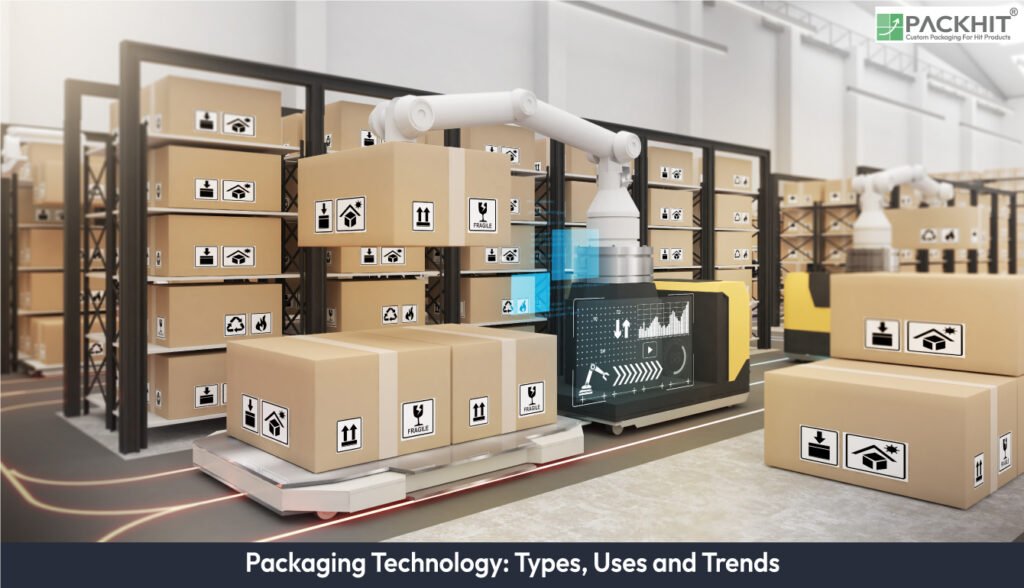
Packaging technology refers to materials, structural design, and digital systems that protect products, carry identity, and monitor condition across supply chains. Packaging technology includes smart, IoT, QR, NFC, and barcode solutions that manage traceability, interaction, and data flow from production to distribution. Packaging technology is applied across production lines and specialised areas such as integrated circuits to control protection, identification, and performance. Packaging technology trends focus on smart interaction, wider IoT use, AI-driven optimisation, and automated inspection that improve efficiency and transparency.
- What is Packaging Technology?
- What are the Main Types of Packaging Technology?
- What are the Uses of Packaging Technology?
- Product Protection
- Traceability and Tracking
- Condition Monitoring
- Anti-Counterfeit
- Consumer Interaction
- Regulatory Compliance
- Operational Efficiency
- Material and Design Optimisation
- What are the Future Trends in Packaging Technology?
- Smart Interaction Growth
- Wider IoT Tag Deployment
- Expanded QR Code Functions
- NFC-Based Authentication
- Barcode System Refinement
- AI-Driven Material Adaptation
- Automated Visual Inspection
- Predictive Shelf-Life Modelling
- How Does AI Affect the Design and Functionality of Packaging?
- How to Choose the Right Packaging Technology for Businesses?
What is Packaging Technology?
Packaging technology encompasses the physical materials, structural methods, and digital systems that protect products, record their identity, and support condition monitoring throughout the distribution cycle. The term covers substrates that form barriers against moisture or oxygen, print processes that add identifiers, and electronic components that capture or transmit data. Smart modules widen this scope with interactive functions. Examples include freshness labels or NFC tags. Market data points toward rapid adoption of such features, as more brands add interaction layers that reflect the shift seen in smart packaging growth forecasts. Packaging technology therefore, spans material science, sensor integration and data workflows, and manufacturers in the UK rely on it to safeguard goods, document traceability and meet regulatory thresholds.
What are the Main Types of Packaging Technology?
The main types of packaging technology are grouped into five defined types that structure how information, identity and product condition move through a package.
- Smart Packaging
- IoT Packaging
- QR Code Packaging
- NFC Packaging
- Barcode Packaging
Smart Packaging
Smart packaging uses embedded indicators, integrated sensors and printed circuits to record or signal product condition across a distribution cycle. Smart packaging tracks freshness events, logs temperature shifts, and supports point‑of‑use prompts for consumers through labels that react to moisture or gas levels. Smart packaging, informed by growth forecasts in the smart packaging market, gains adoption because added data points support expiry prediction, targeted routing and stand‑alone safety checks. Smart packaging also interacts with user devices through printed logic that carries item information at the shelf. Smart packaging supports brand traceability and authentication steps across storage and transit. Smart packaging raises data density through compact printed chips that run simple instructions. Smart packaging, therefore, maps product condition back to producers and forms a technical layer within modern packaging systems.
IoT Packaging
IoT packaging places active tags, lightweight radios and low‑power sensors onto cartons, crates or primary packs to transmit state data at intervals. IoT packaging gathers temperature, humidity or shock events and passes those readings to cloud gateways through short‑range or wide‑area links. IoT packaging records time‑aligned streams that support shelf‑life models and route correction for loads showing risk signs. IoT packaging needs calibration workflows that confirm accuracy before deployment and periodic rechecks once tags enter long journeys. IoT packaging depends on energy management; cells or scavenging modules maintain steady broadcasts through transit. IoT packaging creates a continuous map of package movement that aligns with warehouse or transporter systems. IoT packaging, therefore, extends monitoring into the transport chain and attaches machine data to individual shipments.
QR Code Packaging
QR code packaging prints two‑dimensional matrices that carry encoded product information, batch references and consumer‑facing pages in a compact graphic. QR code packaging provides manual scan access for users, retailers and inspectors through smartphone cameras or line‑mounted readers. QR code packaging supports high‑capacity storage of text strings, serial numbers and URLs within a small area on cartons, bottles or pouches. QR code packaging assists recall operations by linking each scanned unit back to a specific production run. QR code packaging suits consumer engagement steps because its scan path opens supplemental instructions or disposal guidance. QR code packaging performs well in varied lighting and tolerates moderate surface distortion, if print contrast meets defined thresholds. QR code packaging, therefore, functions as a low‑cost identity tool embedded in print workflows.
NFC Packaging
NFC packaging uses short‑range chips that read or write identity data when users hold a phone or reader within a few centimetres of a package. NFC packaging supports the encryption of item identifiers, which assists anti‑counterfeit checks in retail environments. NFC packaging stores dynamic records such as lot numbers, timestamps or condition flags within rewritable memory blocks on the tag. NFC packaging aids brands seeking authenticated interactions because tapping a tag triggers device‑level checks that confirm origin. NFC packaging does not depend on printed contrast or camera access, so functionality remains stable across curved or reflective surfaces. NFC packaging, therefore, adds secure interaction capabilities at close range and supports authentication workflows tied to supply‑chain records.
Barcode Packaging
Barcode packaging applies linear or stacked bars that encode numeric or alphanumeric strings for supply‑chain scanning. Barcode packaging anchors inventory movement by linking each unit to a database entry at inbound, storage and outbound stations. Barcode packaging permits rapid reads on conveyor lines through fixed scanners that interpret bar spacing under movement. Barcode packaging forms the baseline identity system for most fast‑moving goods because print cost remains low and read rates remain stable when print density aligns with scanner specs. Barcode packaging supports pallet, case and unit identification, if each level uses distinct coded labels. Barcode packaging, therefore,r e supplies a mature identity layer that sits under newer digital forms such as NFC or IoT tags.
What are the Uses of Packaging Technology?
The uses of packaging technology involve protection, identity control and data capture across production, storage and distribution steps.
Product Protection
Product protection functions create physical and chemical barriers that limit moisture ingress, oxygen transmission, and light exposure for goods requiring extended storage. These functions are particularly important for UK manufacturers packaging food, dietary supplements, and personal-care products that are sensitive to temperature and humidity fluctuations.
Traceability and Tracking
Traceability and tracking functions assign unique identifiers, such as barcodes, QR codes, or NFC tags, to link individual packs with batch and production records. These systems enable efficient recall management when faults occur and align with warehouse and logistics logs that document product movement across the supply chain.
Condition Monitoring
Condition monitoring functions capture temperature, humidity, and shock data using smart sensors or IoT modules attached to goods in transit. By revealing ageing and handling patterns, these functions improve visibility and help reduce waste, especially for products with short or sensitive shelf lives.
Anti-Counterfeit
Anti-counterfeit functions rely on NFC chips, encrypted data blocks, or tamper-evident indicators to verify product authenticity during retail or distribution checks. They allow brand owners to identify counterfeit or substituted goods when tag data does not match verified production records.
Consumer Interaction
Consumer interaction functions use QR codes, NFC taps, or smart labels to provide access to disposal guidance, usage instructions, and batch-specific information. Adoption of these features continues to expand, with sector forecasts indicating growth toward approximately 38 tracked smart-packaging integration metrics.
Regulatory Compliance
Regulatory compliance functions apply mandatory identifiers, hazard symbols, and expiry information through durable print layers that remain legible throughout transport and handling. These functions support audit requirements across food, chemical, and healthcare sectors where traceable documentation is essential.
Operational Efficiency
Operational efficiency functions enable high-speed scanning, robotic picking, and automated sortation through consistently readable codes and integrated sensor data. By logging events automatically, these systems reduce reliance on manual inspections and operator intervention.
Material and Design Optimisation
Material and design optimisation functions are driven by AI systems that analyse stress profiles, label shifts, and scan-performance data to refine wall thicknesses, seal zones, and print layouts. These adjustments improve packaging stability in areas subject to flexing, impact, or sealing stress.
What are the Future Trends in Packaging Technology?
The future trends in packaging technology centre on interactive modules, passive‑to‑active data capture, automation in print validation, and AI‑supported material selection that compresses development cycles and strengthens traceability.
Smart Interaction Growth
Smart interaction technologies include sensors, printed circuits, and reactive inks that change colour or transmit data when gas levels, moisture, or temperature exceed predefined thresholds. These systems generate continuous condition records that allow operators to identify stability trends in stored or transported units. Growing adoption in the smart packaging market, forecast to reach around 38 units of measure across sectors, is driving brands to incorporate additional responsive print layers into packaging designs.
Wider IoT Tag Deployment
The wider deployment of IoT tags integrates active radios and compact power sources into crates, cartons, or pallets moving through complex logistics routes. These tags capture shock, vibration, and temperature data and link it to warehouse or fleet management systems, provided network coverage remains consistent across transit points. This approach improves package-level visibility by highlighting deviations that directly influence shelf-life and quality calculations.
Expanded QR Code Functions
QR codes are evolving from basic text carriers into gateways for batch-linked datasets that store location data, disposal instructions, and authentication references. Scans can connect to production records, enabling faster recall verification when anomalies arise in batch data. This expansion offers manufacturers a low-cost method to monitor consumer interaction at retail and post-purchase stages.
NFC-Based Authentication
NFC-based authentication uses secure, short-range communication to verify product identity at retail or distribution points without requiring line-of-sight scanning. NFC memory can store detailed data such as timestamps, audit updates, and anti-tamper indicators. This technology is particularly valuable for brands exposed to counterfeit substitution risks, as discrepancies between scan data and production logs are easier to detect.
Barcode System Refinement
Barcodes remain the primary identification method for high-volume production lines. Ongoing refinement focuses on tighter print-density control to maintain scan accuracy on high-speed conveyor systems. Improved ink formulation, contrast ratios, and bar spacing reduce misreads by meeting stricter optical performance standards.
AI-Driven Material Adaptation
AI-driven material adaptation applies pattern recognition to historical testing data, mechanical stress analysis, and production logs to identify structural weaknesses in packaging designs. These insights guide the selection of lighter laminate structures or revised rib geometries while preserving barrier performance during transport. As a result, development cycles are shortened by reducing the need for repeated physical prototyping.
Automated Visual Inspection
Automated visual inspection systems use trained image-analysis models to evaluate print quality, code placement, and seal integrity. Defects are classified by behavioural patterns rather than simple pixel variation, which reduces false rejection rates. Early detection of pattern shifts helps stabilise batch quality throughout production runs.
Predictive Shelf-Life Modelling
Predictive shelf-life modelling translates temperature, humidity, and shock data into ageing curves that inform routing and distribution decisions. Products showing accelerated degradation can be redirected to closer endpoints before quality thresholds are exceeded. This approach reduces product loss by allowing real-time logistics adjustments based on actual handling conditions.
How Does AI Affect the Design and Functionality of Packaging?
AI affects the design and functionality of packaging through direct analysis of material performance, print behaviour and interaction data that comes from production logs. AI sorts material choices, layout rules and data layers through pattern models that read stress charts and density maps. AI builds shorter prototypes from computed strain routes that flag weak zones before cutting or forming. AI predicts interaction behaviour in smart packaging as scan rates, tap points or sensor outputs shift with context, if user patterns change. AI pushes faster growth in smart packaging modules because interactive labels and NFC elements respond to condition records gathered from earlier runs. AI also maps user‑scan distributions on QR codes, if brands track engagement, which supports layout adjustments that raise read accuracy. AI flags printing defects, misaligned codes or unstable inks in real time, if visual readings drift beyond tolerance. AI integrates with smart packaging growth data, including forecasts that point toward a market that climbs toward 38 units of measure in sector reports, which signals rapid adoption of interactive functions.
How to Choose the Right Packaging Technology for Businesses?
Choose the right packaging technology for businesses by mapping product risks against data, identity and interaction requirements. Smart modules suit goods that need condition logs, if freshness or temperature shifts occur. QR codes or barcodes fit units that need low‑cost identity checks, while NFC or IoT tags suit packs that need short‑range authentication or continuous telemetry. AI models refine these choices by sorting print limits, substrate behaviour and interaction data, as smart packaging adoption climbs toward 38 units in reported market forecasts.