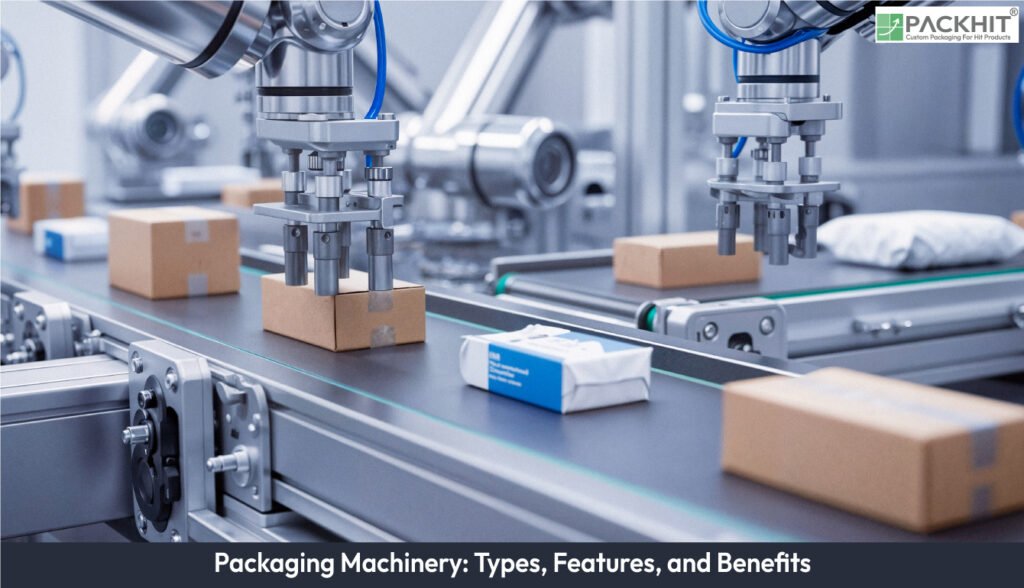
Packaging machinery forms the backbone of automated production lines by performing tasks from product handling to final shipment preparation. Machine families handle specific roles, including primary operations such as filling and capping, secondary processes like cartoning and case packing, and tertiary functions for palletising and end-of-line aggregation. Advanced features such as servo-driven motion, precision dosing, and integrated inspection enhance consistency, throughput and quality control. The benefits include faster production cycles, reduced human error, improved traceability and flexibility for multiple product formats, supported by modular design and adaptable control systems.
- What is Packaging Machinery?
- What are the Types of Packaging Machinery?
- 1. Form-Fill-Seal (FFS) Machines
- 2. Filling Equipment
- 3. Capping and Closure Heads
- 4. Sealing and Heat-Seal Machinery
- 5. Cartoners and Case Packers
- 6. Shrink-Wrapping and Overwrapping
- 7. Thermoformers and Blister Packers
- 8. Modified Atmosphere Packaging (MAP) and Vacuum Systems
- 9. Label Applicators and Coding Systems
- 10. Inspection and Quality Systems
- 11. End-of-Line and Palletising Machines
- Which Packaging Machinery is Used for Custom Boxes?
- What are the Main Features of Packaging Machinery?
- 1. Mechanical Modules
- 2. Motion and Actuation
- 3. Control Systems and HMI
- 4. Sensors and Inspection
- 5. Changeover and Tooling
- 6. Material and Hygiene Construction
- 7. Energy and Thermal Control
- 8. Integration Interfaces
- 9. Serviceability and Spares Strategy
- What are the Benefits of Using Packaging Machinery?
- Faster Throughput
- Steadier Consistency and Quality Control
- Greater Adaptability and SKU Management
- Lower Waste Reduction
- Broader Traceability and Compliance
- Safer Health, Safety and Hygiene Control
- Sharper Operational Predictability
- What are the Effects of Packaging Machinery on the Environment and Sustainability?
What is Packaging Machinery?
Packaging machinery is automated equipment and a systemised assembly that performs production-line packaging tasks. Machinery handles product contact, including filling, sealing and labelling, unit grouping and protection, including cartoning, case packing and tray sealing, and shipment preparation, including palletising and stretch-wrapping. Efficiency improves because machines automate discrete tasks, enforce repeatable process parameters and provide data for optimisation and quality control. Innovation drives rapid prototyping and additive manufacturing to accelerate tooling iteration, affect mechanical interfaces, fixture design and spare-part availability, while core control systems remain consistent. Functional roles include product presentation and metering, containment and closure, labelling and marking, inspection, and aggregated handling for distribution.
What are the Types of Packaging Machinery?
Packaging machinery is commonly grouped into primary, secondary and tertiary families, plus specialist subsystems for labelling, inspection and atmosphere control. Primary families perform product‑contact operations (examples: filling, capping, sealing); secondary families assemble and protect unit loads (examples: cartoning, case packing, shrink wrapping); tertiary families enable distribution handling (examples: palletising, stretch wrapping).
1. Form-Fill-Seal (FFS) Machines
Form–fill–seal machines shape packaging film into individual packs, fill them with measured product quantities, and seal them for distribution. Vertical FFS (VFFS) and horizontal FFS (HFFS) machines handle different pack orientations and product types. Examples include pouches, bags and sachets. Machine motion can be intermittent or continuous, and sealing technology determines suitability for liquids, powders or granules.
2. Filling Equipment
Filling equipment delivers precise product volumes into containers using metering systems. Examples include piston fillers, peristaltic pumps and gravity fillers. Selection depends on product consistency, particle content and required fill accuracy. Dosing mechanisms control overfill, minimise waste and ensure uniform portioning.
3. Capping and Closure Heads
Capping machines attach lids, caps or closures using torque control or sensor guidance. Examples include screw caps, snap lids and crimp seals. Variants include rotary chucks, spindle heads and continuous motion cappers, chosen to match production speed and cap geometry.
4. Sealing and Heat-Seal Machinery
Sealing equipment joins films or trays using heat, pressure and dwell time control. Examples include band sealers, tray sealers and impulse sealers. Precise temperature and pressure management ensures hermetic seals and prevent leaks or contamination across different substrates.
5. Cartoners and Case Packers
Cartoning and case packing systems erect cartons or secondary packs and insert products according to defined patterns. Examples include horizontal cartoners, top-load cartoners and robotic case packers. Machines manage orientation, collation and timing to maintain synchronisation with upstream production lines.
6. Shrink-Wrapping and Overwrapping
Shrink and overwrap machines apply film around products and use heat tunnels to conform the material. Examples include flow wrappers and sleeve wrappers. Film properties, tunnel temperature and tension control determine the final package appearance and protective performance.
7. Thermoformers and Blister Packers
Thermoforming and blister packing machines create cavities in web material and seal products with a lidding layer. Examples include thermoformed trays and blister packs for pharmaceuticals or small parts. Tooling precision ensures wall thickness, package integrity and consistent product protection.
8. Modified Atmosphere Packaging (MAP) and Vacuum Systems
MAP and vacuum machines remove or replace air inside packages to extend shelf life. Examples include gas-flush tray sealers and continuous vacuum belt systems. Gas composition control and sealing reliability are critical to maintain freshness and prevent spoilage.
9. Label Applicators and Coding Systems
Labelling and coding equipment applies identification, traceability and regulatory information. Examples include wrap-around labellers, print-and-apply units, inkjet and laser coders. Integration with vision inspection and serialisation systems ensures compliance and accurate data capture.
10. Inspection and Quality Systems
Inspection and quality machines verify packaging and product integrity using non-contact methods. Examples include metal detectors, checkweighers and vision inspection systems. Systems provide reject signals, monitor line performance, and collect statistical quality data for process optimisation.
11. End-of-Line and Palletising Machines
End-of-line machinery prepares cases for shipment by stacking, aggregating and securing loads. Examples include robotic palletisers, layer palletisers and stretch-hood systems. Equipment design determines load patterns, pallet stability and transport readiness.
Which Packaging Machinery is Used for Custom Boxes?
Die‑cutters, slotters, folding units and glueing machines process carton or corrugated sheets into custom boxes for production runs.
Packaging machinery used for producing custom boxes is defined by converting equipment that cuts, scores, folds and glues carton or corrugated materials into finished packs. Die-cutters, including rotary and flatbed types, cut blanks to precise profiles. Slotters add machine-score lines and bleeds, while folding and glueing machines assemble boxes for shipment. Digital finishing systems and CNC cutting tables serve low-volume production, prototypes or short runs.
Performance of custom box machinery depends on positional accuracy, repeatable creasing and slotting, and fast tooling changeover. Rapid prototyping accelerates die board creation and test fixtures, shortening validation cycles for new box styles and print alignment. Inline customisation relies on servo registration, variable-speed feeders and synchronised printing units to maintain precise print-to-cut registration.
What are the Main Features of Packaging Machinery?
Main features combine mechanical modularity, precision motion control, process monitoring and operator interfaces for recipe management and diagnostics. These functional characteristics determine whether a machine meets a given product, throughput and regulatory requirement.
1. Mechanical Modules
Mechanical modules create defined feed, form, fill, seal and transfer actions through interchangeable stations that match product and pack dimensions. Modules include forming heads, sealing jaws and servo-indexing tables that maintain alignment and cycle timing. Mechanical modules add flexibility when carton, film or container geometry changes, if operators replace format parts and recalibrate station spacing.
2. Motion and Actuation
Motion and actuation control apply servo motors and closed-loop positioning that generate accurate motion profiles for each stroke, rotation or index. Motion and actuation control replaces fixed cams with programmable axes for variable pitch, and supports belt-driven indexing for light loads. Motion and actuation control reduce shock loads on forming or sealing tools and preserve seal integrity if product bulk varies between cycles.
3. Control Systems and HMI
Control systems and HMI regulate cycle logic through PLC hardware, recipe memory, alarm logs and touchscreen panels that guide operators. Control systems and HMI share network data for line synchronisation and remote diagnostics. Control systems and HMI also enforce access levels for adjustments that influence fill weight, seal temperature or label registration.
4. Sensors and Inspection
Sensors and inspection capture photoelectric, encoder, load‑cell and vision data that confirm product presence, weight range, fill height or label placement. Sensors and inspection signals pass to the PLC, which triggers reject stations for out-of-limit units. Sensors and inspection readings form quality records if producers track batch conformance or run statistical checks.
5. Changeover and Tooling
Changeover and tooling manage the replacement of fixtures, format plates and sealing bars for new SKUs. Changeover and tooling reduce downtime through tool‑less clamps and modular parts that slot into fixed datum points. Changeover and tooling planning sets sequence, torque values and verification steps to prevent collision or mis-registration after adjustment.
6. Material and Hygiene Construction
Material and hygiene construction establish stainless‑steel frames, AISI 304 or 316 contact zones and IP-rated enclosures that withstand wet cleaning and food‑grade requirements. Material and hygiene construction choices dictate cleaning chemicals, lubrication type and inspection cycles, if the line handles chilled or allergen‑controlled products.
7. Energy and Thermal Control
Energy and thermal control regulate heat‑sealing temperature through PID loops and power consumption through variable‑frequency drives. Energy and thermal control stabilises jaw temperature for consistent hermetic seals and limit energy spikes during start‑up. Energy and thermal control improve cycle uniformity if film thickness shifts within a batch.
8. Integration Interfaces
Integration interfaces define conveyor height, IO pinouts and communication protocols for upstream or downstream links. Integration interfaces cover mechanical couplings, stop‑start handshake signals and Ethernet-based fieldbus connections used for speed matching. Integration interfaces remove bottlenecks when two machines differ in pitch length or belt speed.
9. Serviceability and Spares Strategy
Serviceability and spares strategy set access routes, wear‑part lists and preferred spare stock that shape mean time to repair and lifecycle cost. Serviceability and spares strategy includes panels that open without tools, modular PLC racks and stocked consumables such as belts or knives. Serviceability and spares strategy reduce unplanned stoppage risk when operators inspect wear points at routine intervals.
What are the Benefits of Using Packaging Machinery?
Packaging machinery increases throughput, improves repeatability and reduces the labour intensity of repetitive packaging tasks. The operational benefits include consistent fill and seal quality, reduced variability between shifts, and measurable improvements in line efficiency. Benefits manifest across several domains: throughput, quality, cost and compliance.
Faster Throughput
Faster throughput reduces time per packed unit by raising cycle frequency and maintaining continuous motion across filling, sealing or wrapping stages. Faster throughput depends on a balanced upstream supply if product inflow varies between batches. Systems such as continuous FFS lines or rotary fillers keep a steady index and prevent dwell‑time losses during shifts. Faster throughput also stabilises downstream case‑packing rhythm and cuts queue build‑up on conveyors.
Steadier Consistency and Quality Control
Steadier consistency and quality control regulate dosing, temperature and sealing pressure to prevent underfill, overfill or seal voids. Steadier consistency and quality control arise from load‑cell metering, closed‑loop feedback and monitored seal jaws that register temperature drift. Steadier consistency and quality control cut product waste, reduce rework events and maintain uniform weight distribution if product viscosity changes during a run.
Greater Adaptability and SKU Management
Greater adaptability and SKU management support quick changes between product formats by switching recipes, indexing values and format parts. Greater adaptability and SKU management rely on modular stations, retained datum points, and HMI recall lists that store previous setups. Greater adaptability and SKU management reduce downtime across short production runs if operators rotate between multiple carton styles or container volumes.
Lower Waste Reduction
Lower waste reduction results from accurate dosing, controlled sealing and stable film tracking that restricts scrap generation. Lower waste reduction depends on consistent web tension and blade condition, if film splice quality varies. Lower waste reduction keeps packaging material usage within defined tolerances and reduces rejects linked to misformed seals or misaligned labels.
Broader Traceability and Compliance
Broader traceability and compliance record batch data, timestamps, and code integrity across every unit. Broader traceability and compliance rely on serialised codes, camera checks and logged inspection signals that tie each pack to its production window. Broader traceability and compliance support regulated sectors that require documented print accuracy or allergen control.
Safer Health, Safety and Hygiene Control
Safer health, safety and hygiene control use enclosed guarding, stainless‑steel contact parts and IP‑rated components that tolerate washdown cycles. Safer health, safety and hygiene control restrict operator contact with heated zones or moving belts, if maintenance tasks occur during brief stops. Safer health, safety and hygiene control also keeps microbial risk low for chilled or ready‑to‑eat products.
Sharper Operational Predictability
Sharper operational predictability results from fault logs, sensor feedback and diagnostic screens that flag wear points early. Sharper operational predictability lowers unplanned stoppages by linking alarms to replaceable parts such as belts or knives. Sharper operational predictability also shapes maintenance planning if daily inspection data registers trend shifts in torque load or cycle count.
What are the Effects of Packaging Machinery on the Environment and Sustainability?
Packaging machinery affects environmental and sustainability performance through energy demand, material efficiency and waste generation. Machines draw electrical load across heaters, motors and vacuum pumps, and this load varies with pack format and cycle frequency. Material efficiency shifts when web tension, blade condition or forming accuracy change, because inaccurate cuts raise scrap and increase upstream material use. Emissions rise if heaters cycle without PID stability or if compressed‑air valves vent excess volume.
- Environmental impact is reduced through three operational areas: energy control, material reduction and waste segregation. Energy control depends on insulated heaters, variable‑frequency drives and standby modes. Material reduction comes from precise forming, accurate dosing and stable sealing pressure, if film thickness or carton grade varies within a batch. Waste segregation increases recovery rates for plastics, paper and metals, when lines include scrap chutes for offcuts or reject bins separated by material class.
- Sustainability gains appear when machinery supports lower‑impact materials such as recyclable films, compostable laminates or FSC‑certified board. Stable temperature zones prevent burn‑through on thinner films, while consistent creasing reduces fracture on recycled fibreboard. UK producers reference WRAP and Defra criteria for recyclability, and machines align with these criteria when seal geometry suits mono‑material structures.