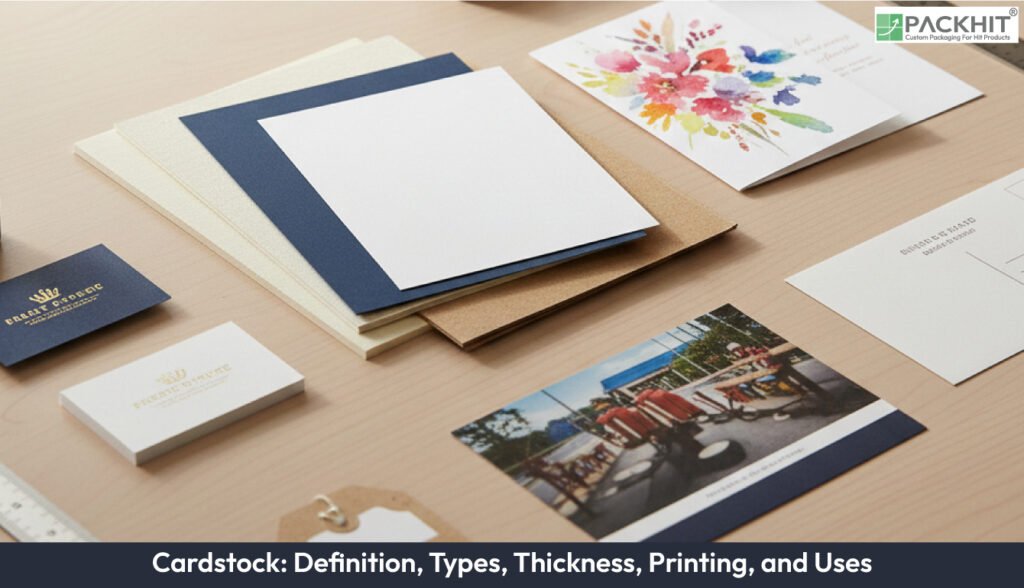
Cardstock provides a versatile medium between standard paper and heavier corrugated board, offering a balance of stiffness, printability, and foldability. Cardstock appears in a variety of weights, finishes, and textures, allowing designers and pack engineers to match material properties with functional and aesthetic requirements. Applications range from stationery to small-format packaging, with selection guided by mass, caliper, surface treatment, and the intended printing or finishing method. Careful consideration of fibre composition, sheet density, and processing ensures reliable performance in cutting, scoring, embossing, and assembly without compromising the visual or tactile quality.
- What is Cardstock?
- What are the Different Types of Cardstock?
- Coated Cardstock
- Uncoated Smooth Cardstock
- Textured Cardstock
- Letterpress and Cotton‑Based Cardstock
- Recycled Cardstock
- Solid‑Colour Cardstock
- How Thick is Cardstock?
- What Printing Processes are Used on Cardstock?
- 1. Digital Inkjet Printing
- 2. Digital Dry‑Toner Printing
- 3. Offset Printing
- 4. Letterpress Printing
- 5. Screen Printing
- 6. Foil Stamping
- Where is Cardstock Most Commonly Used?
- Invitations
- Business Cards
- Postcards and Greeting Cards
- Folding Cartons
- Presentation Boxes
- Sleeves and Slip Cases
- Hang Tags and Product Cards
- Internal Inserts
- What Material Characteristics Determine Cardstock Performance?
- What is Manufacturing Workflow for a Cardstock Box?
- What Finishing Processes are Commonly Used With Cardstock?
- What are the Common Cardstock Issues and How to Fix Them?
- What are the key Differences Between Cardstock and Corrugated Board?
What is Cardstock?
Cardstock is a stiff, paper-based board with higher weight and thickness than standard printing paper but lower structural strength than corrugated board. Packaging and print industries use cardstock when low mass, clean edges, and high print quality matter more than heavy load resistance. Fibre composition, surface treatment, and finish define performance, making cardstock suitable for lightweight boxes, premium packaging, and high-quality stationery where structure and printability must work together.
What are the Different Types of Cardstock?
Cardstock is categorised by surface finish, coating status, texture, fibre origin, and basis weight; principal commercial variants include coated (gloss/satin/matte), uncoated smooth, textured linen or felt, recycled-fibre grade,s and speciality press stocks such as cotton or letterpress papers.
Coated Cardstock
Coated cardstock uses a thin mineral or polymer layer that reduces ink absorption and stabilises colour density. The coating controls gloss levels, dot gain behaviour, and surface friction, so gloss, satin, and matte grades show different reflectivity and image contrast. Coated variants support tight registration on offset presses and maintain clean edges after die‑cutting, if the coating weight remains consistent across the sheet.
Uncoated Smooth Cardstock
Uncoated smooth cardstock contains no surface seal and absorbs more ink than coated stock. The open surface creates a softer print character and a tactile feel that suits stationery, writable inserts, and carton formats that need pen‑friendly surfaces. Ink drying depends on fibre porosity, so uncoated sheets display longer dry times and show more visible grain direction if heavy solids cover the sheet.
Textured Cardstock
Textured cardstock incorporates embossed or mould‑made patterns such as linen, felt, or laid. Texture interrupts light reflection and influences ink lay, so photographic images appear softer and line art gains subtle shadowing. Textured grades support deeper embossing than smooth coated stock, if the fibre density is high enough to prevent surface tearing.
Letterpress and Cotton‑Based Cardstock
Letterpress and cotton‑based cardstock use dense or rag‑content fibres that compress cleanly under relief pressure. The structure supports deep impressions, consistent ink transfer, and stable sheet edges during heavy debossing. Cotton‑based boards show strong tear resistance and maintain shape in humid environments if the calliper exceeds the mid‑range.
Recycled Cardstock
Recycled cardstock uses post‑consumer or post‑industrial fibre, and grades range from partial to 100% recycled content. Recycled fibres reduce whiteness and alter surface uniformity, although print stability remains predictable on coated variants. Recycled sheets reduce fibre variability if mills standardise the de‑inking and refining stage.
Solid‑Colour Cardstock
Solid‑colour cardstock uses pre‑dyed fibres or integrally coloured pulp to create uniform colour through the sheet. This approach removes the need for full‑bleed flood coats and prevents white edges after die‑cutting. Solid‑colour grades support inserts, tags, and small cartons that rely on colour contrast, if the dye load maintains stability across production batches.
How Thick is Cardstock?
Cardstock thickness is specified by mass per unit area and by sheet calliper, because weight alone does not define rigidity or folding behaviour. Typical consumer and commercial cardstock falls between about 180 and 350 g/m², while heavier cover stocks extend beyond that range. In calliper terms, common values sit between 10 and 16 points, which equals roughly 0.254 to 0.406 millimetres.
Light cardstock around 180–220 g/m² suits postcards, greeting cards, and simple sleeves. Medium cardstock with a near 230–300 g/m² supports invitations, postcards, and many retail cartons. Heavy cardstock at 300–400 g/m² or higher is chosen for business cards, rigid panels, and applications needing sharp embossing or deep die cuts.
A calliper is widely used in packaging and stationery specifications because it reflects tactile feel and structural response. One point equals 0.001 inch, so higher point values indicate thicker sheets. Increased thickness improves perceived quality and embossing depth but reduces foldability, making scoring necessary to prevent fibre cracking.
Thickness directly affects die-cut accuracy, crease depth, adhesive performance, and stacking behaviour. Prototype testing on the selected grade confirms fold quality and bond strength before full production.
What Printing Processes are Used on Cardstock?
Printing on cardstock uses multiple print technologies selected by stock weight, surface treatment, and production scale. Common processes include digital printing, offset lithography, letterpress, screen printing, and foil stamping, each suited to specific surface and performance requirements.
Printing processes used on cardstock apply digital, offset, letterpress, screen, and foil methods to place colour, relief, or opaque layers on sheets with different coatings and calipers
1. Digital Inkjet Printing
Digital inkjet printing deposits aqueous or pigment‑based inks onto cardstock through controlled nozzles, and the process depends on careful ink absorption on porous fibres. Digital inkjet printing supports short runs and variable data on 180–300 g/m² sheets, if drying time prevents cockling or mottling. Droplet size, sheet porosity, and coating weight influence colour density and edge sharpness, and straight‑path feeding limits head strikes on thick callipers.
2. Digital Dry‑Toner Printing
Digital dry‑toner printing bonds toner particles to cardstock through electrostatic transfer and fuser heat. Digital dry‑toner printing handles short to medium runs on coated and uncoated grades, if feed settings match the calliper and fuser temperature avoids curl. Toner adhesion depends on surface smoothness; textured grades show reduced fusion consistency without pre‑conditioning.
3. Offset Printing
Offset lithography transfers ink from plate to blanket to sheet and controls dot gain through calibrated water‑ink balance. Offset lithography prints long runs on coated cardstock with consistent density, if coating integrity supports sharp halftones. Fountain solution settings, blanket pressure, and grain direction affect registration, and 200–350 g/m² stocks carry ink films without distortion.
4. Letterpress Printing
Letterpress printing forms relief impressions by pressing raised plates into the sheet under high pressure. Letterpress printing creates tactile depth on cotton‑based or dense‑fibre cardstock, if caliper supports compression without cracking. Ink coverage stays thin, so line art and type remain crisp, and impression strength varies with moisture content and fibre stiffness.
5. Screen Printing
Screen printing forces viscous or opaque inks through a mesh stencil and applies thick ink films for high-opacity graphics. Screen printing covers textured or high-calliper cardstock if the mesh count matches the ink viscosity and sheet thickness. Speciality inks such as metallic, fluorescent, or raised gels sit cleanly on 250–400 g/m² stock due to low absorbency and stable surface tension.
6. Foil Stamping
Foil stamping uses heat and pressure to transfer foil from a carrier to a sheet through a metal die. Foil stamping forms dense metallic or pigmented layers on smooth cardstock surfaces, if the calliper provides resistance for clean edges. Temperature, dwell time, and foil type affect adhesion, and coated sheets maintain sharper boundaries than fibrous uncoated grades.
Where is Cardstock Most Commonly Used?
Cardstock is used for print and packaging applications that require rigidity, clean print surfaces, and a premium tactile feel. Common uses include:
Invitations
Invitations use 220–300 g/m² cardstock to form rigid panels that keep typography sharp and colours uniform. Pre-scored fibres fold cleanly when the grain direction runs parallel to the hinge. Coated sheets reduce ink spread, while uncoated sheets improve pen marking for RSVP panels.
Business Cards
Business cards rely on 300–350 g/m² cardstock to maintain crisp edges during trimming. Dense fibres keep surfaces flat under foil, embossing, or spot varnish. Thicker callipers support deep impressions when the moisture content is balanced during finishing.
Postcards and Greeting Cards
Folding cartons use 230–300 g/m² sheets to form structural shapes for cosmetics, supplements, or small hardware. Controlled creasing maintains precise panel geometry. Uniform fibre density keeps closures aligned during filling.
Folding Cartons
Folding cartons use 230–300 g/m² sheets to form structural shapes for cosmetics, supplements, or small hardware. Controlled creasing maintains precise panel geometry. Uniform fibre density keeps closures aligned during filling.
Presentation Boxes
Heavier single-ply cardstock creates semi-rigid shells for jewellery, cosmetics, and electronics. Smooth surfaces accept foil or embossing without tearing. Laminated exteriors improve scuff resistance during handling.
Sleeves and Slip Cases
Coated cardstock forms sliding covers with even ink lay and low-friction movement. Lamination protects edges, reduces abrasion, and stabilises trimmed panels.
Hang Tags and Product Cards
Sheets between 250–350 g/m² support hole punching and variable-data printing. Dyed-through stock hides white edges after cutting, anchoring branding for garments, accessories, and small tools.
Internal Inserts
Internal inserts brace products inside cartons and hold shape under pressure. Scoring matched to the calliper prevents splitting during folding. Higher fibre density reduces collapse and keeps items centred in small retail packs.
What Material Characteristics Determine Cardstock Performance?
Cardstock performance is primarily determined by fibre structure, surface treatment, and finishing. Fibre content and sheet formation control stiffness, thickness stability, and z-direction strength, while denser fibres enable sharper die cuts and deeper embossing. Surface coatings reduce ink absorption, enhance print clarity, and improve color saturation, whereas uncoated stocks produce softer tonal transitions and a natural tactile feel. Calendering affects surface smoothness and gloss, and the chosen finish must align with intended printing and post-processing methods to ensure reliable end-use performance.
What is Manufacturing Workflow for a Cardstock Box?
A typical manufacturing workflow for a cardstock box involves a series of coordinated steps that transform flat sheets into a finished, functional package:
- Preparing dielines and nest panels to maximise sheet efficiency and reduce material waste.
- Applying printing and post-print coatings to achieve the desired visual appearance and surface protection.
- Die-cutting and creasing the sheets to define the box shape and allow precise folding.
- Applying adhesive to designated areas to ensure secure assembly and structural integrity.
- Folding and glueing the blank to form the finished box with correct alignment and seam strength.
- Accounting for performance effects: coating affects die-cutting friction, calliper influences crease depth and adhesive bonding, and nesting layout impacts material yield and production cost.
What Finishing Processes are Commonly Used With Cardstock?
Cardstock can be enhanced with finishing and special processes to improve visual appeal, tactile experience, and durability. Common methods include:
- Embossing/debossing: Creates raised or recessed patterns; stronger effects require higher calliper and denser fibres.
- Foil stamping: Applies metallic or colored foil using heat and pressure; adhesion depends on surface smoothness and heat tolerance.
- Spot UV and varnish: Adds localised gloss or sheen to highlight areas and create contrast on coated stocks.
- Lamination: Applies a protective film that reduces abrasion and moisture damage, and increases stiffness in a small but noticeable step. The film layer also changes fold behaviour if the sheet carries a higher calliper after lamination.
What are the Common Cardstock Issues and How to Fix Them?
Common cardstock issues include cracking on fold lines, patchy print on textured fibres, feed jams on thick sheets, and weak adhesive bonds, and each issue reduces through correct scoring, smoother stock selection, straight‑path feeding, and adhesive matching.
- Cardstock often cracks along fold lines when folded without proper scoring. Scoring before folding and using a reduced fold radius prevents cracking and preserves structural integrity.
- Textured cardstock can produce patchy or uneven print results. Applying a coating or choosing a smoother stock variant improves ink lay, and performing a test print ensures accurate colour and dot gain.
- Heavy or textured cardstock can cause printer feed jams. Using a single-sheet, straight-path feed and verifying the printer’s maximum recommended GSM reduces jams and ensures smooth printing.
- Adhesives fail to bond properly on coated or speciality stocks. Selecting adhesives compatible with the surface type and increasing dwell time improves adhesion and long-term hold.
What are the key Differences Between Cardstock and Corrugated Board?
Cardstock differs from corrugated board because cardstock supports fine‑detail printing on a smooth, single‑ply sheet, while corrugated board carries heavier loads through a fluted core that resists crush, puncture, and stacking pressure.
The table below highlights the key differences between cardstock and corrugated board, comparing print quality, tactile feel, structural strength, puncture resistance, weight, and ideal use cases.
| Feature | Cardstock | Corrugated Board |
|---|---|---|
| Print Surface | Smooth, high-quality, supports detailed graphics, and finishes | Less smooth, suitable for larger-scale printing, limited fine detail |
| Tactile Experience | Offers a premium feel, supports embossing, foil, and texture | Basic tactile feel, not ideal for embossing or premium finishes |
| Structural Strength | Moderate stiffness, lower compressive strength | High compressive strength, supports stacking and heavy loads |
| Resistance to Puncture | Limited | High, withstands impacts and punctures |
| Weight | Lightweight, reduces shipping volume | Heavier, increases shipping weight |
| Best Use Cases | Short-distance transport, retail display, secondary packaging | Primary packaging, transit protection, stacking, heavy products |
Cardstock excels in visual appeal and lightweight applications, while corrugated board offers superior strength and protection for heavier or stacked shipments, guiding material selection based on packaging requirements.