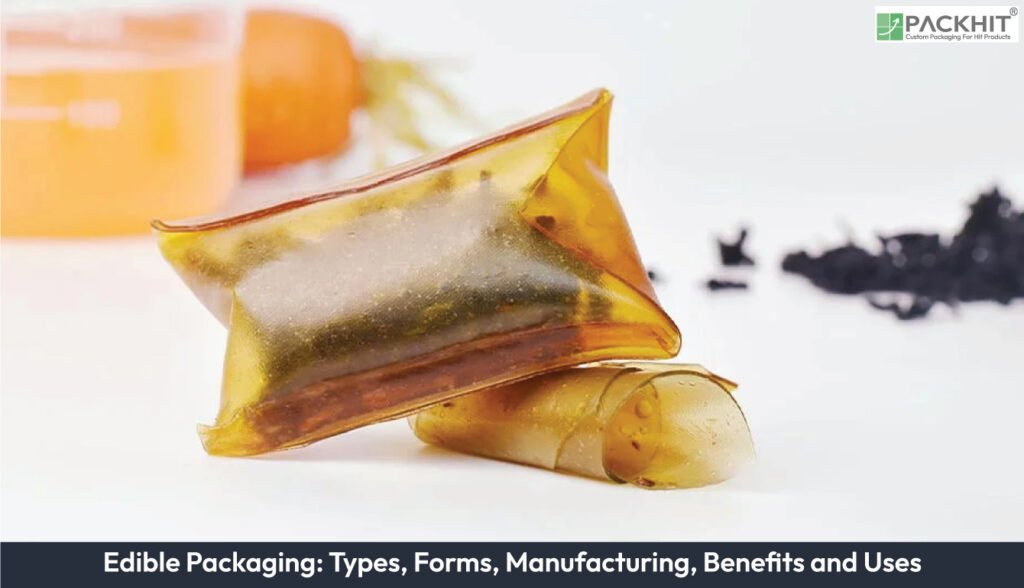
Edible packaging uses food‑grade polymers to protect products, replace single‑use plastics, and biodegrade through natural pathways across films, coatings, containers, pods and utensils made from polysaccharides, proteins, lipids or composites. Manufacturing relies on formulation, casting or extrusion, controlled drying and post‑treatments that set strength and barrier properties, which shift with moisture and temperature. Benefits include waste reduction, portion control and the ability to carry antimicrobial or antioxidant compounds, while applications span food, pharmaceutical and cosmetic formats. Adoption remains constrained by moisture sensitivity, lower mechanical strength, cost, allergen labelling and regulatory controls, so manufacturers select materials by moisture load, barrier needs, handling stress and storage conditions.
- What is Edible Packaging?
- What are the Types of Edible Packaging Materials?
- What Physical Forms Does Edible Packaging Take?
- How is Edible Packaging Manufactured?
- 1. Formulation of the polymer system
- 2. Casting, extrusion or mould filling
- 3. Controlled drying or structural setting
- 4. Post‑treatments for barrier and strength
- 5. Cutting, sealing and packaging
- How do Thermal and Moisture Conditions Alter Performance?
- What are the Benefits of Edible Packaging?
- Waste reduction
- Functional payload delivery
- Portion control and convenience
- Reduced secondary packaging
- What are the Applications of Edible Packaging?
- What are the Limitations of Edible Packaging?
- How are Safety and Regulatory Obligations Managed for Edible Packaging?
- How to Select Edible Packaging for a Product?
- Which Tests Should be Performed Before Launch?
- Practical Examples of Edible Packaging
- Frequently asked questions
What is Edible Packaging?
Edible packaging is a packaging material formulated from food-grade components such as polysaccharides, proteins, lipids and composite blends that biodegrade without toxic residues. It includes surface-applied coatings that modify gas and moisture exchange (for example, alginate coatings on fruit), free-standing films and sheets (for example, starch films), and integral containers or utensils (for example, moulded edible cups and spoons).
What are the Types of Edible Packaging Materials?
Edible packaging materials fall into four technical groups that use natural polymers that biodegrade through hydrolysis or enzymatic action. Each group shows a distinct barrier pattern, structural profile and ingestion tolerance, and manufacturers match these classes to moisture load, handling stress and flavour neutrality.
Polysaccharide-based matrices
Polysaccharide matrices create oxygen‑tight films from starch, alginate or cellulose derivatives. These matrices absorb moisture because their carbohydrate chains attract water. Typical uses include starch sheets for dry snacks and alginate coatings for fruit. Biodegradation occurs through microbial metabolism of sugar units, if storage moisture allows microbial access. According to university groups working on natural polymer systems during 2023, alginate and starch films reach moderate tensile strength ranges and maintain clean decomposition without toxic residues.
Protein-based matrices
Protein matrices form cohesive networks from gelatin, whey or soy protein. These matrices give moderate mechanical strength and moderate oxygen resistance. Examples include gelatin capsules for powders and soy‑based films for dry confectionery. Heat denatures these networks above 60–80 °C, if drying exceeds these thresholds. Enzymes in the stomach break down the polypeptide chains after ingestion. Allergen statements apply to milk or soy sources, if regulatory bodies classify them as priority allergens.
Lipid-based layers
Lipid layers use waxes or fatty esters that restrict water vapour transmission. These layers show low oxygen resistance because their hydrocarbon chains allow oxygen permeation. Examples include plant‑wax coatings on citrus and fatty‑ester laminates on confectionery. Melting points vary with fatty acid composition, and this sets the usable temperature range. Lipid layers limit weight loss in humid storage if the oxygen sensitivity of the product stays low.
Composite edible packaging
Composite matrices combine polysaccharides, proteins or lipids with fillers or functional additives. Cellulose nanocrystals raise tensile strength in brittle films. Chitosan introduces antimicrobial activity against spoilage organisms if humidity stays controlled. Plant extracts add antioxidant action in coated foods. These composites target situations where water vapour and oxygen need separate control, for example coatings for fresh produce or wrappers for dry snacks. Their biodegradability follows natural pathways because each component decomposes without harmful residues.
What Physical Forms Does Edible Packaging Take?
Edible packaging appears as films, coatings, containers, sachets and utensils. These forms use natural polymers that break down cleanly, if discarded. They support food, pharmaceutical and cosmetic products, for example fruit coatings, capsules and topical strips.
Films and wraps
Films and wraps use cast or extruded sheets that control gas and moisture transfer and break down cleanly after disposal. Polysaccharide and protein matrices dominate these sheets, and examples include alginate films for fresh produce and starch wraps for dry snacks.
Surface coatings
Surface coatings use liquid dispersions that form thin layers on fruits, confectionery or baked items. These layers slow oxidation and moisture loss and biodegrade through natural hydrolysis. Pectin coatings on apples and alginate coatings on citrus are common examples.
Moulded containers and shells
Moulded containers and shells use gelation or baking processes that set the structure into cups, beads or trays. Containers show moderate rigidity and suit dry or semi‑moist foods. Examples include calcium‑set alginate beads and baked protein cups.
Sachets and single‑serve pods
Sachets and single‑serve pods use sealed edible films that hold sauces, powders or condiments. These pods dissolve in water or in the mouth and cut plastic waste. Starch pods for instant sauces and soluble seasoning sachets are common examples.
Utensils
Utensils use cereal‑based or protein‑based doughs shaped through baking or thermoforming. These utensils remain stable during eating and compost after disposal. Examples include baked cereal spoons for frozen desserts and edible straws shaped from starch composites.
How is Edible Packaging Manufactured?
Edible packaging is manufactured by blending natural polymers with additives, forming films or shapes through casting or extrusion, and fixing structure through controlled drying or setting to create biodegradable formats for food, pharmaceutical or cosmetic use.
1. Formulation of the polymer system
Formulation starts with a polymer phase from polysaccharides or proteins, a solvent such as water, a plasticiser such as glycerol, and functional additives such as cellulose nanocrystals or antioxidants. The formulator blends these at a fixed solids level to reach the viscosity required for casting or extrusion. Homogenisation disperses solids if composite systems contain reinforcing fillers. Degassing removes entrapped air and prevents voids in thin films.
2. Casting, extrusion or mould filling
Film formation or shaping uses four common routes: casting for flat sheets, slot‑die extrusion for continuous films, mould filling for shells or utensils, and extrusion‑based 3D printing for intricate shapes. Casting spreads a measured slurry across a support to form thicknesses from 10 to 200 µm. Slot‑die extrusion forms continuous ribbons for sachets or pods. Mould filling sets trays or cups made from gelled matrices, if higher rigidity is needed. Extrusion printing deposits stacked layers for complex containers.
3. Controlled drying or structural setting
Drying removes free water under temperature and humidity control. Typical ranges sit between 30 and 80 °C. The drying profile depends on thickness and polymer class: polysaccharides lose moisture quickly and become brittle unless plasticised; proteins form denatured networks at elevated temperatures. If ionic gels are used, calcium baths set alginate structures. If lipid layers are laminated, moderate heating fixes the layer without melting fatty esters.
4. Post‑treatments for barrier and strength
Post‑treatments adjust barrier and strength. Ionic crosslinking restricts swelling in hydrophilic matrices, for example calcium ions fixing alginate chains. Thermal annealing tightens protein networks. Lipid lamination reduces water vapour transmission in hydrophilic films. These treatments raise shelf stability, if humidity remains controlled.
5. Cutting, sealing and packaging
Finishing steps cut and trim films, seal pods through heat or pressure, and package items under clean‑room conditions. Cutting patterns reflect the final geometry of sachets and wrappers. Sealing uses low temperatures to avoid denaturing edible matrices. Packaged items pass microbial checks to confirm hygienic production.
How do Thermal and Moisture Conditions Alter Performance?
Edible materials soften, denature or melt when exposed to temperatures above their structural transition points. For example, some protein films begin to lose cohesive strength as they denature above 60–80 °C, while lipid layers melt according to their melting points. Moisture raises plasticisation and reduces tensile strength for hydrophilic matrices. Therefore, water-rich foods and high-humidity storage require moisture-resistant formulations, such as lipid-laminated composites or hydrophobic coatings.
What are the Benefits of Edible Packaging?
Edible packaging reduces solid waste streams and can supply active functions while conserving material resources when matched to the product’s moisture and storage profile.
Waste reduction
Edible packaging reduces post-consumer waste because the material is consumed with the product or breaks down through natural biodegradation. Films, coatings and pods remove a discrete plastic wrapper from disposal streams, for example wrappers for single‑serve snacks replaced by starch films.
Functional payload delivery
Edible films support active compounds that change food stability or flavour. Matrices carry antimicrobials, antioxidants or flavourings, for example chitosan layers that restrict spoilage organisms on fresh produce. These compounds disperse uniformly through hydrophilic polymer networks.
Portion control and convenience
Single‑serve pods and sachets hold a measured quantity of sauces, powders or seasonings. The pack dissolves in water or the mouth and removes dosing errors, for example condiment pods that disintegrate during meal preparation. The pod’s wall thickness sets dissolution time.
Reduced secondary packaging
Surface coatings applied to fruit, vegetables or confectionery remove the need for a secondary bag or tray. These coatings slow water loss and respiration and decompose without residues, for example coated berries shipped in open trays. The coating’s permeability regulates moisture exchange.
What are the Applications of Edible Packaging?
Edible packaging supports food, pharmaceutical and cosmetic products through formats that break down naturally and add controlled functionality. Each sector uses different matrices because moisture levels, handling loads and sensory constraints vary across products.
Food Industry
Food producers apply edible films, coatings, containers, sachets and utensils where the packaging either dissolves, is eaten with the product or decomposes without residues. Coatings slow water loss on fruit and vegetables, for example citrus treated with alginate layers. Films wrap confectionery or dry snacks and reduce plastic waste if the wrapper is consumed. Containers shaped from gelled matrices hold single‑serve portions, for example baked protein cups for snacks. Starch pods carry sauces and dissolve in water or in the mouth, if direct release is required. Cereal‑based spoons function as temporary utensils for ice cream or frozen desserts.
Pharmaceutical Industry
Pharmaceutical producers use edible matrices for oral capsules, strips and dissolvable films. Gelatin or polysaccharide capsules enclose powders or oils and break down in the stomach. Thin oral strips deliver active compounds by rapid dissolution if swallowing is difficult for the patient. These systems require controlled solubility, mechanical integrity during handling and compliance with food‑contact and medicinal regulations.
Cosmetic Industry
Cosmetic manufacturers use edible‑grade polymers in dissolvable skincare patches and flavour‑based lip treatments. These patches hold active plant extracts or moisturisers and disintegrate on the skin surface. Formulations require biocompatibility and stable storage, if humidity varies during shipping. The matrices decompose cleanly after disposal because they contain polysaccharides, protein gels or lipid composites derived from natural sources.
Across these sectors, manufacturers select edible packaging when waste reduction and simple end‑of‑life handling outweigh limits in mechanical strength. Adoption expands as composite structures raise tensile strength, and as regulatory alignment clarifies production controls for edible matrices used in contact with food, pharmaceuticals or cosmetics.
What are the Limitations of Edible Packaging?
Limitations relate to environmental sensitivity, structural performance, cost and regulatory/health constraints that restrict substitution for conventional plastics in many applications.
- Moisture sensitivity: hydrophilic matrices absorb water and lose strength, for example starch films that soften in humid storage and break down faster than expected.
- Mechanical weakness: edible films show lower puncture and tear resistance than polyethylene, for example thin wrappers that fail when they contact abrasive foods.
- Allergens and food safety: protein films contain milk, egg or soy allergens that require clear labelling, for example gelatin films that do not suit restricted diets.
- Scale and cost: natural feedstocks and controlled drying steps raise unit costs compared with high‑volume polymer extrusion, for example composite films that need long drying times.
- Consumer acceptance: taste and mouthfeel must remain neutral, for example savoury notes that reduce acceptance in sweet confectionery and limit repeat use.
How are Safety and Regulatory Obligations Managed for Edible Packaging?
Edible packaging must meet food-contact laws and food-safety criteria in the jurisdiction of sale and requires explicit allergen labelling where source proteins are present. Producers validate through migration testing, microbiological assays and sensory panels and document traceability for raw materials and production controls.
Is Edible Packaging Eco‑Friendly?
Yes, edible packaging is eco‑friendly because it is made from biodegradable food‑grade materials that decompose without harmful residues and reduce plastic waste and end‑of‑life disposal impacts.
How to Select Edible Packaging for a Product?
Select based on the product’s moisture content, mechanical protection needs, storage conditions and sensory compatibility. Start with a material family that matches the dominant constraint and refine the formulation with additives and lamination.
- Moisture compatibility: choose lipid-laminated or hydrophobic-coated systems for high-moisture foods, for example lipid-laminated films for moist bakery items.
- Barrier requirement: select polysaccharide or protein films for oxygen-sensitive products when dry, for example vacuum-sealed snacks.
- Mechanical protection: use reinforced composites or moulded shells for fragile items, for example reinforced protein cups for handheld foods.
- Sensory and allergen profile: avoid allergenic source materials where ingestion is expected, for example choose alginate over milk-derived films for allergen-sensitive markets.
Which Tests Should be Performed Before Launch?
The required tests check mechanical strength, barrier limits, sensory impact, microbiological safety and regulatory compliance. These tests confirm stability in storage, if humidity or temperature varies, and verify safe contact with foods, pharmaceuticals or cosmetics.
- Mechanical testing: measure tensile strength and puncture resistance with ASTM or ISO film methods adapted for edible matrices such as starch films.
- Barrier testing: record WVTR and OTR at the storage humidity and temperature that match the product, for example accelerated humidity runs for composite films.
- Sensory panels: assess taste, texture and aroma with trained and consumer groups, for example triangle checks of flavour carry-over in coatings.
- Safety testing: track microbial load, migration limits and shelf-life stability, for example challenge runs on coatings that absorb moisture during storage.
Practical Examples of Edible Packaging
Applied examples show direct trade-offs between strength, convenience and environmental impact. Each case uses natural polymers that break down cleanly after use.
- Fruit coating: a calcium‑alginate coating applied by dipping slows respiration and water loss in fresh fruit, for example apples that hold moisture longer than untreated controls. This coating decomposes through natural hydrolysis if discarded.
- Single‑serve sauce sachet: a starch‑based film sealed into a soluble pod removes a plastic wrapper for meals on the move, for example pods that dissolve in hot water or in the mouth. The starch matrix biodegrades through enzymatic action if moisture remains present.
- Edible utensil: a baked cereal‑based spoon supports frozen desserts and is eaten after use, for example spoons shaped by thermoforming cereal doughs. The utensil breaks down as a natural carbohydrate if disposed of instead of consumed.
Frequently asked questions
Who uses edible packaging?
Food manufacturers, catering operators and niche-product brands use edible packaging where its functional trade-offs match the product: fresh-produce suppliers, confectionery makers and foodservice outlets are common users.
Can edible packaging replace plastics?
Edible packaging can replace plastics in limited applications where moisture exposure and mechanical stresses are low; broad replacement requires improved mechanical performance or hybrid systems combining edible layers with thin structural supports.
Are edible films safe to eat?
Edible films formulated from approved food-grade ingredients and produced under food-hygiene controls are safe to eat; however, allergen content and microbial safety must be declared and controlled through testing.
How long do edible packages last?
Shelf-life varies by formulation and storage conditions: typical film-based wrappers last weeks to months under dry storage, while high-moisture applications require refrigeration and may last days to weeks.