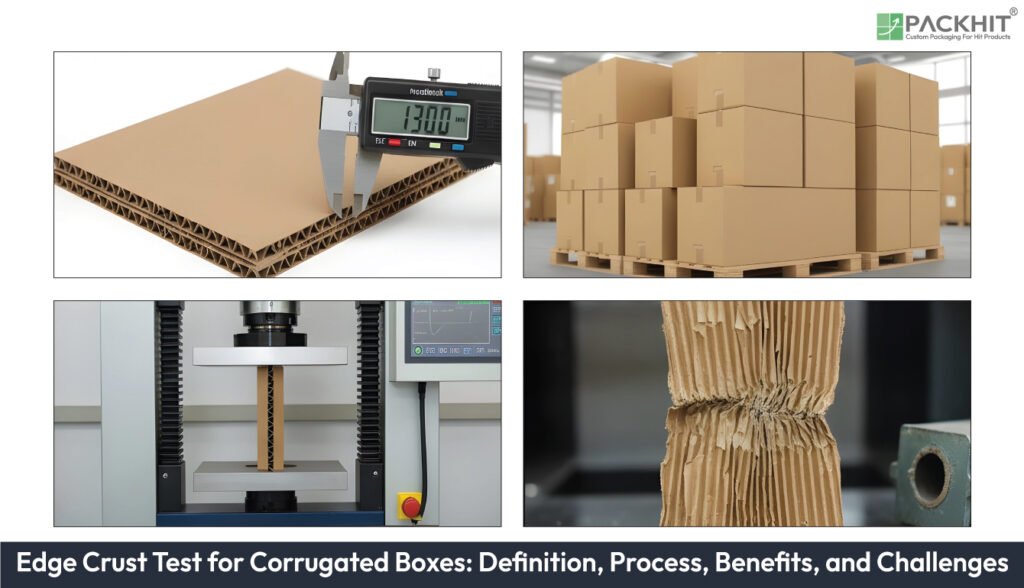
The Edge Crush Test (ECT) measures the edgewise compressive strength of corrugated board, defined by standards such as TAPPI T811 and ISO 3037, which specify how narrow, conditioned strips are cut, prepared, and compressed on edge until failure to calculate force per unit width. It is performed using parallel platens at a controlled loading rate, and results are reported with units, conditioning climate, and mean values from multiple strips. ECT is widely used for stacking-strength prediction, production quality control, material selection, and rapid, economical testing, though its accuracy can be affected by moisture sensitivity, specimen-cutting damage, machine variability, simplified loading geometry, and complex material interactions. Unlike the Mullen burst test, which measures hydrostatic puncture resistance, ECT targets vertical compression and is therefore preferred for stacking-driven applications. In practice, engineers use ECT charts, McKee-based calculators and common unit conversions to link board strength with box compression. Because ECT captures only edge compression, it is supplemented with burst, bending-stiffness, and box-compression tests when packaging faces puncture, flexure, or complex shipping conditions.
- What is the Edge Crush Test?
- How is the Edge Crush Test Performed?
- What are the Practical Benefits of Measuring ECT?
- Stacking‑strength Prediction
- Production Quality Control
- Material Selection and Procurement
- Speed and Sample Economy
- What are the Major Challenges and Limitations of ECT?
- Moisture Sensitivity
- Specimen Preparation Effects
- Fixture and Machine Variability
- Limited Loading Geometry
- Material Interaction Complexity
- How Does the Edge Crush Test Compare with the Mullen Burst Test?
- How ECT Charts and Calculators are Used in Practice?
What is the Edge Crush Test?
The Edge Crush Test (ECT) measures the edgewise compressive strength of corrugated board and is reported as force per unit length (kN/m or lb/in). The method characterises how much linear load the board edge withstands before local crushing or buckling occurs, making it a primary laboratory indicator for vertical stacking capacity. As a defining specification, ECT is a mechanical short-column test applied to a narrow strip of board cut with the flutes perpendicular to the applied load; the result reflects combined properties of the liners, the corrugated medium, and the flute profile, such as A, B, C, and E flutes. ECT is classified as a standardised board test used in production quality control, material selection, and packaging design inputs.
Which Standards Define the Edge Crush Test?
Standards such as TAPPI T811 and ISO 3037 specify specimen geometry, conditioning, loading rate, and the calculation used for ECT. TAPPI T811 is commonly cited in North American practice under the title that references edgewise compressive strength by the short-column method, while ISO 3037 provides a parallel international procedure; both set the required sample handling, environmental conditioning, and reporting conventions used in procurement and laboratory exchanges.
How is the Edge Crush Test Performed?
The test compresses a narrow strip of corrugated board on its edge between platens at a controlled rate until failure, and the peak load divided by strip width gives the ECT value.
Sample Preparation and Conditioning
Samples are cut into narrow strips with the flutes kept perpendicular to the applied load and conditioned to the laboratory climate before testing. Strips stay at 25 mm width and require clean edges, so cutters or steel‑rule dies avoid edge crush. Conditioning fixes moisture content at 23 °C and 50% relative humidity for at least 24 hours. Replicates come from different sheet areas, for example, five strips across the machine and cross‑machine directions, and labels record orientation and roll source because local defects shift results. These steps keep the short‑column method consistent across batches, if recycled fibre or mixed liners appear in the board and alter the moisture response.
Test Set-up and Execution
The specimen sits on its narrow edge and is compressed between parallel platens at a fixed crosshead speed until the load peaks and the board fails. The test rig follows the cited standards like TAPPI T811 and ISO 3037. Platens stay parallel and aligned, protective pads limit local indenting, and the loading rate stays constant to avoid dynamic shifts in force. A common rate is 12.7 mm/min (0.5 in/min), although the standard defines the exact value. Failure shows flute collapse, local buckling or liner and medium crush. The machine records the maximum force before the drop, a value that links directly with the stacking demands that led to the use of ECT instead of older burst‑strength methods based on hydrostatic loading.
Calculation and Reporting
ECT = peak force ÷ specimen width and is expressed in N/mm, kN/m or lb/in. A peak force of 500 N on a 25 mm strip gives 500 N ÷ 0.025 m = 20,000 N/m = 20 kN/m. Results use the mean value from the tested strips and include simple spread data like standard deviation. Reports include the number of strips tested, the named test method such as TAPPI T811 or ISO 3037, and the climate used during conditioning. The value links directly with stacking checks because ECT reflects how much load the board carries at its edge. Recycled fibre grades often show different performance in burst strength tests, although they reach expected ECT ranges, which makes clear reporting important for material comparison.
What are the Practical Benefits of Measuring ECT?
The practical benefits of measuring ECT are mentioned below:
Stacking‑strength Prediction
Stacking‑strength prediction uses measured ECT to calculate box compression capacity through empirical relations such as McKee‑type formulae. The calculation links edgewise resistance with panel bending stiffness and box perimeter, so palletised loads gain a quantifiable safety margin. UK manufacturers adopt these relations because recycled‑fibre liners shift tensile behaviour yet keep predictable edge compression. The value supports height limits for unit loads that pass through mixed humidity zones during storage.
Production Quality Control
Production quality control uses routine ECT checks to detect weak liners, bonding defects, and flute instability as rolls pass through the corrugator. Operators compare readings across machines and in cross‑machine directions when humidity drifts or mediums vary in recycled content. Early detection avoids downstream waste in die‑cutting or case‑erection. Plants stamp certification marks on finished cartons that declare grade compliance for distribution cycles that include pallet stacking.
Material Selection and Procurement
Material selection and procurement use minimum ECT thresholds to align board grades with shipping pressures and handling loads. Buyers specify numeric limits based on known distributions of stacked weight across pallet patterns. Recycled grades pass these limits, although their burst values drift, a pattern noted in trade comparisons of Mullen versus ECT. Procurement teams record supplier variance and match flute profiles with typical UK consumer‑goods loads.
Speed and Sample Economy
Speed and sample economy arise because the short‑column method compresses 25 mm strips and reports results within minutes. Laboratories cut multiple strips from representative regions, and if roll defects or moisture gradients appear. The method consumes minimal material and fits rapid incoming‑roll checks, R&D trials and line adjustments that precede full box‑compression validation.
What are the Major Challenges and Limitations of ECT?
The major challenges and limitations of ECT are detailed below:
Moisture Sensitivity
Moisture sensitivity alters edgewise compressive strength because corrugated fibres gain or lose moisture rapidly in warehouse climates. Minor changes in relative humidity shift flute stiffness and liner compression strength, so conditioned testing at 23 °C and 50% RH gives a fixed reference for procurement and cross‑lab comparison. Recycled liners absorb moisture faster than virgin liners, and this accelerates short‑term strength loss during distribution.
Specimen Preparation Effects
Specimen preparation effects arise when cutting tools deform flute tips or produce inconsistent strip widths. Crushed flute crowns reduce apparent edge resistance and cause premature buckling. Steel‑rule dies, or precision cutters, limit local damage if operators avoid joint seams, splice areas or regions with bonding voids. Accurate width control matters because ECT derives from force‑per‑unit‑length.
Fixture and Machine Variability
Fixture and machine variability stems from platen geometry, platen alignment and crosshead speed. Small angular errors shift load paths and alter peak readings by several per cent. Calibrated load cells, verified speeds and platen parallelism checks give consistent readings across laboratories if the same test standard (TAPPI T811 or ISO 3037) governs setup and reporting.
Limited Loading Geometry
Limited loading geometry restricts ECT to a short‑column compression mode that excludes common field failures. Warehouse collapse often involves corner crush, panel bending fatigue or puncture from impact, examples documented in transport audits. ECT does not represent these modes because the test isolates edge compression only, so engineers supplement it with burst or box‑compression tests for complex shipping cycles.
Material Interaction Complexity
Material interaction complexity reflects how flute profile, liner tensile strength and adhesive bond quality combine to produce identical ECT values from different constructions. B‑flute boards with stiff recycled liners sometimes reach the same ECT as C‑flute boards with softer virgin liners, although their stacking performance differs under long‑term humidity shifts. Adhesive bond strength and medium weight raise or depress flute stability if bonding defects appear along the corrugator.
How Does the Edge Crush Test Compare with the Mullen Burst Test?
ECT and the Mullen burst test measure distinct failure modes: ECT quantifies edgewise compression resistance while Mullen measures resistance to hydrostatic bursting pressure and relates to tensile and puncture properties. Use ECT when the primary design concern is vertical stacking and compression; use burst testing, such as Mullen burst test or hydraulic burst, when resistance to localised puncture, impact or tensile rupture is critical. Both tests are complementary in procurement specifications: ECT provides a better signal for stack performance, while burst strength reports face/liner and medium integrity under expansive loading.
How ECT Charts and Calculators are Used in Practice?
Engineers and manufacturers map measured or specified ECT values into box‑compression estimates, grade selection and acceptance limits using empirical charts and calculators. Calculators use ECT with bending stiffness, box perimeter and depth to predict compression strength through relations such as McKee. Charts group liner grade, medium weight and flute type, such as single‑wall, double‑wall, into ECT bands that guide quoting and material sourcing. These tools sit alongside Burst Strength data, if procurement teams compare recycled and virgin constructions because recycled boards of equal weight often show lower burst values. Each chart or calculator uses simplified assumptions, so compression tests at the box level verify the predicted strength for critical or irregular geometries.
Common Numerical Examples and Unit Conversions
ECT values are often quoted in lb/in in some markets and in kN/m in SI practice; conversion is straightforward by unit arithmetic. Example conversions: 32 lb/in ≈ 5.6 kN/m, 44 lb/in ≈ 7.7 kN/m, 48 lb/in ≈ 8.4 kN/m. Example calculation: a 25 mm strip reaching 500 N peak load yields 500 N ÷ 0.025 m = 20,000 N/m = 20 kN/m. Report the units used and the conversion method when exchanging results across regions.
When Should ECT be Supplemented by Other Tests?
Supplement ECT with burst, bending stiffness and box-level testing when the packaging application exposes the product to puncture, repeated flexure or complex stacking and handling conditions. Use burst testing. like hydraulic burst to evaluate puncture and tensile resistance of liners; measure bending stiffness to refine bending-dominated box-strength models; perform box-compression tests to validate empirical predictions for specific box geometries and closure methods.