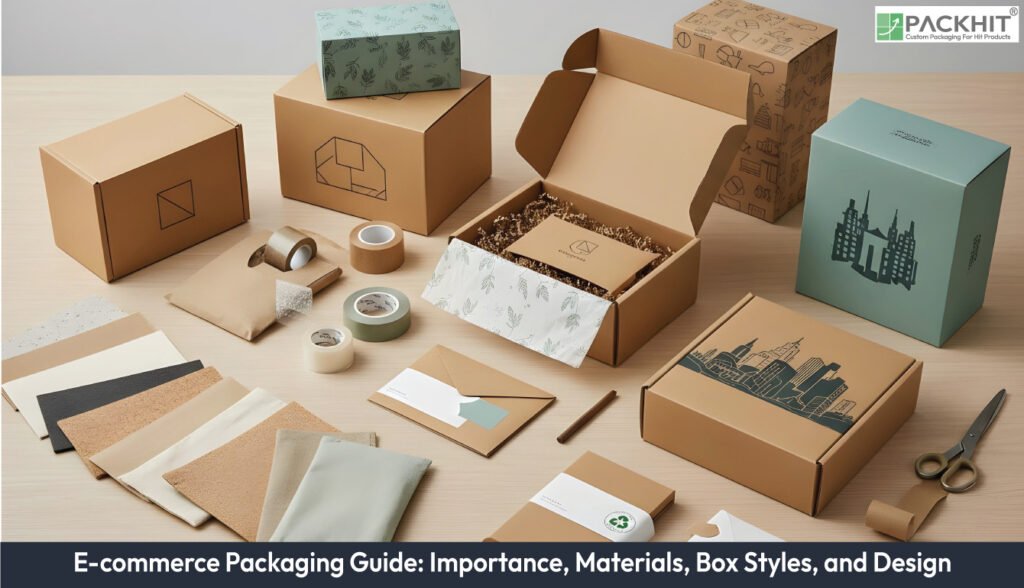
E-commerce packaging is the protective system of inner and outer layers that stabilises products in parcel transit, making it essential for reducing damage, cutting shipping costs, and shaping first impressions at delivery; it also acts as a marketing tool through branding, printed cues, tactile finishes, and digital touchpoints like QR codes. Materials such as corrugated board, paperboard cartons, polymer mailers, moulded pulp, foams, and reliable tapes define strength, weight, printability, and recyclability, while common box styles such as tuck-end cartons, mailer boxes, and rigid set-ups match different product and protection needs. Printing methods, including digital, flexography, offset, rotogravure and label-based systems, influence artwork clarity and cost, supporting both short-run personalisation and high-volume consistency. E-commerce packaging is designed through structured workflows that test durability, optimise dimensions, support clear labelling, enhance unboxing, and accommodate returns or reuse without compromising recyclability. Custom inserts and handwritten notes are added through tight-fitting cavity designs and simple writable cards that stay visible at opening, ensuring stability and a personalised customer experience.
- What is E-commerce packaging?
- Why is E-commerce Packaging Important?
- How Does E-commerce Packaging Improve Product Marketing?
- What Materials are Used for E-commerce Packaging?
- Corrugated Fibreboard
- Paperboard and Folding Cartons
- Polymer Films and Mailers
- Moulded Fibre and Pulp
- Foams and Engineered Cushions
- Closures, Adhesives and Tapes
- What are the Common Box Styles Used for E-commerce Packaging?
- Mailer Boxes (auto-bottom and crash-lock)
- Snap‑Lock Bottom Cartons
- Full Overlap Box (FOL)
- Straight Tuck‑End Boxes (STE)
- Reverse Tuck‑End Boxes (RTE)
- Rigid Set‑up Boxes
- Two‑piece Telescopes
- What Printing Methods are Suitable for E-commerce Packaging?
- How is E-commerce Packaging Designed for Consumers?
- Design workflow and measurable targets
- Structural and dimensional guidelines
- Unboxing and branding
- Returns and reuse
- How to Add Custom Inserts and Handwritten Notes in E-commerce Packaging?
What is E-commerce packaging?
E-commerce packaging is the protective set of outer and inner enclosures built to keep products stable in parcel transport and direct‑to‑consumer delivery. It groups primary product contact layers, secondary display layers, and shipping‑grade outer layers into one transport‑ready form. The structure controls product movement, absorbs impact and presents required information during carrier handling.
Why is E-commerce Packaging Important?
E-commerce packaging is important because it protects goods in transit, cuts avoidable shipping costs, and forms the first branded contact at the doorstep. Protection reduces breakage during carrier handling, and fewer damaged units reduce returns and replacement labour. Shipping cost falls when the box shape matches the product and avoids excess volume that triggers dimensional weight charges. The branded exterior and interior panels guide how consumers judge product quality and influence repeat ordering.
How Does E-commerce Packaging Improve Product Marketing?
E‑commerce packaging improves product marketing by placing branding, product cues and behavioural prompts directly in the customer’s hands at the moment of delivery. It shapes perception through colour systems, typography and printed panels that frame the product in a controlled reveal sequence. Surface treatments such as varnish, embossing or foil add tactile contrast, and inserts like QR codes, discount slips or instruction cards shift the parcel into a measurable digital touchpoint. Variable‑data printing personalises each unit without structural changes. These additions must stay compatible with protective strength and recycling limits because metallic layers or plastic laminates restrict fibre recovery and add sorting difficulty at the end of life.
What Materials are Used for E-commerce Packaging?
E‑commerce packaging materials control mechanical strength, surface print quality, shipment weight, and end‑of‑life sorting outcomes. Material choice shifts carton performance, unit cost, and carrier compliance because each substrate behaves differently in compression, impact and moisture exposure.
Corrugated Fibreboard
Corrugated fibreboard provides stacked‑load resistance through a bonded structure of linerboard and fluted medium. Single‑wall panels support light goods with ECT values around 32, while double‑wall formats raise compression performance for dense products that require ECT 44 or higher. Flute types such as A, B, C, E and F change both cushioning and print definition; larger flutes absorb impact better, if lower artwork precision is acceptable.
Paperboard and Folding Cartons
Paperboard and folding cartons supply a dense, smooth surface that holds high-resolution graphics on 200–400 g/m2 stock. This non‑fluted material suits consumer-display packaging and low-impact items. Transit risk rises with fragile items if cartons ship without a corrugated outer.
Polymer Films and Mailers
Polymer films and mailers reduce tare weight through LDPE, LLDPE or polypropylene layers. Film gauge, barrier build and seal strength change puncture resistance and tamper visibility. Single‑layer poly mailers support apparel; laminated bubble mailers stabilise lightweight electronics, if added cushioning is required. Film recovery depends on local recycling for mono-material streams.
Moulded Fibre and Pulp
Moulded fibre and pulp create formed cavities from recycled slurry that anchor products inside outer cartons. Pulp density and wall thickness shift impact absorption; thicker forms reduce shock transfer. Moisture softens fibre walls; if exposure occurs during transit, and dimensional tolerances stay broader than die‑cut inserts.
Foams and Engineered Cushions
Foams and engineered cushions hold fragile components by using EPE, polyurethane or EPS blocks with defined density and compression set. High‑density foam stabilises electronics and glassware with repeatable deformation limits. EPS and polyurethane blends release compounds during storage, if temperature varies, and end‑of‑life recycling remains limited in most regions.
Closures, Adhesives and Tapes
Closures, adhesives and tapes secure outer panels under vibration and impact. Acrylic pressure‑sensitive tape accelerates packing lines, while water‑activated gummed tape locks fibres across the seam and creates clearer tamper evidence. Tensile strength, backing thickness and peel force determine seal reliability during conveyor handling.
What are the Common Box Styles Used for E-commerce Packaging?
The common box styles used for e-commerce packaging are discussed below:
Mailer Boxes (auto-bottom and crash-lock)
Mailer boxes use one-piece corrugated panels with rapid setup joints and move consumer goods through fast pick lines. Auto-bottom locks reduce assembly steps. Crash-lock versions add stability if contents shift during transit.
Snap‑Lock Bottom Cartons
Snap‑lock bottom cartons use interlocking rear panels that lock after a short press and hold lightweight to mid‑weight consumer goods such as skincare bottles or nutrition jars. These bottoms keep shape when cartons pass through pick lines, if the fill pressure stays moderate.
Full Overlap Box (FOL)
Full Overlap Box uses fully overlapping flaps to increase panel thickness and supports dense goods that need stronger edge protection. FOL panels resist corner crush during conveyor transitions. Outer liners reduce abrasion if cartons contact rough surfaces.
Straight Tuck‑End Boxes (STE)
Straight tuck‑end boxes use folding‑carton panels with front and rear tucks that close along the same side of the carton. These panels hold lightweight retail items such as serums, sachets or compact electronics. Flat carton stock prints dense graphics because the surface stays uniform, and the clean front panel supports small text. Crease depth and calliper control tuck snap, if packers close large volumes at speed.
Reverse Tuck‑End Boxes (RTE)
Reverse tuck‑end boxes position the top and bottom tucks on opposite sides, so panel stress spreads more evenly during conveyor handling. This layout reduces accidental opening when cartons rotate in transit and suits subscription components such as sample tubes or accessory packs. RTE creases require precise scoring because the opposing tucks flex in different directions, and panel alignment affects how square the carton stays under stacked loads.
Rigid Set‑up Boxes
Rigid set‑up boxes use mounted board walls with fixed corners that hold shape under stacked loads. These boxes support jewellery, electronics or glass sets, and the fixed lid lifts without panel flex. Board density, paper wrap grain and corner reinforcement control lid tracking during transport, if cartons shift on conveyors.
Two‑piece Telescopes
Two‑piece telescopes use a base and lid that slide with controlled friction and secure shaped goods such as apparel kits or multi‑component tools. Clearance between the lid and base stays narrow to reduce rattle. Board stiffness and wrap tension influence lid glide and alignment if parcels face vibration or angled drops.
What Printing Methods are Suitable for E-commerce Packaging?
The printing methods used for e-commerce packaging include digital printing, flexography, offset lithography, rotogravure and label‑based marking systems. Each method alters artwork clarity, cost per unit and variable‑data capacity, and the behaviour changes across corrugated liners, paperboard sheets and polymer films.
The printing methods used for e-commerce packaging are given below:
Digital Printing
Digital printing transfers variable data through non-contact imaging and produces controlled colour output on corrugated liners, paperboard sheets, and polymer films. Digital printing delivers short-run flexibility for SKU groups under roughly 5,000 units and holds photorealistic artwork with tight dot gain control. Digital printing inserts names, QR identifiers, or batch codes without plate changes, if campaigns require rapid artwork updates.
Flexography
Flexography prints images through elastomeric plates that carry fast-drying inks across corrugated flutes, paperboard, and thin films. Flexography supports medium-to-large runs because plate costs are distributed across higher volumes and maintain consistent ink laydown for spot colours or line art. Flexography controls print repeat and ink viscosity to stabilise solids if substrates absorb ink at different rates.
Offset Lithography
Offset lithography uses planographic plates that transfer ink through a blanket cylinder and form even colour films on paperboard. The process keeps tight registration on folding cartons, holds small text under 6 pt, and prints detailed images at scale. Ink–water balance, blanket hardness and feeder alignment control dot spread and reduce banding on coated stock.
Rotogravure
Rotogravure prints by pulling liquid ink from engraved cells in a metal cylinder and lays down dense, uniform colour on polymer films. The method supports long runs above 100,000 impressions and holds repeatable density across wide webs. Cell depth, solvent blend and doctor‑blade angle shape edge definition, if film tension stays constant during printing.
How is E-commerce Packaging Designed for Consumers?
Design must satisfy protection criteria, logistic constraints and consumer-facing presentation simultaneously.
Design workflow and measurable targets
The design workflow moves through fixed steps that define product geometry and fragility, match those traits to a material group, build a prototype and confirm performance with transit tests. Each step holds the package to measurable values such as allowed damaged‑unit percentage, stacking height and maximum cubic volume that controls DIM weight. The workflow replaces long planning phases with short verification loops that test one change at a time.
Structural and dimensional guidelines
Structural choices control how the package holds shape, protects corners and presents flat panels for labels. Cushioned items sit on 10–25 mm of protective material, and flat label zones stay free of seams because parcel scanners read clean surfaces faster. Closure panels use overlaps that match automated case sealers. Inserts cut from corrugated or foam hold fragile parts within ±1–3 mm of clearance, so movement stays low in transit.
Unboxing and branding
The unboxing path moves from a protective shell to a brand panel and ends with a short message or insert that sits near the product. Coatings such as matte or gloss stay minimal when the package enters paper‑recycling streams. Foil or emboss steps sit away from label areas because pressure from adhesives distorts these finishes.
Returns and reuse
Return‑ready shapes rely on resealable closures or a return‑label pouch built into the outer wall. These features cut handling time when goods come back through the warehouse. Subscription shipments often use cartons that fold flat, so return volume falls, and material waste stays lower across repeated cycles.
How to Add Custom Inserts and Handwritten Notes in E-commerce Packaging?
To add custom inserts and handwritten notes in ecommerce packaging, use inserts that restrict product movement and place a short handwritten line on uncoated stock for clear marking.
Corrugated, foam or moulded-pulp cavities keep items stable, and a tight fit ranging between 1–3 mm prevents shifts in transit. Printed cards with a small writable area reduce packing time if order volume rises, and packers place both elements near the top layer so the note appears as the carton opens.