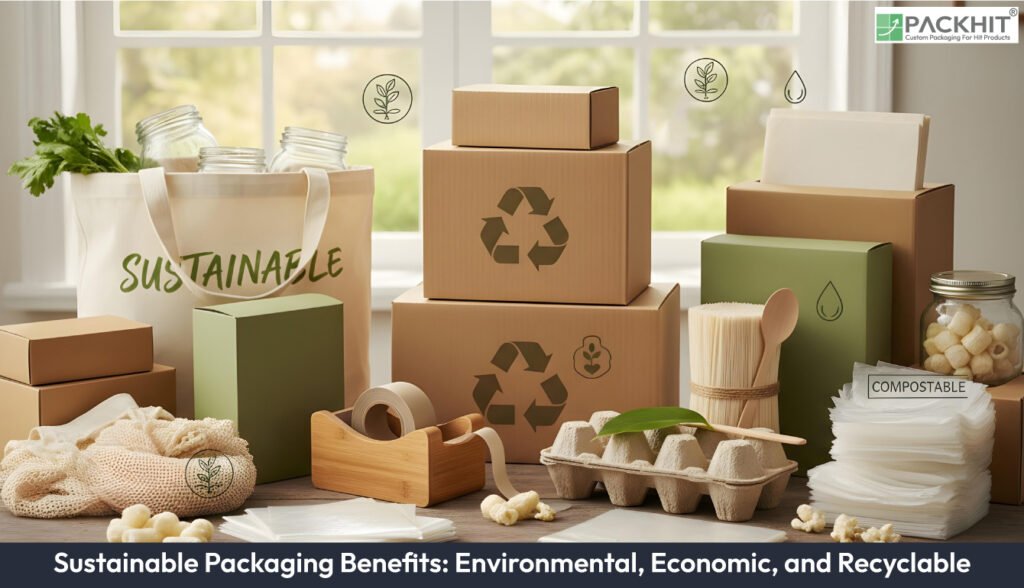
Sustainable packaging benefits span environmental, economic and recyclability gains, each driven by material choices, cleaner chemistry and pack formats that match UK waste systems. Environmental benefits of sustainable packaging include lower waste volumes, reduced CO2e and reduced chemical release. Economic benefits of sustainable packaging include lighter formats, financial incentives and stronger consumer response to low‑impact materials. Recyclable benefits of sustainable packaging include mono‑material construction, compatible inks and clear labels raise sorting accuracy.
- What are the Environmental Benefits of Sustainable Packaging?
- Reduced Packaging Waste
- Lower Lifecycle Carbon Emissions
- Reduced Chemical Toxicity
- Less Reliance on Fossil‑fuel Resources
- Improved Ecological Performance in Waste Streams
- Community and Environmental Health Gains
- What are the Economic Benefits of Sustainable Packaging?
- Material Reduction and Lower Procurement Cost
- Transport Savings from Lighter Formats
- Financial Incentives for Sustainable Practices
- Stronger Consumer Purchasing Behaviour
- Corporate Reputation and Investor Confidence
- Operational Gains from Supply Chain Efficiency
- How Does Sustainable Packaging Improve Recyclability and End‑of‑life Handling?
- Mono‑material Design Increases Recycling Accuracy
- Clear Disposal Labelling Guides Consumer Sorting
- Compatible Inks, Adhesives, and Additives Protect Material Value
- Lightweighting Reduces Residual Waste Volume
- Compostable Formats Support Organic Waste Streams
- Design that Reduces Chemical Load Improves Safe Processing
- Returnable and Reusable Systems Cut End‑of‑life Pressure
- Material Alignment with Local Infrastructure Raises True Recyclability
- How do Material Choices and Production Methods Improve Packaging Sustainability?
- How Sustainable Packaging Affects Consumers’ Perception of Your Brand?
What are the Environmental Benefits of Sustainable Packaging?
Environmental benefits of sustainable packaging reduce pollution, cut lifecycle emissions, and lower ecological toxicity across manufacturing, transport and disposal. These benefits matter for UK manufacturers because reduced waste volume, lower CO2e output and cleaner material chemistry align with regulatory pressure and consumer expectations.
Reduced Packaging Waste
Reduced packaging waste lowers landfill pressure through recyclable fibres, compostable biopolymers and lighter pack formats. Reduced packaging waste also decreases local authority disposal loads, which helps regions that face limited landfill capacity.
Lower Lifecycle Carbon Emissions
Lower lifecycle carbon emissions occur when recycled fibre, plant‑based polymers and lightweight designs cut extraction emissions, production energy use and transport mass. Lower lifecycle carbon emissions align with UK net‑zero frameworks that measure cradle‑to‑gate and end‑of‑life CO2e values.
Reduced Chemical Toxicity
Reduced chemical toxicity results from packaging materials that contain fewer hazardous additives, fewer volatile organic compounds and lower allergen presence. Reduced chemical toxicity supports public health goals because fewer harmful substances enter soil, waterways and air during disposal.
Less Reliance on Fossil‑fuel Resources
Less reliance on fossil‑fuel resources follows from renewable fibre, starch blends and plant‑based plastics that replace petroleum polymers. Less reliance on fossil‑fuel resources stabilises material supply because renewable feedstock sources respond better to global oil price fluctuations.
Improved Ecological Performance in Waste Streams
Improved ecological performance in waste streams occurs when mono‑material packaging increases recovery quality and lowers contamination. Improved ecological performance in waste streams strengthens recycling economics because processors obtain cleaner, higher‑value feedstock.
Community and Environmental Health Gains
Community and environmental health gains reflect reduced chemical exposure, better air quality and lower microplastic leakage. Community and environmental health gains also increase local support for brands that cut environmental loads, according to behaviour patterns observed in UK consumer groups.
What are the Economic Benefits of Sustainable Packaging?
Economic benefits of sustainable packaging arise from lower material use, reduced transport mass, improved consumer response and access to financial incentives that offset conversion costs. These benefits matter for UK manufacturers because cost pressure pairs with stricter environmental rules.
Material Reduction and Lower Procurement Cost
Material reduction and lower procurement cost occur when lightweight fibre packs, thinner films or redesigned formats decrease mass per unit. Material reduction and lower procurement cost cut spend on raw inputs and reduce storage volumes across production sites.
Transport Savings from Lighter Formats
Transport savings from lighter formats emerge when reduced pack weight lowers load mass and fuel use. Transport savings from lighter formats support freight planning because fewer tonnes move across UK distribution networks.
Financial Incentives for Sustainable Practices
Financial incentives for sustainable practices arise through grants, tax credits and targeted subsidies. Financial incentives for sustainable practices offset early equipment changes or trials that transition producers toward recyclable or compostable inputs.
Stronger Consumer Purchasing Behaviour
Stronger consumer purchasing behaviour follows from rising demand for low‑impact packaging; an example shows premium‑willing segments exceeding 80 per cent. Stronger consumer purchasing behaviour boosts revenue where recyclable designs or lower‑toxin materials create visible differentiation.
Corporate Reputation and Investor Confidence
Corporate reputation and investor confidence increase when verifiable sustainability actions reduce environmental risk. Corporate reputation and investor confidence shape market access because procurement teams prefer suppliers with traceable material footprints.
Operational Gains from Supply Chain Efficiency
Operational gains from supply chain efficiency occur when lighter bottles, trays or cartons move through filling, palletising and transport with lower breakage rates. Operational gains from supply chain efficiency appeared in a beverage example that cut container weight and lifted sales while improving throughput.
How Does Sustainable Packaging Improve Recyclability and End‑of‑life Handling?
Sustainable Packaging Improve Recyclability and End‑of‑life Handling by reducing material complexity, raising recovery quality, and aligning packaging formats with UK waste infrastructure so that more packs move through recycling, composting, or reuse without contamination.
Mono‑material Design Increases Recycling Accuracy
Mono‑material design increases recycling accuracy because single‑polymer films, fibre‑only cartons, or one‑resin bottles pass through automated sorting with fewer misreads. Mono‑material design removes incompatible layers that block reprocessing and raises feedstock quality for UK recycling plants.
Clear Disposal Labelling Guides Consumer Sorting
Clear disposal labelling guides consumer sorting by giving direct instructions on where the pack goes within kerbside systems. Clear disposal labelling cuts household sorting errors, if symbols match local authority guidance, and raises recovery rates for paper, plastics, and compostables.
Compatible Inks, Adhesives, and Additives Protect Material Value
Compatible inks, adhesives, and additives protect material value because low‑migration inks, water‑based adhesives, and low‑toxin additives reduce contamination during pulping or plastic reprocessing. Compatible inks, adhesives, and additives support public health goals cited in research that links reduced VOC release to fewer community‑level risks.
Lightweighting Reduces Residual Waste Volume
Lightweighting reduces residual waste volume because thinner films, lower‑mass bottles, and compact cartons cut the material fraction that enters landfill when recovery is not possible. Lightweighting also cuts transport mass, which connects recyclability gains with earlier economic benefits.
Compostable Formats Support Organic Waste Streams
Compostable formats support organic waste streams when starch‑based plastics, fibre moulded trays, or mycelium foams decompose in industrial composting. Compostable formats still rely on local infrastructure; compostable formats fail to deliver intended outcomes if regions lack collection routes.
Design that Reduces Chemical Load Improves Safe Processing
Design that reduces chemical load improves safe processing because low‑toxin polymers, reduced plasticisers, and fewer allergenic components lower exposure during sorting and reprocessing. Design that reduces chemical load aligns with health research that reports fewer hazardous emissions during breakdown.
Returnable and Reusable Systems Cut End‑of‑life Pressure
Returnable and reusable systems cut end‑of‑life pressure because refillable bottles or durable transit crates circulate through supply chains multiple times. Returnable and reusable systems lower demand for single‑use disposal routes and reduce waste‑handling requirements across UK logistics networks.
Material Alignment with Local Infrastructure Raises True Recyclability
Material alignment with local infrastructure raises true recyclability because fibre, PET, and HDPE match established UK capabilities. Material alignment with local infrastructure avoids false claims; material alignment with local infrastructure matters because packs that cannot be processed enter the landfill regardless of intent.
Below is a structured table that groups these outcomes so UK manufacturers can compare environmental, economic, recyclability and governance gains in one place.
| Benefit | Primary Outcome | Mechanism |
|---|---|---|
| Environmental | Lower waste volume and reduced CO2e | Renewable fibres, recycled polymers, lightweight formats, cleaner production |
| Economic | Lower cost per unit and freight savings | Reduced material mass, efficient pallets, returnable loops |
| Recyclability | Higher sorting accuracy and better recovery | Mono‑material design, compatible inks, water‑based adhesives |
The table summarises the benefits of sustainable packaging that appear when material selection, pack design and waste‑stream compatibility align with UK infrastructure and public expectations. Each cluster reflects factors already visible in consumer surveys, local authority guidance and commercial cases that document lighter packs, lower chemical load and clearer recyclability signals.
How do Material Choices and Production Methods Improve Packaging Sustainability?
Material choices and production methods improve packaging sustainability by cutting resource intensity and lowering chemical load in each unit. Recycled fibre, plant‑based polymers and low‑toxin additives reduce extraction impact and limit VOC release into waste streams. Cleaner production steps that use water‑based inks or reduced‑heat forming decrease energy demand across UK manufacturing. These changes support consumer preference for safer packs and align with incentives that reward verified low‑impact materials.
How Sustainable Packaging Affects Consumers’ Perception of Your Brand?
Sustainable packaging affects consumers’ perception of your brand because cleaner materials, reduced chemical load and visible recycling cues create a sense of responsible practice that many UK buyers recognise during purchase decisions. A 20% rise in satisfaction in a beverage example shows how recyclable formats shift sentiment when material changes are transparent. Lower‑toxin packs also reduce perceived health risk, if fibres or plant‑based polymers cut VOC release cited in public health studies. Community support strengthens when brands cut environmental pressure through traceable materials and reduced waste volume.