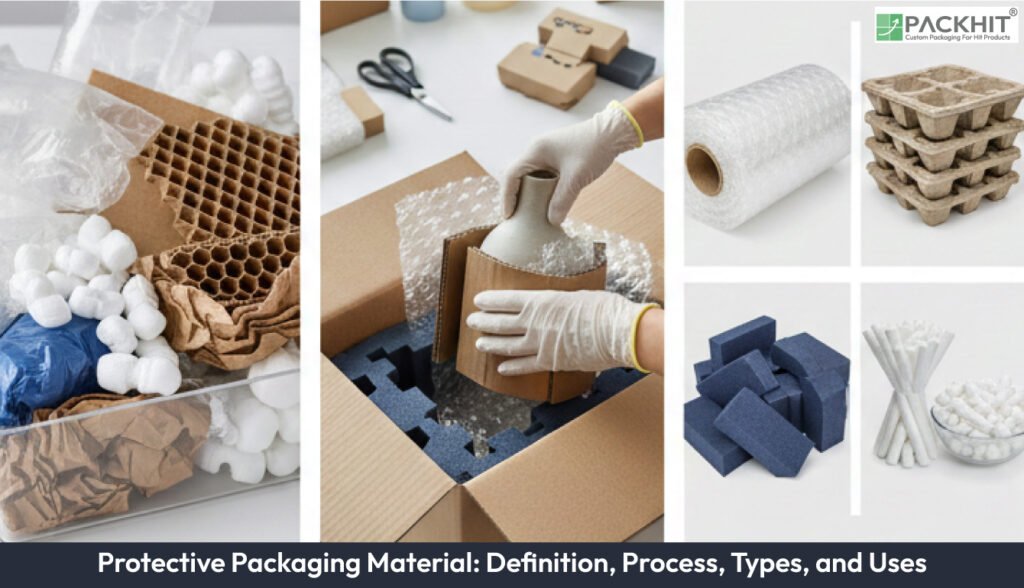
Protective packaging materials control impact, vibration, environmental exposure, and electrostatic risks to safeguard products across storage, transport, and retail stages. Functional categories include cushioning, structural containment, barrier systems, thermal insulation, and specialised protection. Material selection balances mechanical performance, barrier efficiency, and compatibility with production and logistics processes. Production employs techniques such as extrusion, foaming, corrugation, thermoforming, and pulp moulding, with performance confirmed through standardised tests. Applications range from fragile electronics to perishable foods, with packaging tailored to distribution hazards, handling conditions, and end-of-life considerations.
- What is Protective Packaging Material?
- How are Protective Packaging Materials Produced and Specified?
- Material Conversion and Forming Processes
- Board, Pulp, and Rigid Structure Manufacturing
- Density, Structure, and Performance Control
- Specified Product and Distribution Requirements
- Material Selection and Validation Testing
- Converting, Finishing, and Final Integration
- What are the Main Types of Protective Packaging Materials?
- Foam-Based Cushioning (Polyethene, Polyurethane, Expanded Polystyrene)
- Flexible Films and Bubble Systems (LDPE, LLDPE, Laminated Films)
- Inflatable and Air-Cushion Systems (Air Pillows, Tubular Cushions)
- Corrugated and Fibre-Based Structures (Single-Wall, Double-Wall, Honeycomb, Moulded Pulp)
- Rigid Supports and Semi-Rigid Trays (Thermoformed, Injection-Moulded)
- Functional Materials: Barrier Films, ESD Materials, Desiccants and Thermal Packs
- What are the Uses of Protective Packaging Materials?
- Transportation and Shipping Protection
- Storage and Warehousing Control
- Handling and Distribution Safety
- Retail and Point-of-Sale Protection
- Cold-Chain and Temperature Management
- Return and Reverse Logistics
- Electronics and ESD-Sensitive Products
- Automotive and Industrial Components
- Food and Perishable Goods
- Medical and Regulated Products
- What are the Benefits of Protective Packaging Materials?
- How Does Sustainability Impact Material Selection?
- Comparative Matrix of Protective Packaging Materials: Properties and Deployment
- How Should Protective Packaging be Selected and Validated?
- How is Protective Packaging Integrated into Supply-Chain Operations?
- What are Common Mistakes in Protective Packaging?
What is Protective Packaging Material?
Protective packaging material is a material or system designed to reduce product damage during handling, storage, and transport. Protective packaging material controls mechanical shock, vibration, compression, moisture, temperature change, and electrostatic discharge. Common protective packaging materials include foam, corrugated board, moulded pulp, barrier films, and insulated structures. Performance depends on measurable properties such as compressive strength, resilience, puncture resistance, water vapour transmission rate, and surface resistivity. Material selection aligns with product weight, fragility level, and distribution conditions.
Protective packaging material serves specific functional roles. Cushioning materials absorb impact energy and vibration during transit. Structural materials resist crushing and stacking loads in storage and shipping. Barrier materials block moisture, gas, or contamination exposure. Void fill and immobilisation materials restrict internal product movement. Thermal protection materials regulate temperature for sensitive goods. Electrostatic protection materials control static charge for electronic products. Final selection balances protection performance, cost efficiency, packing density, and end-of-life handling.
How are Protective Packaging Materials Produced and Specified?
Protective packaging materials are produced by converting polymers, fibres, and foams through extrusion, corrugation, moulding, or forming processes, and they are specified by matching measurable mechanical, barrier, and ESD (Electrostatic Discharge) properties to defined product fragility and distribution hazards.
Material Conversion and Forming Processes
Protective packaging materials are produced using established conversion technologies that shape base materials into functional forms. Polymer extrusion and film blowing melt thermoplastic pellets and form films or sheets, while blown-film processes create flexible films that can later be laminated or metallised to add barrier performance. Foam generation uses chemical or physical blowing agents to create open-cell or closed-cell structures, with densities typically ranging from about 15 to 200 kg/m³ depending on application needs.
Board, Pulp, and Rigid Structure Manufacturing
Corrugated board production forms flutes between linerboards, where flute profile and liner grammage, commonly around 125–300 g/m², determine compressive strength and cushioning behaviour. Moulded pulp manufacturing uses water-formed or dry-formed processes to create trays and inserts, especially where cushioning and recyclability are required. Thermoforming and vacuum forming shape heated polymer sheets into trays and supports, while injection moulding produces durable crates and custom rigid supports.
Density, Structure, and Performance Control
Production controls focus on density, geometry, and material structure to achieve predictable protection. Foam cell structure influences energy absorption and resilience. Flute geometry and liner weight govern stacking strength and load distribution. Sheet thickness and forming precision affect rigidity and fit within the package system.
Specified Product and Distribution Requirements
Protective packaging specification begins by quantifying product mass and centre of gravity. Distribution conditions are analysed to derive expected shock, vibration, and compression loads across the logistics cycle. Target deceleration limits or transmitted acceleration thresholds are then defined to match product fragility levels.
Material Selection and Validation Testing
Candidate materials are selected based on required cushioning, structural support, barrier performance, or electrostatic control. Validation uses standardised laboratory tests, including drop testing, vibration testing, compression testing, and climatic conditioning, to confirm that selected materials meet performance targets under expected environments.
Converting, Finishing, and Final Integration
Converting operations complete the production cycle and adapt materials for use. Die cutting defines dimensions, laminating enhances strength or barrier properties, heat sealing forms closures, and printing adds handling or branding information. Final dimensions and attachment features are set to ensure compatibility with packing operations and consistent protective performance.
What are the Main Types of Protective Packaging Materials?
Six principal families account for the majority of use cases: foam-based cushioning, flexible film systems, inflatable and air-filled devices, corrugated and fibre-based structures, rigid supports and trays, and functional additives and inserts such as desiccants and ESD media.
Foam-Based Cushioning (Polyethene, Polyurethane, Expanded Polystyrene)
Foam is a compressible polymer matrix that absorbs kinetic energy; typical variants include cross-linked polyethene foam, polyethene foam (EPE), polyurethane foam and expanded polystyrene (EPS). Key characteristics are density (examples: 18–65 kg/m3 for EPE), compressive stress at 25% strain, and resilience; closed-cell foams give moisture resistance, open-cell foams give breathability. Manufacturing routes include extrusion with physical foaming, bead expansion for EPS, and slabstock foam production for polyurethanes. Use cases: fragile electronics, precision instruments and cushioning inserts for retail packaging.
Flexible Films and Bubble Systems (LDPE, LLDPE, Laminated Films)
Flexible films such as LDPE (Low‑Density Polyethene), LLDPE (Linear Low‑Density Polyethene), and multilayer laminates provide surface protection, barrier and containment. Bubble film uses trapped air in discrete cells to provide low-cost cushioning; film thicknesses range from tens to several hundred micrometres. Laminated films and metallised layers add oxygen and moisture barriers for perishable goods. Converting steps include slitting, lamination and heat sealing to create pouches, wraps and cushions.
Inflatable and Air-Cushion Systems (Air Pillows, Tubular Cushions)
Inflatable packaging uses low-mass air-filled chambers (examples: single-chamber cushions, multi-chamber tubular systems) to achieve high compressibility and low weight; inflation is performed at the packing station with on-demand machines. Advantages include low storage volume before inflation and adjustable cushioning performance; limitations include puncture susceptibility and variable performance under repeated compression.
Corrugated and Fibre-Based Structures (Single-Wall, Double-Wall, Honeycomb, Moulded Pulp)
Corrugated fibreboard (examples: single-wall B-flute, C-flute, double-wall constructions) supplies stacking strength, edge protection and a moderate cushioning effect. Moulded pulp and honeycomb fibre structures provide shaped cradle support for irregular geometries and are common in food, electronics and consumer goods packaging. Fibre systems are often chosen where recyclability and cost are critical.
Rigid Supports and Semi-Rigid Trays (Thermoformed, Injection-Moulded)
Thermoformed trays and injection-moulded supports (examples: PET trays, ABS crates) stabilise products within secondary packaging and resist compressive loads. They are used for delicate assemblies, automotive components and repeatable returnable systems. Production is typically higher-cost per unit but yields a precise fit and reuse potential.
Functional Materials: Barrier Films, ESD Materials, Desiccants and Thermal Packs
Functional materials control specific hazards: barrier films and foils restrict moisture and gas ingress (examples: metallised polyester, aluminium foil laminates), ESD and conductive foams manage electrostatic charge (examples: carbon-loaded polyethene, dissipative films), desiccant sachets and oxygen scavengers limit moisture or oxygen exposure, and phase-change materials or insulated panels control temperature during transit. Selection requires matching permeability metrics and electrical properties to product sensitivity.
What are the Uses of Protective Packaging Materials?
Protective packaging materials prevent damage during transport, storage and handling by controlling shock, vibration, compression, moisture and temperature around goods.
Transportation and Shipping Protection
Protective packaging materials absorb shock and reduce vibration during road, air, and sea transport by using cushioning profiles, corrugated structures, or inflated chambers that keep transmitted acceleration within product fragility limits. Added corner blocks, surface wraps, and restraining inserts reduce shear and abrasion during cross‑dock handling.
Storage and Warehousing Control
Protective packaging materials limit moisture ingress, corrosion, and mould growth during short‑ and long‑term storage through barrier films, vapour corrosion inhibitors, and sealed corrugated containers. Desiccants and liners stabilise humidity in high‑cycle warehouses where seasonal moisture increases failure rates.
Handling and Distribution Safety
Protective packaging materials stabilise products during picking, packing, palletisation, and internal movement by restricting internal motion with void fill, trays, and dividers. Reinforced edges prevent abrasion on conveyors, and load‑spreading pads reduce point compression during stacking.
Retail and Point-of-Sale Protection
Protective packaging materials preserve surface finish, provide tamper‑evident cues, and maintain visual quality for in‑store displays through clear films, rigid inserts, and abrasion‑resistant coatings. Printed seals and tear‑strips give quick evidence of opening during shelf rotation.
Cold-Chain and Temperature Management
Protective packaging materials maintain defined temperature ranges for food and pharmaceuticals by combining insulated walls, reflective foils, and phase‑change packs that slow heat transfer across the distribution cycle. Internal dividers prevent cold spots from damaging sensitive units.
Return and Reverse Logistics
Protective packaging materials protect goods during returns, inspection, refurbishment, and redistribution cycles with reclosable outer packs, foam sets with repeated‑use density, and abrasion‑resistant inner trays. Stack‑rated corrugated cases prevent collapse during multi‑stage routing.
Electronics and ESD-Sensitive Products
Protective packaging materials control electrostatic discharge and mechanical shock for electronic components and devices through dissipative films, conductive foams, and shielding laminates. Groundable trays prevent charge build‑up during pick‑and‑place handling.
Automotive and Industrial Components
Protective packaging materials support heavy loads and complex geometries using crates, dunnage, and reinforced systems with defined compression values. Textile‑lined inserts reduce scuffing on coated or machined parts during inter‑facility transport.
Food and Perishable Goods
Protective packaging materials manage gas exchange and moisture to slow spoilage and extend shelf life, using controlled‑permeability films, MAP pouches, or micro‑vented fibre trays. Cushion pads prevent bruising of soft produce during bulk movement.
Medical and Regulated Products
Protective packaging materials provide sterile barriers, validated seals, and compliance support for healthcare and medical devices by using medical‑grade films, peelable lidding, and rigid thermoformed cavities that hold components steady for sterilisation and post‑sterile handling.
What are the Benefits of Protective Packaging Materials?
Protective packaging materials cut product damage, reduce return frequency, stabilise goods in transit and storage, and maintain surface condition by controlling shock, vibration, moisture and compression forces. Some key benefits include:
- Reduced Product Damage: Protective packaging materials lower breakage and deformation by absorbing shock, controlling vibration, and limiting environmental exposure during distribution.
- Lower Returns and Insurance Costs: Protective packaging materials reduce return rates and insurance claims by decreasing damage frequency and severity.
- Preserved Product Functionality and Appearance: Protective packaging materials maintain product integrity and surface finish, which protects usability and brand perception.
- Regulatory and Customer Compliance: Protective packaging materials support compliance with sector requirements such as food contact safety, medical validation, and ESD control.
- Improved Pack-Out and Shipping Efficiency: Protective packaging materials enable denser packing and better space utilisation, which reduces dimensional-weight charges and transport costs.
- Reliable Supply Chain: Protective packaging materials stabilise products during handling, storage, and reverse logistics, improving delivery consistency.
- Aligned Sustainability: Protective packaging materials support sustainability targets through recyclable, reusable, or material-efficient design choices.
- Cost Optimisation: Protective packaging materials allow optimisation between material cost and damage risk, avoiding losses linked to overpacking or underpacking.
How Does Sustainability Impact Material Selection?
End-of-life considerations and sustainability directly influence the selection of protective packaging materials. Fibre-based substrates such as corrugated board and moulded pulp offer recyclability and compostability if coatings or laminates do not hinder processing. Monomaterial polymer designs improve recycling efficiency, whereas multilayer laminates enhance barrier properties but complicate end-of-life handling unless chemical recovery is feasible. Strategies include reducing mixed-material laminations, incorporating recycled content, using reusable dunnage, and choosing certified compostable polymers where industrial composting exists. Life-cycle assessment evaluates environmental impacts such as greenhouse gas emissions, energy consumption, and waste generation to guide material choice.
Comparative Matrix of Protective Packaging Materials: Properties and Deployment
Protective packaging materials support deployment by matching cushioning, barrier, structural and ESD properties to product fragility so that goods remain intact through transport, storage and handling.
The table below summarises common materials, their principal protective role and practical considerations for deployment.
| Material Family | Principal Role | Advantages | Limitations | Typical Applications |
|---|---|---|---|---|
| Polyethene foam (EPE, cross-linked) | Cushioning and surface protection | Low weight, reusable, good resilience | Bulk volume, variable recyclability by type | Electronics foam inserts, appliance cushioning |
| Bubble film and LDPE film | Low-cost cushioning, void fill, surface protect | Low cost, easy to convert, and packs flat before use | Puncture risk, limited barrier unless laminated | Small parcel cushioning, wrapping finished goods |
| Corrugated board | Containment, stacking strength, light cushioning | Recyclable, established supply chain | Limited shock attenuation for heavy fragiles | Outer cases, partitioned inserts, mailers |
| Moulded pulp | Shaped cradle support, impact protection | Recyclable, compostable, good for irregular shapes | Moisture sensitivity unless treated | Egg trays, beverage carriers, protective trays |
| Inflatable cushions | Low-mass void fill and cushioning | Minimal pre-shipment volume, adjustable performance | Puncture susceptibility, single-use variants are common | Parcel void fill, product separation |
| Barrier laminates and metallised films | Moisture/oxygen barrier, shelf-life extension | Excellent barrier properties at low thickness | Recycling complexity, cost | Food pouches, pharmaceutical blister backing |
| ESD and conductive media | Electrostatic discharge protection | Protects sensitive electronics during handling | Must be grounded or used with protocols | Component bags, conductive foams, shielding trays |
How Should Protective Packaging be Selected and Validated?
Protective packaging is selected and validated by matching material properties to measured product fragility and transport hazards, then confirming performance through drop, vibration, compression and climatic tests. The selection and validation process is carried out as:
- Quantify product fragility and map the distribution environment.
- Determine product mass, centre of gravity, and fragility index to define protection requirements.
- Identify transport hazards such as drop height, vibration intensity, stacking load, and temperature or humidity extremes.
- Establish acceptable transmitted shock, deformation, or compression thresholds.
- Screen candidate materials based on mechanical and barrier properties against defined limits.
- Apply standardised tests that replicate handling and transport conditions.
- Conduct drop testing to measure impact resistance at specified heights.
- Perform vibration testing to evaluate fatigue and resonance risks during transport.
- Execute compression testing to confirm stacking strength under warehouse or pallet loads.
- Run puncture and abrasion tests to assess resistance to sharp edges and surface wear.
- Conduct climatic conditioning to verify stability under temperature and humidity extremes.
- Adjust cushion thickness, material density, insert geometry, and barrier layers according to test results.
- Iterate design until packaging meets damage-risk targets, regulatory standards, and cost constraints for the intended distribution cycle.
How is Protective Packaging Integrated into Supply-Chain Operations?
Protective packaging integrates into supply‑chain operations by matching fragility limits to route hazards, instrumenting pilot shipments to verify protection, and training packing‑line staff to apply materials with consistent placement, sealing and labelling.
- Specify packaging requirements, including product dimensions, mass, fragility limits, barrier or ESD properties, and intended service life.
- Produce a pilot batch and instrument shipments to record damage incidents and identify root causes.
- Train packing-line staff on correct placement, sealing, and labelling of protective materials.
- Conduct periodic audits to verify compliance and consistency of packing operations.
- Monitor operational metrics such as damage-per-million-units shipped, average package volume per unit, and recycling or reuse rates.
- Adjust material selection, convert to monomaterial constructions when recycling is needed, and implement reusable dunnage for frequent internal handling.
What are Common Mistakes in Protective Packaging?
Mistakes in protective packaging arise from mismatched cushioning, overlooked transport variability, incorrect material choices for recycling streams, excess bulk in foam or inserts, omitted ESD control for electronics and reliance on supplier data without verifying real‑route performance.
- Mismatched cushioning performance fails to protect fragile products. Mitigation involves mapping product fragility against expected handling and transport hazards.
- Ignoring distribution variability exposes products to unforeseen shocks. Mitigation uses pilot shipments and data collection to validate protection.
- Using materials incompatible with local recycling or composting streams complicates end-of-life handling. Mitigation specifies recyclable or compostable materials and avoids mixed-material laminations.
- High-bulk-density cushioning increases freight and transport costs. Mitigation optimises cushion thickness and geometry to balance protection and shipping efficiency.
- Omitting electrostatic protection for sensitive electronics risks damage. Mitigation adds ESD shielding or conductive packaging layers.
- Relying solely on supplier specifications can overlook real-world performance gaps. Mitigation adopts standardised drop, vibration, compression, and climatic tests to confirm effectiveness.