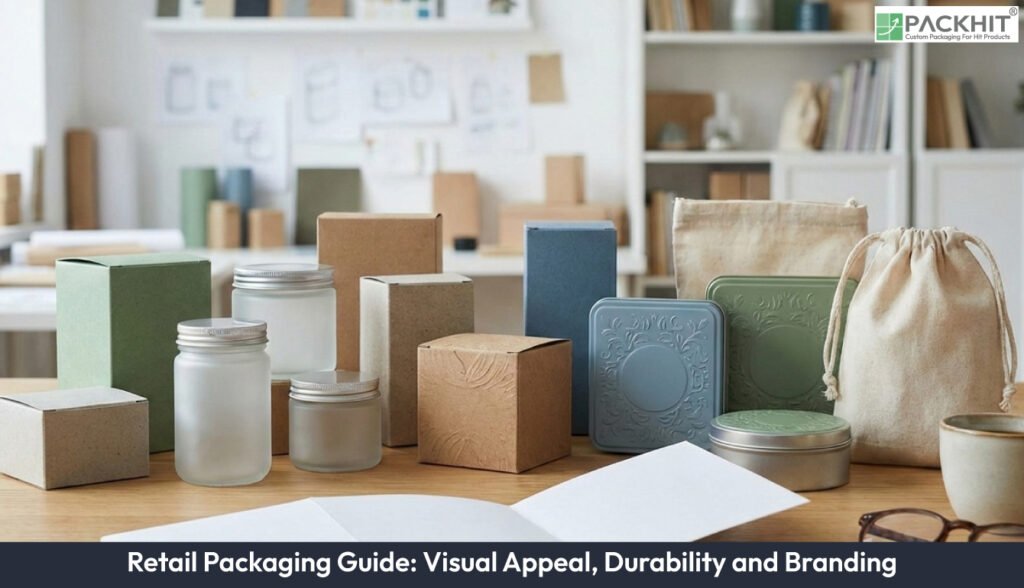
Retail packaging refers to the containers and wraps that protect products, communicate brand information, and support handling and display in retail environments. Retail packaging shapes shelf presence and visual impact through colour structure, typography, graphics, finishes, and structural stability that guide shopper attention. Retail packaging materials determine durability and protection by balancing resistance to impact, moisture, compression, and handling across board, film, plastic, glass, metal, and composite formats. Retail packaging influences branding by linking colour systems, typography, material choice, structure, and finish to brand recognition, perceived quality, and positioning. Retail packaging decisions balance branding, durability, and unit cost by aligning print coverage, substrate grade, and structural form with performance requirements and procurement targets.
- What is Retail Packaging?
- How Does Retail Packaging Change Shelf Presence and Influence Visual Impact?
- Colour Structure Changes Shelf Recognition
- Typography Layout Directs Product Identification
- Graphic Density Shapes Perceived Product Quality
- Structural Format Controls Facing Stability
- Finish Texture Alters Light Behaviour
- Information Hierarchy Sets Scan Order
- Which Retail Packaging Materials Determine Durability and Protection?
- Paperboard Grades
- Corrugated Fibreboard
- Rigid Paperboard
- Flexible Films
- Plastic Containers
- Glass Containers
- Metal Cans
- Composite Materials
- Recycled Substrates
- How Retail Packaging Influences Branding?
- Colour Systems Shape Brand Recall
- Typography Hierarchy Fixes Product Identity
- Graphic Style Signals Product Quality
- Structural Form Communicates Positioning
- Material Choice Frames Brand Values
- Finish Texture Alters Shelf Visibility
- Information Layout Guides Shopper Decisions
- How Brands Balance Branding, Durability, and Unit Cost in Retail Packaging?
What is Retail Packaging?
Retail packaging refers to the container or wrap that protects a product, presents brand details and supports handling in a retail setting. It covers three physical functions: containment that keeps units together during display, protection that reduces crush or puncture during stocking, and communication that carries printed identifiers such as barcodes, warnings and brand marks. Most formats use fibre‑based boards or flexible films because these substrates print dense graphics and maintain shape during transport. Retail packaging shapes shopper recognition on shelves if the print layout stays consistent across SKUs. Phone‑based support numbers. Brands in the UK specify retail packaging early in the production cycle so dimensional tolerances match automated filling and so packaging integrates without delays in procurement or pre‑press.
How Does Retail Packaging Change Shelf Presence and Influence Visual Impact?
Retail packaging changes shelf presence and influences visual impact through structural cues, print density and layout consistency that guide shopper attention in the first seconds of product scanning.
Colour Structure Changes Shelf Recognition
Colour structure sets the first recognition cue because colour blocks create contrast that draws shopper sightlines across adjacent products; colour decisions affect navigation speed in crowded shelves and support SKU grouping across ranges.
Typography Layout Directs Product Identification
Typography layout orders information because type scale, weight and spacing determine how quickly product name, variant and key attributes register; typography choices reduce search time in categories where shoppers scan 3 to 5 labels per second.
Graphic Density Shapes Perceived Product Quality
Graphic density frames perceived product quality because saturated artwork, controlled gradients and balanced white space guide how the pack reads from one metre away, a distance where print clarity and consistency influence purchase bias.
Structural Format Controls Facing Stability
Structural format controls facing stability because board stiffness, panel width and fold accuracy keep the pack upright during replenishment and reduce tilt, a condition that weakens visibility and suppresses shelf pick rate.
Finish Texture Alters Light Behaviour
Finish texture alters light behaviour because matte coatings diffuse overhead lighting and gloss coatings reflect highlight bands, an effect that changes the visibility of brand marks at variable angles during aisle movement.
Information Hierarchy Sets Scan Order
Information hierarchy sets scan order because fixed zones for product identifiers, claims and warnings keep the shopper’s eye on predictable paths; consistent hierarchy across SKUs improves range comprehension in categories with frequent variant comparison.
Which Retail Packaging Materials Determine Durability and Protection?
Retail packaging materials such as paperboard grades determine durability and protection because each substrate resists impact, moisture or compression in different ways, and each material grade changes how a pack survives stocking, transit and shopper handling.
Paperboard Grades
Paperboard grades provide structured containment because board density, fibre length and calliper control resistance to crush and scuff during shelf replenishment. Paperboard grades. For example, folding boxboard or solid bleached board, print clean graphics and maintain predictable fold accuracy for retail cartons.
Corrugated Fibreboard
Corrugated fibreboard supports mechanical protection because fluted mediums absorb impact loads during warehouse stacking. Corrugated fibreboard. For example, single‑wall or double‑wall formats, stabilise shippers and outer sleeves used around fragile consumer goods.
Rigid Paperboard
Rigid paperboard maintains a fixed geometry because thick board layers hold shape under compressive force. Rigid paperboard. For example, set‑up boxes or book‑style enclosures reduce deformation during transport and carry heavier items with controlled edge strength.
Flexible Films
Flexible films protect against moisture or oxygen because polymer layers create controlled barriers that slow transfer rates. Flexible films. For example, polyethene or laminated PET structures resist tearing during automated filling and reduce pack weight in high‑volume goods.
Plastic Containers
Plastic containers preserve shape integrity because moulded walls hold form under stress and reduce puncture risk. Plastic containers. For example, PET jars or HDPE bottles support repeated handling on retail shelves and maintain closure tightness during transit.
Glass Containers
Glass containers add chemical stability because inert surfaces isolate formulations that react to plasticisers. Glass containers. For example, a fa lint or amber bottle reduces permeation and protects sensitive liquids if breakage control is managed through dividers or corrugated outers.
Metal Cans
Metal cans resist dents and moisture because alloy walls block vapour and light. Metal cans, for example, aluminium beverage cans or steel tins, protect goods that require sealed environments during long distribution cycles.
Composite Materials
Composite materials combine mechanical traits because multi‑layer bonds distribute loads across different substrates. Composite materials. For example, paper‑foil‑polymer laminates maintain barrier strength for products that degrade with light or oxygen exposure.
Recycled Substrates
Recycled substrates support durability when fibre consistency and grade selection remain controlled. Recycled substrates. For example, post‑consumer recycled board or rPET maintain acceptable compression strength if the product demands moderate rather than high‑impact protection.
How Retail Packaging Influences Branding?
Retail packaging influences branding because printed identifiers, substrate selection and structural form shape how shoppers recognise products, compare variants and assign product quality during short shelf‑scanning windows.
Colour Systems Shape Brand Recall
Colour systems control brand recall because colour blocks guide shopper sightlines across crowded shelves; colour systems form predictable visual anchors that reduce search steps during product comparison.
Typography Hierarchy Fixes Product Identity
Typography hierarchy fixes product identity because scale, spacing and weight set a readable order; typography hierarchy shortens scanning time when shoppers view multiple variants within a few seconds.
Graphic Style Signals Product Quality
Graphic style signals product quality because artwork density, tonal balance and white‑space ratios define how cartons or pouches read at one‑metre distance; graphic style sets perceived clarity if printing holds tight registration.
Structural Form Communicates Positioning
Structural form communicates positioning because board thickness, panel geometry and closure type suggest robustness; structural form shapes tactile cues during shopper handling if folds stay accurate through logistics cycles.
Material Choice Frames Brand Values
Material choice frames brand values because fibre content, polymer grade or recycled proportion reflect durability and environmental claims; material choice links brand values with procurement targets if barrier strength remains adequate for product stability.
Finish Texture Alters Shelf Visibility
Finish texture alters shelf visibility because matte coatings diffuse overhead lighting and gloss coatings reflect highlight bands; finish texture changes how brand marks register at varied viewing angles during aisle movement.
Information Layout Guides Shopper Decisions
Information layout guides shopper decisions because fixed zones for claims, warnings and identifiers create a predictable scan path; information layout supports cross‑SKU consistency if print grids remain aligned across production cycles.
How Brands Balance Branding, Durability, and Unit Cost in Retail Packaging?
Brands balance branding, durability and unit cost in retail packaging by matching print coverage, substrate grade and structural form so the pack holds graphics, resists handling and stays within the target price band. Brands compare three variables because print density increases ink passes, board weight changes compression strength and freight cost shifts with pack volume. Brands select one compromise point that keeps artwork legible and material strength stable, if procurement data shows price pressure at scale. Brands verify this balance through short pilot runs that record damage frequency and pickup rates across two or three controlled variants.