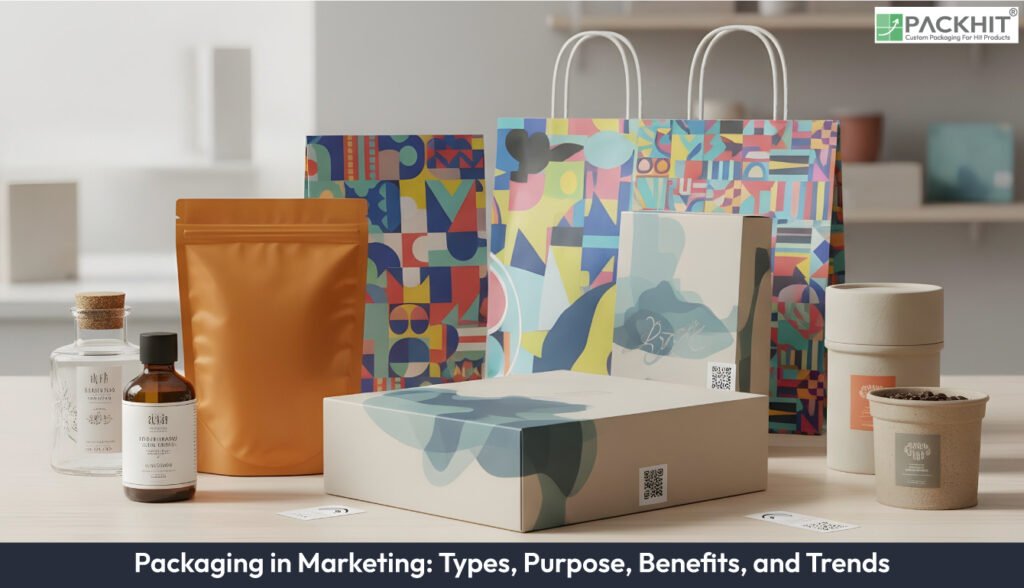
Packaging in marketing is a strategic tool that combines structure, graphics, and labels to protect products, communicate information, promote brand identity, and influence purchase decisions across retail and online contexts. Packaging types in marketing shape how buyers notice, compare, and trust products at each contact point. Promotional, retail, smart, frustration-free, and sustainable packaging each control visibility, information flow, and post-purchase perception, which directly affects selection speed, brand recall, and repeat buying. The purpose of packaging in marketing is to attract attention, reduce buyer uncertainty, enable comparison, and reinforce brand recall after purchase. Effective packaging delivers benefits such as higher recognition, faster sales conversion, cost control, and customer retention. Future packaging trends in marketing focus on digital linkage, material reduction, and post-purchase communication. QR codes, NFC tags, and refill formats turn packaging into an ongoing brand contact point.
What is Packaging in Marketing?
Packaging in marketing is the planned use of physical containers, graphics, and labels to identify a product, communicate key information, and influence buying decisions. It combines structure, visuals, and text to act as a constant brand signal at the point of contact. In retail categories with self-service displays, packaging often replaces direct sales communication.
Packaging also operates as a marketing control surface in online sales. Visual consistency with product listings, damage resistance, and opening clarity affect customer evaluation after delivery. These factors shape reviews, returns, and repeat purchasing without additional advertising input.
What are the Functions of Packaging in Marketing?
Packaging performs five primary marketing functions that operate in parallel rather than in sequence. The functions of packaging in marketing are mentioned below:
- Brand packaging: Brand packaging reinforces brand identity through consistent layout, colour logic, tone of copy, and pack structure, which links advertising, retail presence, and post-purchase recognition into a single visual system.
- Information transmission: Information transmission communicates product contents, pack quantity, usage steps, compliance text, and comparison signals, such as size variants, flavour options, or device compatibility, which reduce uncertainty at the shelf and on product pages.
- Promotion: Promotion shapes buyer judgement through visual order, surface finish, colour coding, and physical weight cues that signal value tier, quality expectation, or limited availability during comparison.
- Convenience: Convenience supports handling, opening, dispensing, resealing, and portion control, which affects storage behaviour, usage frequency, and repeat purchase across retail and e‑commerce channels.
Failure in any one function weakens the overall packaging marketing contribution, even if other elements perform adequately.
What are the Types of Packaging Used in Marketing?
The types of packaging used in marketing include promotional packaging, retail packaging, smart packaging, frustration-free packaging, and sustainable packaging, each designed to communicate, persuade, and support buyer decisions. These packaging types focus on visibility, message clarity, comparison speed, and post-purchase perception.
Promotional Packaging
Promotional packaging supports short-term sales and campaign visibility. It applies limited graphics, seasonal colour systems, co-branding, or bundled formats. Examples include holiday gift boxes, multi-pack offers, and event-specific sleeves. As a marketing tool, promotional packaging interrupts habitual buying patterns. Time-bound visuals signal urgency and reduce decision delay. Bundled units also reframe price perception by shifting focus from unit cost to total quantity.
Promotional packaging supports launch cycles and clearance strategies. Temporary designs allow brands to test messaging, flavours, or formats without changing core packaging assets, which limits operational risk while increasing shelf impact.
Retail Packaging
Retail packaging communicates product identity and decision cues at the point of sale. It uses front-panel hierarchy, colour contrast, typography scale, and structural form to support fast comparison on shelves or digital listings. Examples include cereal boxes, cosmetic cartons, and bottled beverages.
For marketing, retail packaging functions as a substitute for in-store sales assistance. Brand name placement, product category labels, and benefit claims guide selection within 3 to 7 seconds of visual contact. Consistent shelf-facing design improves recognition across retail chains and reduces buyer hesitation in self-service environments.
Retail packaging also supports price positioning; for example, matte finishes, rigid cartons, and restrained colour palettes signal higher price tiers, while high-contrast graphics and large numerals support value-driven categories, shaping the perceived quality before product handling.
Smart Packaging
Smart packaging uses embedded digital or mechanical elements to transmit data, authenticate products, or respond to user interaction. Common forms include QR codes, NFC tags, temperature indicators, and tamper sensors that connect the physical package to digital content or status signals.
In marketing, smart packaging functions as a direct communication layer after purchase, linking buyers to instructions, reordering pages, or verification tools. Scan-based access tracks engagement if customers interact with the package using mobile devices. Smart packaging also reduces counterfeiting and builds trust in regulated categories such as food, pharmaceuticals, and electronics.
Frustration Free Packaging
Frustration-free packaging reduces opening effort and post-purchase resistance. It removes excess layers, plastic ties, heat seals, and hard clamshells that slow access. Examples of frustration-free packaging include tear-strip cartons, pull-tab mailers, and single-layer corrugated boxes.
From a marketing perspective, frustration-free packaging protects brand perception after delivery because easier opening reduces negative reviews, return rates, and customer support requests. This effect is measurable in e-commerce categories where packaging is the first physical brand contact.
Clear opening cues and minimal internal components also support repeat purchases. Buyers associate simple access with operational competence, which improves trust in subscription products, electronics accessories, and household goods.
Sustainable Packaging
Sustainable packaging signals material responsibility and regulatory alignment. It uses recycled paperboard, mono-material plastics, reduced ink coverage, or refill formats. For marketing, sustainable packaging functions as a credibility signal rather than a visual feature alone. Material callouts, recycling icons, and certification text support brand claims during comparison. Clear disclosure reduces scepticism and supports informed choice.
Sustainable packaging also affects brand selection in regulated categories such as food, personal care, and supplements. Buyers often treat material transparency as a proxy for product integrity, especially when price differences are small.
What is the Purpose of Packaging in Marketing?
The main purpose of packaging in marketing is to attract attention, explain the product, and support buying decisions. The packaging shows the product name, use, and brand in a clear way. The design helps buyers compare items on a shelf or screen. The structure protects the product during handling and storage. Clear packaging reduces doubt and speeds up selection. Consistent packaging also supports brand recall after purchase.
How Does Packaging for Brand Identity Support Long‑Term Recognition?
Packaging for brand identity supports long‑term recognition by acting as a repeated marketing signal at every buyer touchpoint. Fixed colours, typography scale, logo position, and pack structure create visual memory through shelf exposure, product listings, and post‑purchase handling. In marketing, this consistency reduces reliance on paid media because the package itself performs brand recall during comparison and reuse. Over time, the pack becomes a lead‑in for trust, faster selection, and repeat buying without additional promotional input.
What are the Benefits of Effective Packaging in Marketing?
Effective packaging produces measurable commercial outcomes across several dimensions. The benefits of packaging in marketing are mentioned below:
- Brand recognition: a consistent package design, such as the same colours, logo placement, and box shape, helps buyers remember the product across stores and online listings.
- Sales conversion: clear product names, readable labels, and visible differences, such as size or flavour marks, help buyers choose faster at the shelf.
- Cost control: strong packaging structures, such as rigid boxes or sealed bottles, lower damage during shipping and handling, which reduces returns and wasted stock.
- Customer retention: easy opening, resealable packs, and clear usage instructions support repeat purchases after the first use.
These benefits build over time, as repeated exposure to the same packaging improves recognition, reduces confusion, and strengthens buyer confidence across multiple purchase cycles.
What are the Future Trends in Packaging for Marketing?
Future trends in packaging for marketing centre on using packaging as an active marketing surface rather than a passive container. Physical packs now link to digital content through QR codes and NFC tags that carry instructions, verification data, and reorder paths. Material reduction focuses on thinner structures and mono-material formats while keeping front-panel recognition intact. Refill systems, reuse formats, and short-run personalisation support repeat purchases and controlled brand exposure.