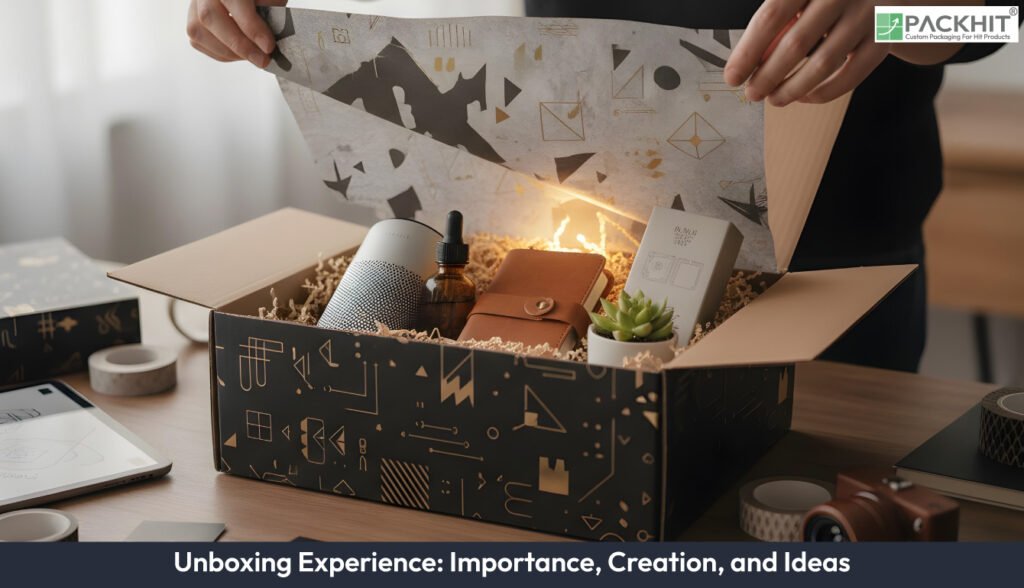
The unboxing experience shapes first judgment, emotional response, and brand recall through a controlled sequence of physical interactions. Packaging sets expectations, replaces in-store contact for e-commerce, and influences trust, repurchase intent, and perceived quality. Emotional response forms through sensory cues such as resistance, texture, sound, and reveal order, which either reinforce or conflict with pre-purchase expectations. Memorable unboxing depends on coordinated structure, material choice, visual hierarchy, message timing, and protection logic. Intentional design follows defined steps, from mapping the opening sequence and assigning structural roles to testing handling forces and controlling cost without breaking sequence clarity. Practical unboxing ideas rely on layered reveals, guided opening cues, contextual inserts, and interior–exterior contrast. Luxury unboxing differs through heavier materials, slower access, reduced messaging, and multi-stage reveals, which anchor value perception when packaging becomes the primary physical brand contact.
- Why Does the Unboxing Experience Matter for Brands?
- How Does Unboxing Create Emotional Connections With Customers?
- What Elements Shape a Memorable Unboxing Sequence?
- How is an Intentional Unboxing Experience Created?
- Step 1: Define the opening sequence
- Step 2: Assign structure to each reveal stage
- Step 3: Select materials based on touch and resistance
- Step 4: Place graphics according to timing
- Step 5: Add functional inserts with a single role
- Step 6: Prototype and test physical handling
- Step 7: Balance cost against sequence integrity
- What are Practical Unboxing Ideas for Product Packaging?
- How Does Luxury Unboxing Differ From Standard Packaging?
Why Does the Unboxing Experience Matter for Brands?
Unboxing directly affects how customers evaluate a product and the brand behind it. The opening sequence sets an initial judgment frame that shapes perceived quality, satisfaction, and willingness to repurchase. Physical interaction strengthens brand recall and increases repeat purchase. In e-commerce, unboxing often replaces all other physical brand touchpoints. For direct-to-consumer cosmetics and consumer electronics brands, packaging performs the role of in-store interaction by communicating care, competence, and value. Packaging structure, sequence, and presentation directly determine trust and brand credibility.
How Does Unboxing Create Emotional Connections With Customers?
Unboxing creates emotional connections through controlled sensory and cognitive cues. Texture, sound, resistance, and reveal sequence combine to produce anticipation followed by resolution. These responses occur subconsciously and are stored as overall brand impressions rather than isolated packaging details. Design elements such as personalised inserts, consistent visual language, and deliberate pacing support recognition and familiarity. Emotional reinforcement strengthens when the unboxing experience matches expectations formed through online images or product descriptions.
Mismatch weakens emotional connection. When packaging signals differ from pre-purchase expectations, cognitive dissonance occurs. This dissonance reduces satisfaction even when product performance meets functional requirements.
What Elements Shape a Memorable Unboxing Sequence?
A memorable unboxing sequence results from coordinated structural, visual, and tactile elements. Each component must support a single interpretive path rather than competing for attention.
- Structural order guides how layers are revealed; examples include lift-off lids, drawer mechanisms, or tear strips.
- Material selection affects tactile perception; examples include rigid board, soft-touch coatings, or textured paper stocks.
- Visual hierarchy directs attention through colour contrast and typography; examples include logo placement or internal accent panels.
- Message timing controls when brand or instructional text appears; examples include internal lid copy or final reveal cards.
- Protection logic balances restraint and exposure; examples include moulded inserts or layered tissue.
Failure in any single element disrupts the sequence. Overly complex packaging slows opening and increases frustration, while minimal packaging risks signalling disposability or low perceived value.
How is an Intentional Unboxing Experience Created?
An intentional unboxing experience is created through a defined sequence of design and testing steps that control how the package is opened, revealed, and understood. The process starts before visual design and ends after physical validation.
Step 1: Define the opening sequence
The opening sequence sets the order of access, from first contact to full product reveal. Entry point, reveal layers, and termination point are documented. This sequence replaces transport-led layouts with user-led logic.
Step 2: Assign structure to each reveal stage
Structural components are matched to sequence stages. Outer cartons manage protection and orientation. Inner trays, sleeves, or frames control pacing and exposure. Each structure serves one function, for example, protection, pause, or presentation.
Step 3: Select materials based on touch and resistance
Material selection follows structural intent. Board thickness defines the opening force. Coatings define surface friction. Paper stocks define sound and fold memory, for example, uncoated kraft or soft-touch laminated SBS.
Step 4: Place graphics according to timing
Graphics appear only at defined moments. External panels carry identification. Internal lids carry orientation cues. Final layers carry product or instruction text. Early exposure to dense information is avoided.
Step 5: Add functional inserts with a single role
Inserts are included only if they perform one task. Common roles include stabilisation, separation, or instruction. Multi-purpose inserts increase visual noise and slow opening.
Step 6: Prototype and test physical handling
Physical mock-ups are produced at scale-representative materials. Tests measure lift force, tear accuracy, and opening time. Friction points are removed through iteration, for example, excess adhesive or misaligned tabs.
Step 7: Balance cost against sequence integrity
Cost controls affect board grade, print coverage, and insert count. Sequence logic remains unchanged. Savings are applied to surfaces or finishes, not to reveal order or handling clarity.
What are Practical Unboxing Ideas for Product Packaging?
Effective ideas prioritise sequencing clarity and sensory consistency. Creativity functions within physical and cognitive limits rather than through novelty alone.
- Layered reveals separate protection from presentation by assigning distinct roles to outer and inner components; examples include shipping cartons that open into secondary rigid boxes or folded paper wraps that uncover the product after removal.
- Guided opening cues reduce uncertainty by signalling the correct entry point and motion; examples include fabric pull tabs, tear strips with controlled resistance, or printed arrows aligned with the opening force.
- Contextual inserts extend brand recall through functional information tied to product use; examples include care cards for textiles, origin notes for food items, or setup cards for electronics.
- Material contrast differentiates interior from exterior through tactile and visual change; examples include matte-coated outer boards paired with smooth uncoated liners or dark exteriors that open into light internal trays.
Ideas remain effective only when aligned with brand positioning and product category. Overstatement in low-involvement goods produces incongruity, while underinvestment in high-consideration products weakens perceived value.
How Does Luxury Unboxing Differ From Standard Packaging?
Luxury unboxing differs from standard packaging through material weight, opening resistance, message reduction, and sequencing control. These differences change how the product is assessed at first contact, particularly in e-commerce, where packaging replaces in-store evaluation.
The comparison below outlines structural and perceptual contrasts between luxury and standard packaging formats used in consumer goods.
| Packaging Attribute | Luxury Unboxing Characteristics | Standard Packaging Characteristics |
|---|---|---|
| Material density | High-grammage boards and rigid structures, such as 1200–1800 gsm greyboard | Lightweight folding cartons, such as 250–400 gsm SBS or kraft |
| Opening resistance | Measured friction and lift force that slows access and builds anticipation | Minimal resistance to prioritise speed and convenience |
| Message volume | Reduced external text, with branding limited to logos or symbols | High information density, including instructions, compliance text, and promotions |
| Reveal sequence | Multi-stage reveal using lids, drawers, or internal frames | Single-step opening with immediate product exposure |
| Interior treatment | Contrasting internal finishes, such as lined papers or coated inserts | Unfinished interiors or printed flaps with functional graphics |
| Role in brand perception | Signals price justification and brand legitimacy, especially in online channels | Signals product category and basic quality expectations |
In luxury e-commerce categories such as cosmetics, fashion accessories, and consumer electronics, packaging often represents the only physical brand contact. Structural weight, controlled pacing, and visual restraint anchor perceived value before the product is handled.