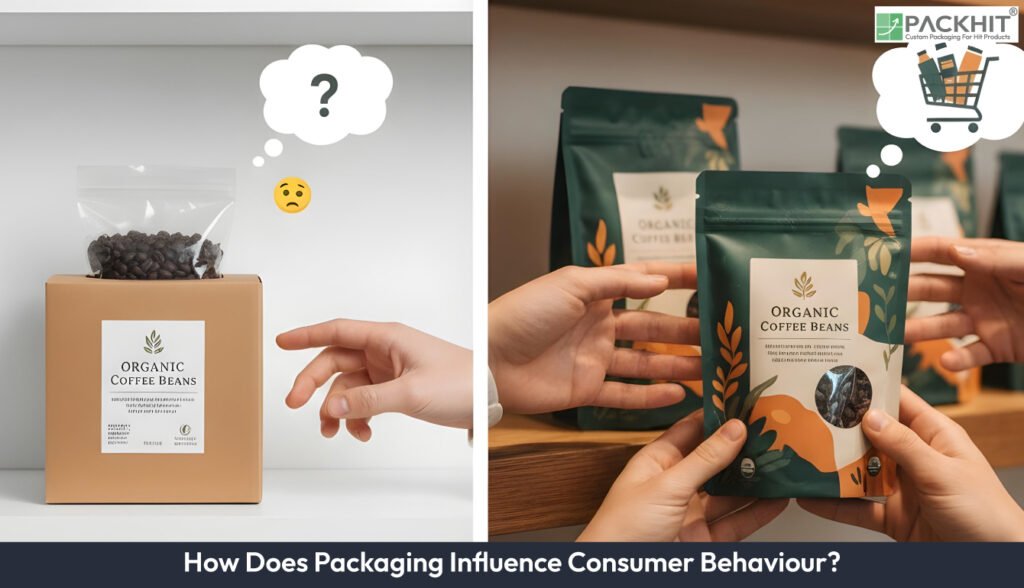
Packaging plays a critical role in guiding consumer choices by translating product, brand, and functional information into instantly interpretable visual and tactile cues. The design of packaging affects not only how buyers perceive quality and trustworthiness but also how they emotionally connect with a product and its brand. Beyond initial impressions, packaging communicates key information, supports usability, and differentiates products within competitive categories. The influence of packaging extends across retail shelves and e-commerce platforms, shaping decisions even before consumers engage in deliberate comparison. Packaging strategy integrates considerations of visual form, material selection, information clarity, and functional design to align consumer perception with brand objectives.
- What Role Does Packaging Play in Consumer Decision-Making?
- How do First Impressions and Shelf Visibility of Packaging Affect Buying Behaviour?
- How Does Packaging Trigger Emotional and Psychological Responses?
- Why is Packaging Important for Building Trust in Consumer Products?
- How Does Branded Packaging Shape Consumer Perception?
- Does Custom Packaging Influence Consumer Behaviour?
- Does Sustainable Packaging Affect Consumer Behaviour?
- Which Packaging Design Elements Affect Consumer Behaviour?
- How Does Packaging Influence Online Shopping Behaviour?
What Role Does Packaging Play in Consumer Decision-Making?
Packaging shapes consumer decision-making by controlling what buyers notice first, how they judge quality, and whether customers trust the product enough to choose it. In consumer behaviour research, purchase decisions emerge from processes of selection, interpretation, and response to available cues. Packaging condenses these cues into a bounded visual and tactile field, influencing what is noticed first and what is discounted.
On crowded shelves, packaging substitutes for direct product evaluation. Shape, colour contrast, and label hierarchy channel attention before price or specifications are read. Two functionally identical products can generate different purchase outcomes when one presents clearer signals of use, origin, or reliability. Consumers frequently rely on surface indicators, such as perceived neatness or consistency, when time or cognitive resources are limited. Packaging acts as a behavioural shortcut, reducing evaluation effort while steering preference formation.
How do First Impressions and Shelf Visibility of Packaging Affect Buying Behaviour?
First impressions influence buying behaviour within seconds of visual exposure. Shelf visibility depends on contrast, proportional balance, and visual separation from neighbouring products. Packaging that stands out without breaking category expectations gains longer visual attention.
Colour acts as an immediate classifier during shelf scanning. Muted colour palettes signal functional or utilitarian positioning, while high-saturation colours suggest novelty or indulgence. Typography reinforces these signals, with dense typefaces implying information depth and minimal layouts suggesting simplicity.
Physical packaging structure contributes alongside graphics. Taller or asymmetrical forms register more easily in peripheral vision, increasing pick-up likelihood. Structural and visual cues guide attention before conscious evaluation of price, value, or suitability occurs. A study in the International Journal of Retail & Distribution Management indicates that 73% of UK shoppers rely on packaging to aid purchasing decisions at the point of purchase.
How Does Packaging Trigger Emotional and Psychological Responses?
Packaging triggers emotional and psychological responses by linking visual and tactile cues to learned expectations. Texture, surface finish, and material weight influence judgments about care, effort, and reliability. Rigid structures with controlled closures communicate stability and control, while lightweight or flexible materials suggest convenience or disposability.
Emotional reactions form through repeated associations. Earth-toned materials and visible fibres activate sustainability expectations, while glossy finishes and metallic accents signal formality or technical precision. These responses occur before conscious reasoning and shape how product information is interpreted.
Emotional alignment between packaging and product function reduces cognitive friction. When visual and structural signals match product use, decision-making becomes faster and confidence increases. Misalignment between packaging cues and product purpose can slow choice and weaken perceived credibility.
Why is Packaging Important for Building Trust in Consumer Products?
Packaging is important for building trust in consumer products because it builds trust by signalling reliability, competence, and consistency. Consumers infer product quality from execution accuracy: alignment of print, clarity of instructions, and durability of materials. Errors or inconsistencies introduce doubt, even when product performance is unknown.
Information design reduces perceived risk by making verification easy. Clear step order, readable font sizes, and direct ingredient lists let buyers confirm use and safety in seconds. Dense labels raise mental load and suspicion because key facts become harder to check. Consistency across packs strengthens trust through recognition. Repeated layouts, colours, and label positions speed identification and transfer confidence from familiar products to new variants. The same effect applies online, where images replace touch and consistency aids quick judgment.
How Does Branded Packaging Shape Consumer Perception?
Branded packaging shapes consumer perception by stabilising recognition and expectation. Logos, colour systems, and structural motifs act as memory cues that enable rapid identification without conscious comparison. Reduced search effort increases confidence during selection and shortens decision time.
Brand perception depends on visual consistency. Excessive variation weakens recognition, while controlled differentiation supports category expansion. Packaging systems that retain core visual elements while adjusting secondary features balance familiarity with novelty.
Branded packaging also transfers reputation. Established visual systems carry accumulated trust from prior experiences. This trust can outweigh minor differences in price or product specification during fast purchase decisions, especially in high-choice retail environments.
Does Custom Packaging Influence Consumer Behaviour?
Custom packaging influences consumer behaviour by increasing perceived relevance and attention. Size, format, or message variations tailored to specific use contexts signal intentional design. Consumers interpret this as evidence of understanding, which increases engagement.
Personalised packaging elements such as limited-run graphics or context-specific labels interrupt habitual shelf scanning. This interruption extends visual processing time and increases the likelihood of evaluation instead of dismissal.
Effectiveness depends on clarity. Custom packaging that prioritises novelty without a functional explanation can confuse. Confusion reduces conversion even when attention increases.
Does Sustainable Packaging Affect Consumer Behaviour?
Sustainable packaging affects consumer behaviour by shifting risk assessment, brand trust, and category choice at the point of evaluation. Consumers associate recyclable and low-waste formats with responsible production, which alters quality perception and purchase confidence. Labelling clarity controls credibility. Explicit recycling symbols, material callouts, and disposal instructions reduce scepticism if claims match visible material properties. Vague sustainability language increases doubt and lowers conversion. Behavioural impact varies by category. In food, visible recyclability increases perceived safety. In household goods, refill systems increase repeat purchase likelihood. In personal care, reduced plastic weight influences brand switching during comparison. For UK consumers, sustainability has become a purchasing lens rather than an added feature, as 2022 Statista data indicated that nearly 8 out of 10 preferred environmentally friendly packaging options.
Which Packaging Design Elements Affect Consumer Behaviour?
Packaging design elements that affect consumer behaviour include colour systems for category recognition, typography for credibility assessment, material choice for quality inference, and structural usability for handling confidence, each shaping attention, emotion, and purchase choice during rapid evaluation.
- Colour systems influence classification and intended use, such as calming tones for wellness products or high-contrast colours for fast-moving goods.
- Typography structure shapes perceived complexity and credibility, with serif typefaces often associated with formality and authority.
- Material selection informs judgements about durability, quality, and environmental responsibility, including recycled board or rigid plastics.
- Structural usability affects handling confidence and convenience, such as resealable closures or ergonomic grips.
- Element interaction determines overall impact, as strong visual clarity can offset simpler construction, while poor typography can weaken trust even with high-quality materials.
How Does Packaging Influence Online Shopping Behaviour?
Packaging influences online shopping behaviour through imagery, proportion, and implied tactility. Without physical interaction, consumers rely on visual cues. High-resolution images, consistent angles, and scale references provide substitutes for touch and weight. Clear packaging visuals with legible labels improve comprehension and reduce uncertainty. Structural elements, such as visible closures or compartment outlines, help consumers mentally simulate product use. Online shopping compresses decision time. Packaging that conveys function and credibility in a single image performs better than designs that require close inspection or additional text. Strong visual communication enhances confidence and increases the likelihood of purchase.