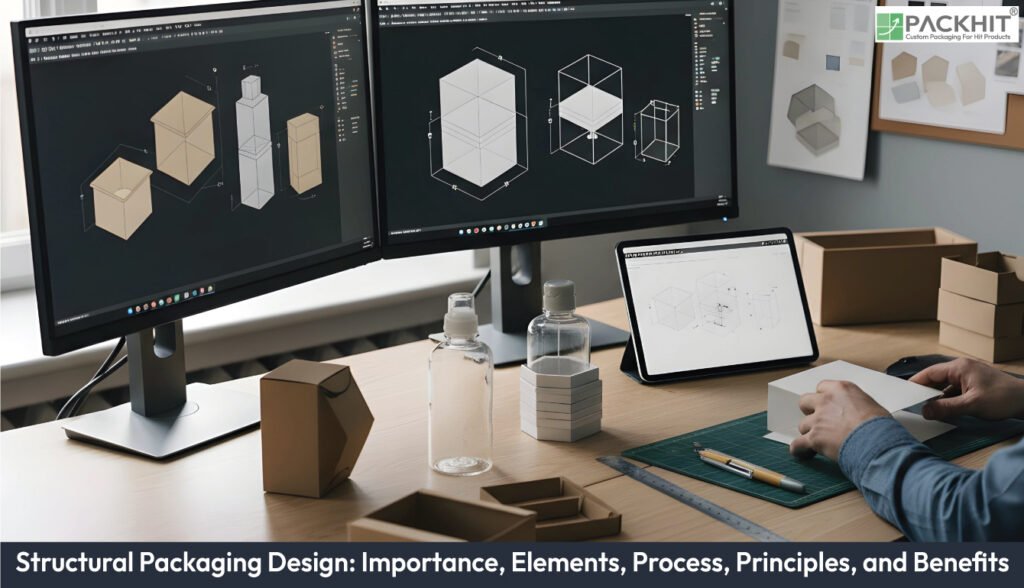
Structural packaging design defines the shape, strength, and construction of a package to ensure it protects the product, supports branding, and performs efficiently through manufacturing, shipping, and consumer use. The key elements of structural packaging design include the outer form, interior containment, closure systems, material specifications, dieline geometry, fit tolerances, and assembly methods. The key principles of structural packaging design are functionality, durability, usability, sustainability, cost efficiency, and innovation. The benefits of structural packaging design include stronger product protection, reduced material waste, faster assembly, improved shipping efficiency, and higher accuracy in prototyping and production. Structural design applies across retail, transit, e-commerce, and point-of-sale packaging, while avoiding common mistakes like improper panel sizing, weak creases, and poor material choices, ensuring reliable performance.
- What is Structural Packaging Design?
- Why is Structural Packaging Design Important?
- What are the Key Elements of Structural Packaging Design?
- Outer Form
- Interior Containment
- Closure Systems
- Material Specification
- Dieline Geometry
- Load and Fit Tolerances
- Assembly Method
- How to Create Structural Design in Packaging?
- 1.Design Conceptualisation
- 2. Dieline Creation
- 3. Material Selection
- 4. Prototype Development
- 5. Testing and Refinement
- 6. Design Finalisation
- What are the Key Principles of Structural Packaging Design?
- What are the Benefits of Structural Packaging Design?
- Product Protection
- Material Efficiency
- Production Accuracy
- Assembly Speed
- Shipping Efficiency
- Prototyping Accuracy
- What are the Uses of Structural Design in Packaging?
- What are the Common Mistakes in Structural Packaging Design?
- How to Ensure Smooth Structural Packaging Design?
- How Does Structural Design Influence Packaging Brand Identity?
What is Structural Packaging Design?
Structural Packaging Design is the discipline that defines the specifications of a package, including its geometry, containment strategy, and assembly method. It encompasses three key structural elements, including the outer form (such as boxes, sleeves, or trays), interior containment (including inserts, cavities, and cushioning), and closure or joining systems (like tabs, locks, or adhesives). The primary objectives of structural packaging design are to protect the product, reduce production costs, and optimise manufacturability. Typical uses include limited-edition retail packaging, transit packaging for fragile items, and point-of-sale displays.
Why is Structural Packaging Design Important?
Structural packaging design is important because it determines the functionality, protection, and usability of the product. A well-designed structure ensures the product is safe during transport, easy to handle, and convenient for the consumer to open and use. It also enhances shelf presence, supports branding, and can reduce material waste, making the packaging both practical and visually appealing.
What are the Key Elements of Structural Packaging Design?
The key elements of structural packaging design include:
- Outer Form
- Interior Containment
- Closure Systems
- Material Specification
- Dieline Geometry
- Load and Fit Tolerances
- Assembly Method
Outer Form
Outer form sets the container geometry through panels, depth ratios, and structural folds. Outer form shapes the principal load path and shelf footprint when designers choose cartons, sleeves, or trays for items such as cosmetics, electronics, or food units.
Interior Containment
Interior containment holds the product through inserts, cavities, or partitions. Interior containment restricts lateral movement in distribution if vibration or impact affects fragile goods such as glass bottles, jars, or moulded components.
Closure Systems
Closure systems secure the package with tabs, locks, adhesives, or tear features. Closure systems prevent accidental opening during transit and set consumer‑handling control for categories such as mailers, folding cartons, or retail sleeves.
Material Specification
Material specification defines board grade, flute type, and calliper. Material specification influences compression strength and moisture response for corrugated, paperboard, and speciality substrates used in food, electronics, or e‑commerce packaging.
Dieline Geometry
Dieline geometry regulates cuts, creases, and fold sequences. Dieline geometry gains accuracy in KASEMAKE because fixed reference points reduce drift across print runs for folding cartons, corrugated boxes, or rigid‑set components.
Load and Fit Tolerances
Load and fit tolerances determine internal clearance, stacking limits, and edge‑crush margins. Load and fit tolerances prevent panel bowing or product abrasion if distribution involves long‑haul trucks or multi‑carrier sorting.
Assembly Method
The assembly method defines the forming steps, glue zones, and operator sequence. Assembly method reduces labour variation in folding workflows for designs that rely on single‑motion locks, pre‑creased angles, or auto‑bottom formats.
How to Create Structural Design in Packaging?
To create a structural packaging design, follow the process below:
- Design Conceptualization
- Dieline Creation
- Material Selection
- Prototype Development
- Testing and Refinement
- Design Finalization
1.Design Conceptualisation
Design conceptualisation sets the package type by comparing product mass, fragility categories, and shipping paths. Design conceptualisation separates formats such as folding cartons, corrugated transit boxes, rigid sets, blister cards, and flexible pouches when geometry or load limits differ.
2. Dieline Creation
Dieline creation builds the flat layout with panels, flaps, cuts, and crease lines. Dieline creation benefits from KASEMAKE because the CAD engine fixes reference points, cut depths, and symmetry constraints that reduce production drift across print runs.
3. Material Selection
Material selection assigns paperboard grades, corrugated flute types, or speciality substrates. Material selection compares board callipers, stiffness ranges, moisture response, and printability when the product requires barrier control or stack resistance.
4. Prototype Development
Prototype development produces physical samples or 3D CAD mockups. Prototype development uses KASEMAKE sample outputs, because the cutting table matches crease behaviour and fold accuracy that later appears on full‑scale lines.
5. Testing and Refinement
Testing and refinement measure stack compression, drop impact, vibration shift, and closure performance. Testing and refinement adjust crease geometry, flute grade, or panel width, if failure points appear during load or transit checks.
6. Design Finalisation
Design finalisation prepares die‑cut files, print‑ready layouts, and production‑aligned crease maps. Design finalisation exports DXF formats for cutting tables and PDF/X files for litho or digital presses, and these exports match KASEMAKE geometry without dimensional drift.
What are the Key Principles of Structural Packaging Design?
The key principles of structural packaging design include:
- Functionality
- Durability
- Usability
- Sustainability
- Brand Identity
- Cost Efficiency
- Innovation
Functionality
Structural packaging must serve its primary purpose of protecting the product during storage, handling, and transportation. It should make the product easy to store, carry, and use, ensuring that consumers have a seamless experience from purchase to disposal.
Durability
Durability ensures that packaging withstands external pressures, such as stacking, drops, or environmental conditions, without compromising the product inside. Using the right materials and construction techniques helps maintain the package’s integrity throughout its lifecycle.
Usability
Usability focuses on the consumer experience, including how easily the package can be opened, closed, poured, or resealed. Intuitive design reduces frustration, improves satisfaction, and encourages repeat purchases.
Sustainability
Sustainability emphasises reducing environmental impact by using recyclable, biodegradable, or minimal materials. Efficient structural design can lower material usage, reduce waste, and align with eco-conscious consumer expectations.
Brand Identity
Structural packaging should reinforce the brand’s visual and tactile identity. Unique shapes, textures, and opening mechanisms can make the product recognisable on the shelf and strengthen the brand’s presence in a competitive market.
Cost Efficiency
Cost efficiency ensures the package is economical to produce, transport, and store. Optimising material usage, minimising production complexity, and designing for efficient shipping can reduce overall costs without sacrificing quality.
Innovation
Innovation in structural design allows for creative solutions that differentiate the product, improve functionality, or offer new experiences. This can include foldable, modular, or interactive designs that capture consumer attention and add value.
What are the Benefits of Structural Packaging Design?
The benefits of structural packaging design are given below:
- Product Protection
- Material Efficiency
- Production Accuracy
- Assembly Speed
- Shipping Efficiency
- Prototyping Accuracy
Product Protection
Product protection reduces damage rates by matching material strength, crease geometry, and load paths to the product mass and fragility. Product protection also limits vibration transfer during transport if distribution routes include long-haul or multi‑carrier freight.
Material Efficiency
Material efficiency reduces board weight through precise panel sizing, calibrated flute selection, and reduced glue‑area ratios. Material efficiency also lowers waste during die‑cutting because accurate CAD layouts generate tighter nesting patterns.
Production Accuracy
Production accuracy increases repeatability across print runs because die‑cut tolerances, score depths, and glue tabs follow validated CAD geometry. Production accuracy improves alignment control when KASEMAKE creates fixed reference points that reduce machine set‑up adjustments.
Assembly Speed
Assembly speed reduces labour time by simplifying fold sequences and minimising tool changes. Assembly speed also reduces production stalls if operators receive single‑motion locks or pre‑creased angles that remove guesswork during forming.
Shipping Efficiency
Shipping efficiency increases pallet density by using flat‑packed forms and calibrated depth-to-width ratios. Shipping efficiency also reduces void space in transit if outer cartons match inner product spacing without excess clearance.
Prototyping Accuracy
Prototyping accuracy shortens revision cycles because KASEMAKE outputs precise dielines that match production cutters. Prototyping accuracy improves decision timing when physical samples reflect the exact crease behaviour and load response expected in manufacturing.
What are the Uses of Structural Design in Packaging?
The uses of structural design in packaging are listed below:
- Retail packaging uses structural design to form boxes, sleeves, or rigid sets that fit product dimensions, control shelf alignment, and support barcode placement. It also uses exact dielines from KASEMAKE to maintain stacking stability.
- Transit packaging uses structural design to create corrugated forms that resist compression, edge crush, and vibration. It applies calibrated flute grades and load‑path geometry to reduce breakage in long‑haul distribution.
- Point‑of‑sale displays use structural design to form standees, dump bins, and counter units that hold weight and guide product reach. They use locked folds that assemble quickly in stores.
- E‑commerce packaging uses structural design to build tear strips, return flaps, and crush‑tested mailers. It uses precise board callipers taken from KASEMAKE layouts to stabilise goods during multi‑carrier handling.
What are the Common Mistakes in Structural Packaging Design?
Common mistakes in structural packaging design include:
- Incorrect panel sizing creates a loose fit or compression on product edges. For example, when internal clearances fail to match product tolerances.
- Weak crease geometry causes tearing or inconsistent folding, especially if score depths differ from cutter specifications.
- Over‑complex lock systems slow assembly and increase labour time. For example, when multi‑step tabs replace single‑motion locks.
- Poor material selection reduces load resistance if flute grades or board callipers mismatch shipping weight categories.
- Insufficient prototype testing hides stack‑crush or vibration issues if KASEMAKE samples skip compression or drop checks.
- Inaccurate dieline alignment disrupts print registration and glue‑tab fit when CAD reference points are not fixed before production.
- Excessive void space raises freight cost and damage rates. For example, when outer cartons exceed the required depth‑to‑width ratios.
- Ignoring machine constraints creates jams or misfeeds if folding sequences fail to match line speed or tool positions.
How to Ensure Smooth Structural Packaging Design?
To ensure smooth structural packaging design, testing is performed to confirm structural reliability through quantified load, impact, and environmental checks. KASEMAKE CAD supports this process by generating dimensionally accurate prototypes that reflect production geometry. Compression, drop, vibration, and climatic tests provide force, deformation, and shift data that indicate packaging stability under stacked shipping and warehouse conditions. Record compression force, drop height, labour time (seconds), and material weight (grams) during prototyping, especially when revisions depend on early proof of performance.
How Does Structural Design Influence Packaging Brand Identity?
Structural design influences packaging brand identity and sales because physical form, closure style, and material thickness signal product category and quality level in the first visual contact. Packaging design shapes how consumers recognise a brand, if a repeatable dieline creates a familiar profile across cartons, sleeves, or rigid sets. It also affects sales because easy‑open cuts, tear systems, or lock types reduce handling time and increase buyer preference during shelf comparison, and KASEMAKE die lines keep these features consistent in production.