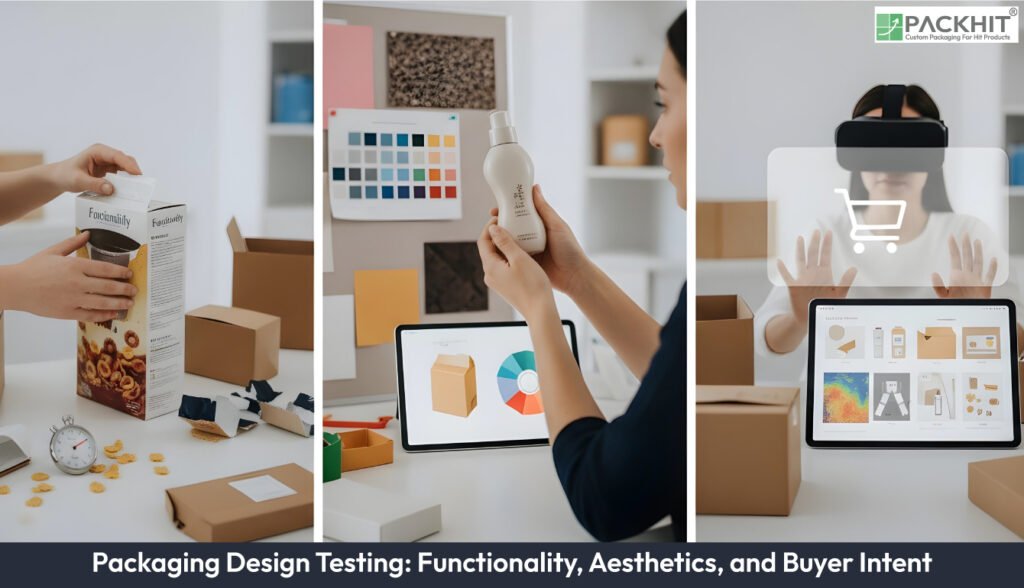
Packaging design testing evaluates whether packaging protects the product, communicates clearly, and attracts buyers by measuring functional strength, visual performance, and print accuracy. Packaging design testing factors include functionality, aesthetics, material behaviour, structural design, printing quality, and buyer intent, all of which shape protection and shopper response. Packaging design testing is integrated into packaging by linking mechanical results, colour accuracy, and consumer data directly into the final production specification. Packaging design testing re-evaluates performance metrics such as load strength, seal integrity, colour stability, print registration, barcode readability, and shelf visibility. Packaging design testing commonly fails when colour control, shopper distance, print drift, material interaction, or consumer tasks are misjudged. Packaging design testing is conducted properly by setting clear targets, using controlled shelf simulations, validating mechanical performance, and applying buyer-intent data to reduce launch risk and improve selection outcomes.
- What is Packaging Design Testing?
- What Factors are Involved in Packaging Design Testing?
- How is Packaging Design Testing Integrated in Packaging?
- Which Performance Metrics are Re-Evaluated in Packaging Design Testing?
- What are the Common Errors that Occurs During Packaging Design Testing?
- How to Conduct Packaging Design Testing Properly?
What is Packaging Design Testing?
Packaging design testing examines whether a pack protects the product, communicates the required information, and supports shopper selection in retail settings. It measures functional strength, visual performance, and print accuracy in controlled trials. Colour testing often receives priority because it shapes first‑glance recognition and influences up to 60–90% of initial product assessment. Results guide design changes that reduce launch risk and support higher sales across categories such as food, cosmetics, electronics, and clothing.
What Factors are Involved in Packaging Design Testing?
The factors that are involved in packaging design testing cover how each component shapes product protection, colour recognition, print clarity, and shopper response across food, beauty, home care, electronics, fashion, and speciality goods.
Functionality
Functionality covers load strength, seal control, and pack stability during storage or transport. Tests quantify compression limits, drop resistance, and barrier retention under humidity shifts or heat cycles. Opening force checks confirm consistency across batches, and reseal behaviour affects repeat‑use comfort for food, beauty, and home care items. Colour contrast marks, tear strips, and grip areas also fall under functional checks because they influence handling in production lines and quick consumer access.
Aesthetics
Aesthetics concerns visual order, colour accuracy, and shape recognition in crowded retail aisles. Tests measure colour drift using controlled lighting because colour drives 60–90% of first‑glance product assessment, according to retail research. Surface finish, gloss levels, and contrast ratios influence how fast a pack stands out against competitive sets. Aesthetic checks also include clutter evaluation, where excessive elements reduce scanning efficiency. Shelf‑simulation tasks show how far a UK shopper detects the pack at two or three metres.
Packaging Material
Packaging material governs strength, moisture behaviour, and ink absorption on press lines. Tests measure fibre composition and coating response because both affect crease formation and deformation under stacking. Material labs run humidity cycling to detect swelling that weakens board integrity for food, electronics, and fashion packs. Thickness choices depend on crush‑limit data gathered through compression rigs. Material porosity readings guide print‑density control during long production runs.
Packaging Design
Packaging design covers layout, claim hierarchy, and ergonomic form across cartons, pouches, and rigid formats. Tests track how fast a shopper finds brand name, variant, and regulatory cues when viewed from two or three metres. Eye‑tracking sometimes maps scanning order to reveal misplaced claims. Structural geometry checks confirm alignment with automated filling and sealing machinery used in UK factories. Design trials also flag crowded panels that slow comprehension in high‑turnover categories like food and beauty.
Packaging Printing
Packaging printing includes colour density, line integrity, and registration across CMYK layers. Tests compare calibrated proofs with press sheets to measure drift over long runs. Barcode readability checks ensure scanning accuracy after varnish or laminate steps, if protective films alter reflectivity. Fine‑line tests reveal plate wear that affects detail in cosmetics and electronics packaging. Print labs also log tolerance bands for large‑format cartons used in home care and garden products.
Packaging Buyer Intent
Packaging buyer intent reflects how fast a shopper selects a pack in a competitive fixture. Shelf‑simulation and click‑rate tasks quantify which colour, shape, or claim changes shift preference. Colour drives early attention, and statistics show up to 42% visibility lift when hue contrast improves. Buyer‑intent data helps manufacturers compare design variants for food, beauty, home care, electronics, fashion, and speciality goods. Controlled exposure tests highlight small copy changes that alter selection order within three seconds.
How is Packaging Design Testing Integrated in Packaging?
Packaging design testing is integrated in packaging when test data moves from individual checks into the finished pack specification across UK manufacturing lines. The integration process links functional proof, colour performance, and consumer‑response data to the packaging specification that enters production.
- Define objectives: State protection targets, visual accuracy thresholds, and buyer‑intent goals before any prototype build.
- Select representative formats: Match pack dimensions, board grades, and print processes with the final production route used for food, beauty, electronics, fashion, or home care examples.
- Run mechanical verification: Apply compression, drop, and humidity cycling to confirm load strength, seal integrity, and deformation limits across controlled conditions.
- Test colour accuracy: Compare calibrated proofs with print samples; verify hue stability under retail lighting because colour drives 60–90% of first‑glance assessment.
- Evaluate consumer response: Use shelf simulations, click‑rate tasks, and variant comparisons to measure attention shifts, including the 42% visibility lift linked with improved contrast.
- Analyse failure modes: Identify weak seals, colour drift, unreadable barcodes, or cluttered panels that slow scanning during two‑metre detection tests.
- Adjust design parameters: Revise claim hierarchy, structural geometry, or ink‑density settings, if test data shows slow recognition or unstable handling.
- Verify pilot production: Check print registration, barcode contrast, and crease performance on short runs to confirm alignment with factory tolerances.
- Approve final specification: Record confirmed materials, print densities, tolerances, and consumer‑response insights in the pack specification that enters full production.
Which Performance Metrics are Re-Evaluated in Packaging Design Testing?
The performance metrics are re‑evaluated in packaging design testing because each metric tracks how protection, colour behaviour, print clarity, and shopper selection shift when a pack moves from prototype to pilot runs.
- Load strength accuracy: Compression data, drop‑test readings, and deformation limits confirm whether fibre grade, coating choice, or crease layout protects food, beauty, electronics, or fashion items during storage or transit.
- Seal and barrier consistency: Seal width, burst strength, and humidity‑cycle readings track barrier retention, if moisture or heat cycles distort pack geometry.
- Colour stability under retail lighting: Hue drift, contrast accuracy, and luminance values are checked against proofs because colour drives 60–90% of first‑glance assessment and shapes the 42% visibility lift linked with corrected contrast.
- Print registration and line integrity: CMYK alignment, ink‑density variation, and fine‑line stability are re‑measured on repeated runs, if long print cycles shift plate pressure or coating absorption.
- Barcode readability: Scan accuracy, quiet‑zone clarity, and reflectivity are checked after varnish or laminate steps that alter surface gloss.
- Panel clarity and claim hierarchy: Reading time, clutter density, and claim‑order detection confirm whether shoppers identify brand, variant, and regulatory cues within a three‑second viewing window.
- Shelf‑visibility response: Detection distance, click preference, and attention maps assess colour contrast, shape cues, and typography, if competing packs block sight lines at two metres.
- Material‑print interaction: Porosity readings, ink holdout, and fibre compression data reveal how board or film materials change print density and crease behaviour.
- Buyer‑intent shift: Selection frequency, variant ranking, and substitution patterns reflect how small copy or colour changes alter buyer intent across food, beauty, home care, electronics, fashion, and speciality categories.
What are the Common Errors that Occurs During Packaging Design Testing?
The common errors that occur during packaging design testing relate to mistakes in colour control, functional verification, print analysis, and consumer‑response measurement across food, beauty, home care, electronics, fashion, and speciality goods.
- Colour‑contrast misjudgement: Test teams record hue data without controlled lighting, if retail environments shift luminance. This creates faulty visibility readings, despite colour driving 60–90% of first‑glance assessment and linking with a 42% visibility lift when corrected.
- Incorrect shopper‑distance assumptions: Trials use one‑metre viewing instead of two‑metre shelf simulation, if fixture layouts differ. This skews detection tests for UK food, beauty, and home‑care aisles where shoppers scan packs at two or three metres.
- Under‑tested print registration: Press checks skip long‑run drift verification if teams test only early sheets. Drift alters CMYK alignment and line clarity, which affects barcode readability after varnish or laminate steps.
- Material‑print interaction oversight: Material porosity and fibre compression results are collected without linking them to ink‑density performance, if sampling excludes humidity cycling. This error leads to inconsistent print density on food or electronics cartons.
- Weak functional replication: Drop and compression tests ignore heat or humidity cycles that distort geometry if mechanical rigs skip barrier checks. This reduces accuracy for fashion boxes, electronics trays, and moisture‑sensitive goods.
- Clutter‑density mismeasurement: Panels are reviewed without timing the three‑second reading window if teams rely on subjective checks. Misplaced claims slow scanning and distort buyer‑intent data.
- Uncontrolled consumer tasks: Buyer‑intent tests use mixed stimuli, if variant spacing, lighting, or device size shifts during digital click tests. This affects selection‑order readings that guide pack hierarchy decisions.
- Incorrect competitive set selection: Comparisons exclude key rival packs, and category mapping is rushed. Missing competitors degrade shelf‑visibility testing for fashion, beauty, or home‑care products.
- Inadequate sample sizes: Colour, print, or seal data is collected from limited units if pilot runs produce small batches. Small samples hide defect clusters found during full UK production cycles.
How to Conduct Packaging Design Testing Properly?
To conduct packaging design testing properly by setting clear performance targets for protection, colour accuracy, and shopper selection across food, beauty, home care, electronics, fashion, and speciality items. The process relies on controlled shelf simulations and mechanical checks because colour shapes up to 90% of first‑glance assessment. Test teams compare design variants to verify contrast, claim order, and barcode clarity, if print layers shift during long production runs. Final decisions use buyer‑intent data that shows visibility lifts of up to 42% when hue contrast improves.