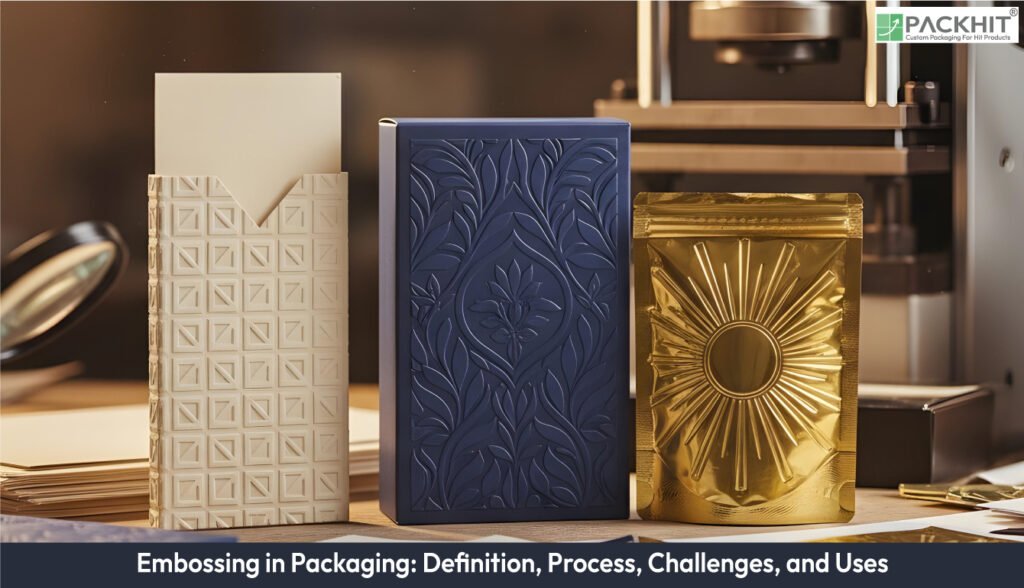
Embossing in packaging forms a raised, three‑dimensional surface on paperboard, paper or metal by pressing the material between matched dies under heat and pressure. Each press cycle pushes the substrate into the die shape, and the relief catches light and adds a firm tactile point. The sequence moves from vector artwork and clear die lines to metal die fabrication, controlled heat–pressure application and cooling that fixes the shape. Blind embossing omits print, registered embossing aligns the relief to printed ink, and combination embossing applies foil and forms the relief in one step. Formed features on metal tins follow the same principle because the tin body accepts deeper contours produced during manufacturing. Common production limits come from substrate response, tight print‑to‑die alignment, tooling wear, coating or lamination effects and restricted detail on micro‑elements. Embossing is used for brand marks, text hierarchy, surface texture and tactile cues, and it links with foil to create stronger light reflection. Thin or flexible substrates deform easily and hold less depth. Selection between blind, registered or combination embossing depends on alignment demands, finish treatment and run tolerances.
- What is Embossing in Packaging?
- What is the Process of Embossing in Packaging?
- 1. Design Preparation and File Requirements
- 2. Die Creation and Tooling
- 3. Heat and Pressure Application
- 4. Cooling and Setting
- 5. Combination and Registered Workflows
- What are the Challenges of Embossing in Packaging?
- Substrate Compatibility and Deformation
- Registration and Alignment
- Tooling Wear, Cost and Lead Time
- Interactions with Coatings, Varnishes and Lamination
- Detail Resolution and Minimum Feature Size
- Flexible Packaging Constraints
- What are the Uses of Embossing in Packaging?
What is Embossing in Packaging?
Embossing in packaging creates a raised surface by pressing paper, cardboard or metal substrates between a shaped die and a counter die under heat and pressure. The process forms a three‑dimensional relief that adds tactile contrast and controlled light reflection on logos or patterns. Metal tins employ a related formed-feature method that presses contours during manufacturing to create deeper relief. Blind embossing forms a raised shape without print or foil; registered embossing matches the raised shape to printed artwork; combination embossing applies foil and forms the relief in one pass. Metal tins use formed features that follow the same three variants.
What is the Process of Embossing in Packaging?
The embossing process follows a defined sequence which includes design preparation, die creation, application of heat and pressure, then cooling and setting. Each stage alters the design-to-production fidelity and sets constraints on achievable detail and repeatability.
1. Design Preparation and File Requirements
Design preparation establishes the raised areas and technical specifications. The design team supplies vector artwork, dedicated die lines, and registration marks on separate layers, allowing the die maker and press operator to reproduce the intended relief. Artwork should use closed vector shapes for relief zones, label which zones are intended for blind or registered embossing and indicate any areas intended to receive foiling when combination tooling is planned. Designers commonly flag problematic details such as very thin strokes or microtype, since embossing has lower resolution than print, and very fine features may not reproduce cleanly.
2. Die Creation and Tooling
Die creation converts artwork into physical tooling: a metal die to form the positive relief and a mating counter die that supports the substrate. The die maker reproduces contours and relief depth to match the design; tooling fidelity determines edge crispness and uniformity across repeats. Necessary tools are the embossing die, the counter die and any backup plates or mats; these components are mounted into a heated press for imprinting.
3. Heat and Pressure Application
Embossing dies, and the counter die compresses the substrate under controlled heat and pressure so the material plastically deforms into the die profile. The heated press imposes temperature and mechanical force appropriate to the substrate; pressure and dwell time govern material flow into the die cavities and thus the height and sharpness of the relief. For registered work, press set-up includes fine positional adjustments to align the die with pre-printed artwork; misalignment at this stage produces a visible offset between print and raised areas.
4. Cooling and Setting
Following imprinting, the embossed panel undergoes cooling and setting so the raised form stabilises and retains shape. Cooling may be passive (ambient air) or controlled, depending on substrate and process control requirements; insufficient setting produces springback where the substrate partially returns toward its original geometry, reducing perceived depth. Correct cooling preserves edge definition and reduces distortion during downstream converting.
5. Combination and Registered Workflows
When combining embossing with other finishes, the workflow must coordinate die geometry, thermal load and registration. Registered embossing requires tighter positional tolerances because the raised element must coincide with printed ink; combination embossing integrates foil application and embossing in one pass to reduce handling, but demands dies that accommodate both foil transfer and relief formation without damaging either finish.
What are the Challenges of Embossing in Packaging?
Embossing presents several practical constraints: substrate compatibility, registration control, tooling durability and interactions with coatings or laminations are the most frequent sources of production issues.
Substrate Compatibility and Deformation
Substrate behaviour varies by fibre content, calliper and surface treatment; for example, uncoated paper, coated paper and cardboard respond differently under heat and pressure. Problems that occur include fibre cracking, delamination of coated surfaces and insufficient retention of relief on thin or highly elastic films. Material selection and pre-press trials are necessary because the same die and press settings that work on one substrate can fail on another.
Registration and Alignment
Registered embossing imposes strict positional tolerances because even small deviations produce visible misalignment with print. Causes of registration error include stretch or shrinkage of the substrate during drying or conveying, thermal expansion of tooling, and mechanical slippage in the press. Mitigation requires stable fixture systems, visible registration marks and iterative press proofs before full runs.
Tooling Wear, Cost and Lead Time
Metal dies reproduce a design but are subject to wear; edge rounding or surface degradation reduces fidelity over time, increasing scrap or necessitating retooling. Tooling also introduces lead time into the supply chain because metal dies must be fabricated and fitted to presses before production. These constraints affect unit economics for short runs and rapid design iterations.
Interactions with Coatings, Varnishes and Lamination
Surface coatings and lamination may compress or obscure embossed relief. For example, liquid varnishes or certain lamination adhesives applied after embossing can fill or flatten raised areas; conversely, applying lamination before embossing can prevent the die from forming a stable relief. Coating type, cure state and lamination method, therefore, influence whether embossing is performed before or after those finishes.
Detail Resolution and Minimum Feature Size
Embossing reproduces broad shapes and moderate-detail elements more reliably than micro-detail. Very fine lines, small type and intricate halftone-like patterns often lose definition in the embossing process. Design teams must trade off visual complexity against embossing fidelity when specifying textures or typographic features.
Flexible Packaging Constraints
Flexible films and laminates present additional limits: films may not plastically hold deep relief, and flexible substrates can wrinkle or distort during embossing or converting. When embossing is required on flexible surfaces, process parameters and tooling geometry must be adjusted and production proofs conducted to confirm behaviour in subsequent packaging operations.
What are the Uses of Embossing in Packaging?
The uses of embossing in packaging are mentioned below:
Brand‑Focused
Embossing raises brand marks, product names and crests on cartons, labels, sleeves and metal tins so the relief catches angled light and creates recognisable tactile reference points. Formed metal surfaces on tin packaging use the same principle because the metal substrate holds deeper relief created during forming.
Text and Hierarchy
Embossing isolates typographic elements by lifting headlines, variant names or strength indicators above the background plane. Light breaks across the raised edges and improves readability if the substrate has adequate stiffness.
Pattern and Surface‑Texture
Embossing forms sculpted textures and repeated patterns on folding boxboard, coated papers or metal tins. The process shapes the surface to create depth zones that break monotony on flat panels and reinforce design themes.
Tactile‑Signal
Embossing introduces grip points or functional tactile markers on closures, pull tabs or access zones. The physical contour change helps users locate features by touch when packaging is handled in low‑light conditions.
Combined‑Finish
Embossing pairs with foil stamping or selective varnish in single‑pass or staged workflows. Combination dies apply foil and relief at the same location; the foil spans the peaks of the formed shape and produces metallic depth. Registered setups align embossing to printed artwork if press alignment holds within the required tolerance.
Embossing appears in higher‑value packaging where tactile contrast and perceived quality carry weight. Retailers and brand owners pick raised details for sharper light–shadow edges on logos or patterned fields. Related processes include foil stamping, debossing that forms recessed shapes, and textured coatings; choice depends on visual intent, registration accuracy and substrate behaviour, as metal tins often accept deeper formed relief created during tin manufacturing.
How to Choose Between Blind, Registered and Combination Embossing?
Use blind embossing when the raised area acts alone without print alignment. Use registered embossing when the raised area matches the printed artwork in the exact position. Use combination embossing when foil and relief sit in the same place in a single pass, if the tooling supports both steps. Metal tins use the same three types because formed features press shapes into the tin body during manufacturing.
Preparing specifications for production
Give production a clear specification set with vector relief shapes on a separate layer, registration marks, the selected embossing type and the substrate category, such as paperboard or metal. Add tooling notes that state die orientation and target pressure or temperature ranges. Run early press proofs to confirm how the substrate responds and to adjust the die or press settings before the main run. Formed features on metal tins follow the same rule, as the tin accepts deeper pressed contours during production.