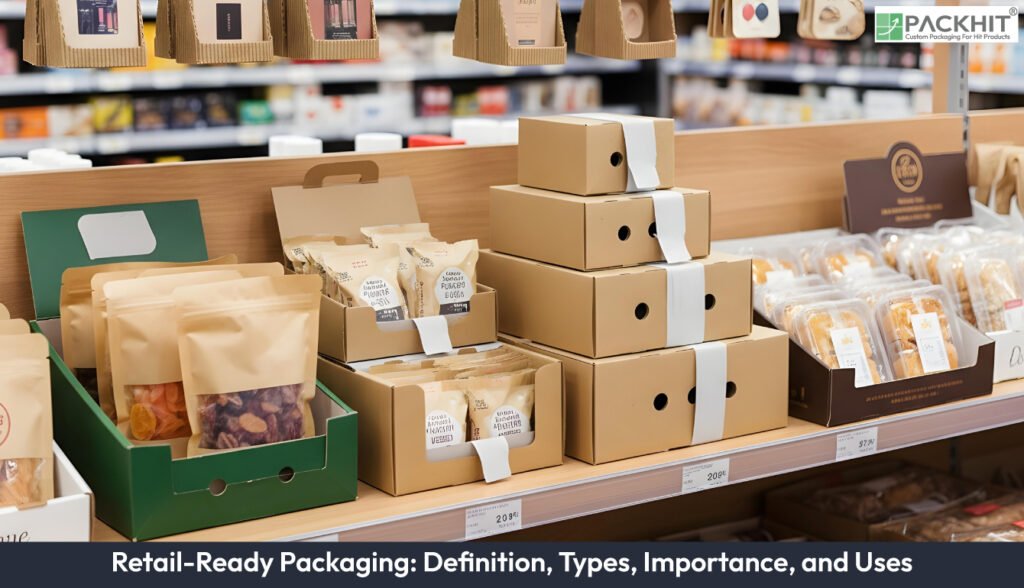
Retail-ready packaging refers to packaging formats engineered to move products from transport to shelf with minimal handling, no secondary unpacking, and immediate visual order. Retail-ready packaging comes in various formats and structures to suit different products, display needs, and retail environments, like pre-filled trays, freestanding merchandising units, and end caps. Retail-ready packaging enhances operational flow, reduces handling, and keeps shelves organised while maintaining brand visibility, for example, cosmetic cartons, electronics accessories, and household cleaning products. The applications are across multiple retail categories, helping products reach customers faster, stay consistently displayed, and support smooth restocking and merchandising processes, such as pharmaceutical units, snack multipacks, and promotional assortments.
- What is retail-ready packaging?
- How does retail-ready packaging work in retail stores?
- What are the main types of retail-ready packaging?
- 1. Pre-filled shelf trays
- 2. Reusable plastic trays
- 3. Freestanding merchandising units
- 4. End caps
- 5. Sidekicks
- 6. Stacking trays and bins
- Why is retail-ready packaging important to retailers and brands?
- Where is retail-ready packaging commonly used in retail stores?
- How does retail-ready packaging improve shelf efficiency and speed-to-market?
- What are the key design and visual requirements in retail-ready packaging?
What is retail-ready packaging?
Retail-ready packaging is packaging prepared for immediate placement on retail shelves without post-delivery modification. The design allows store staff to remove a shipping cover or tear along marked lines and place the package straight onto the shelf. The format connects shipping packaging with in-store display units and reduces handling time during restocking.
Retail-ready packaging is also called shelf-ready packaging and is shortened as RRP or SRP. Large retailers first adopted the format to speed up shelf replenishment. Over the past twenty years, retail-ready packaging has become a common requirement in retail packaging standards.
How does retail-ready packaging work in retail stores?
Retail-ready packaging combines shipping, storage, and shelf display into one single unit. Products arrive already arranged in trays or cartons that fit standard shelf sizes. Store staff remove outer panels, place the unit on the shelf, and start selling right away. In daily retail operations, retail-ready packaging is simple to identify during delivery, simple to open without tools, simple to restock as a complete unit, clear for customers to see and select products, and simple to remove or recycle after products are sold out. Retail-ready packaging reduces stocking mistakes, shortens restocking time, and keeps shelf presentation consistent across different store locations.
What are the main types of retail-ready packaging?
Retail-ready packaging appears in several structural formats, each aligned to product weight, shelf geometry, and merchandising intent. Corrugated constructions dominate due to load tolerance, pallet stability, and compatibility with retail recycling systems.
1. Pre-filled shelf trays
Pre-filled shelf trays use corrugated board to hold multiple retail units in a fixed arrangement that matches standard shelf depths. Pre-filled shelf trays include removable transit lids with perforations that expose the product front, barcodes, and price labels after opening.
2. Reusable plastic trays
Reusable plastic trays use rigid polymers to support repeated handling across multiple replenishment cycles. Reusable plastic trays appear in high-turn categories such as bottled drinks, dairy items, and fresh produce, where wash-and-return logistics operate.
3. Freestanding merchandising units
Freestanding merchandising units occupy floor space rather than shelving and ship preloaded from the manufacturer. Freestanding merchandising units support seasonal campaigns, limited-time promotions, and high-visibility product launches at store entrances or aisles.
4. End caps
End caps position retail-ready packaging at the end of store aisles where customer traffic peaks. End caps use reinforced corrugated structures to carry higher unit counts and present clear front-facing branding without in-store assembly.
5. Sidekicks
Sidekicks attach to shelving uprights or pegboard systems using hooks or clips. Sidekicks carry lightweight packaged goods such as snacks, toiletries, and accessories while keeping primary shelf space free for core ranges.
6. Stacking trays and bins
Stacking trays and bins use modular corrugated designs that allow vertical or horizontal stacking on the shelf. Stacking trays and bins supports variable stock volumes and simplifies replenishment by replacing full units rather than individual items.
Why is retail-ready packaging important to retailers and brands?
Retail-ready packaging matters because it cuts shelf-stocking labour, reduces handling errors, speeds product placement from delivery to shelf, and protects brand visibility at the point of purchase.
- Labour reduction: Retail-ready packaging cuts shelf-stocking time by placing products on shelves as complete units, examples include pre-filled trays and tear-open cartons, which reduce manual handling during daily replenishment.
- Shelf consistency: Standardised tray sizes and fixed product orientation keep shelves uniform across locations, examples include grocery aisles and convenience formats, which support planogram accuracy.
- Faster point-of-purchase availability: Products move from pallet to shelf without secondary unpacking, examples include multipacks and promotional lines, which shortens backroom dwell time.
- Lower in-store error rates: Fixed product counts and defined facing positions reduce misplaced items, examples include mixed-SKU cartons and seasonal assortments.
- Improved supply chain flow: Combined transport and display units reduce packaging transitions; examples include corrugated shelf trays that travel from factory to store without repacking.
- Clear brand recognition: Controlled colour contrast and visible front panels maintain brand identity at the shelf edge, examples include snack trays and personal care cartons, which support faster shopper recognition.
- Higher on-shelf availability: Full-unit replacement keeps shelves stocked during peak trading periods, examples include weekend grocery restocks and promotional changeovers.
- Simplified waste handling: Single-material corrugated formats exit through standard recycling streams, examples include brown board trays and perforated lids removed at the shelf.
Where is retail-ready packaging commonly used in retail stores?
Retail-ready packaging is widely used across multiple retail categories, such as grocery, personal care, and electronics, to improve shelf organisation and faster restocking.
- Grocery and food products: Snacks, beverages, dairy items, and packaged foods often arrive in shelf-ready trays for quick placement.
- Health and personal care: Cosmetics, toiletries, and over-the-counter products use display-ready cartons for better visibility and organised presentation.
- Household goods: Cleaning supplies, paper products, and small home essentials benefit from easy-to-open display cartons.
- Electronics accessories: Small items such as chargers, cables, and batteries use retail-ready trays to reduce handling.
- Pharmaceutical retail: Pharmacies use shelf-ready units to maintain clear labelling and consistent shelf layouts.
Retail-ready packaging supports faster shelf replenishment, improved product visibility, and standardised presentation across different retail environments.
How does retail-ready packaging improve shelf efficiency and speed-to-market?
Retail-ready packaging improves shelf efficiency and speed-to-market by allowing products to move directly from delivery to store shelves with minimal handling. Shelf-sized cartons or trays arrive pre-filled, so store staff place the full unit on the shelf without unpacking individual items. Faster shelf placement reduces labour time and shortens restocking cycles.
Speed-to-market increases because products reach selling positions immediately after delivery. Consistent pack layouts keep shelves organised, reduce placement errors, improve product visibility, and support quicker launches across multiple retail locations.
What are the key design and visual requirements in retail-ready packaging?
Effective retail-ready packaging relies on visual clarity rather than decorative density. Light text on dark backgrounds or dark text on light backgrounds increases legibility at a distance and under variable lighting. Clear contrast supports quick navigation by both staff and shoppers.
Colour use remains disciplined. Limited palettes protect brand recognition across crowded aisles. Key details, such as product name, variant, or price markers, remain immediately visible without searching. These principles mirror wayfinding practices used in physical retail environments.