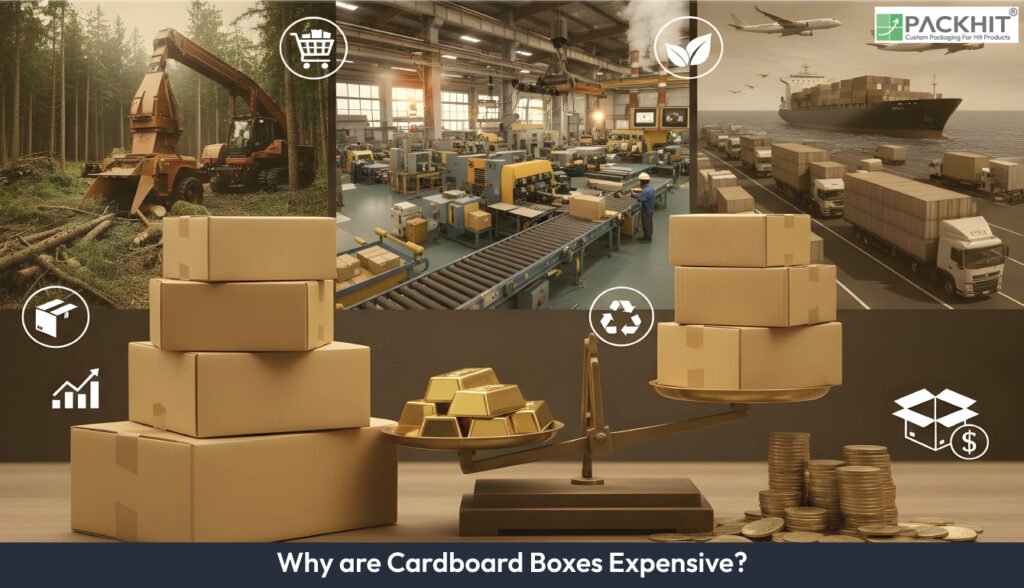
Cardboard boxes cost more because fibre demand stays high, paper grades vary by strength, board structures add material mass, and manufacturing relies on energy‑intensive equipment with fixed set‑up time. Virgin and recycled fibres compete in tight markets, where about 80% of parcels in the US and the EU use cardboard, pushing pulp prices upward. Thicker flute profiles, multi‑wall boards, adhesives, inks and tooling increase unit weight and processing time. Testing, compliance checks, waste, and volume‑based transport charges add further cost, which explains why specification choices, run length, and logistics decisions directly shape the final price of cardboard packaging.
- What Factors Make Cardboard Boxes Expensive?
- Raw Fibre Demand and Market Pressure
- Paper Grade and Fibre Quality
- Board Structure and Material Volume
- Manufacturing Equipment and Set‑Up Time
- Energy, Adhesives and Inks
- Printing, Finishing and Tooling
- Testing, Compliance and Waste
- Transport Volume and Storage
- How are Cardboard Boxes Manufactured?
- What are the Alternatives to Cardboard Boxes?
- How Do Specification Choices Change the Price of Cardboard Boxes?
- How can Purchasers Reduce Unit Box Cost Without Sacrificing Performance?
What Factors Make Cardboard Boxes Expensive?
Cardboard boxes cost more because high fibre demand, combined with paper grade selection, board thickness, energy‑intensive manufacturing, set‑up time, and volume‑based transport charges, increases material, processing, and logistics costs per box.
Raw Fibre Demand and Market Pressure
High fibre demand raises cardboard prices because around 80% of parcels in the US and the EU use cardboard, which keeps pulp and recycled fibre markets tight. This volume equals roughly 400 billion square feet of board each year. Mills compete for virgin kraft pulp and old corrugated containers. When collection rates drop or shipping peaks rise, fibre prices move upward and pass directly into box costs.
Paper Grade and Fibre Quality
Higher fibre grades increase cost because virgin kraft linerboard uses longer, stronger fibres and stricter controls than recycled paper. Linerboard and fluting medium vary by basis weight and strength class. Heavier liners add grams per square metre. Recycled fibre lowers price but introduces strength variation, which often requires thicker board to meet load targets.
Board Structure and Material Volume
Board design increases cost because thicker flute profiles and extra walls consume more paper. Single‑wall, double‑wall and triple‑wall boards use two, three or more liners. A‑, B‑, C‑ and E‑flutes change thickness and cushioning. Each added ply increases sheet weight, adhesive use and transport mass.
Manufacturing Equipment and Set‑Up Time
Capital‑intensive machinery raises unit cost because corrugators, die‑cutters and printers carry fixed operating time. Plate changes, die swaps and colour adjustments stop the line and create scrap. Short production runs spread these fixed minutes over fewer boxes, so the cost per unit rises.
Energy, Adhesives and Inks
Energy and consumables add cost because papermaking and corrugating rely on heat, electricity and chemical inputs. Drying paper consumes most mill energy. Corrugators add heat during flute forming and bonding. Starch adhesives, flexographic inks and coatings add material cost per square metre.
Printing, Finishing and Tooling
Finishing steps raise prices because each print colour, coating or die introduces fixed tooling and handling time. Simple flexo print runs faster. Litho‑lamination and digital print add stages or ink use. Rotary and flat dies cost the same regardless of order size, which affects small batches.
Testing, Compliance and Waste
Quality and compliance checks increase cost because testing, certification and scrap reduce usable output. ECT, BCT and burst tests remove samples from sale. FSC or PEFC documentation adds administrative work. Trim waste, misprints and warped sheets reduce yield, so material cost per finished box increases.
Transport Volume and Storage
Logistics increase cost because cardboard boxes occupy pallet space even when shipped flat. Freight pricing uses cubic metres. Larger footprints and higher board weights raise transport charges. Storage space for flat blanks also adds overhead for manufacturers and buyers.
How are Cardboard Boxes Manufactured?
Cardboard boxes are manufactured by converting virgin or recycled paper fibres into linerboard and fluting medium, bonding them into corrugated sheets with heat and starch adhesive, then printing, cutting, folding and testing the board into flat‑packed boxes.
- Fibre sourcing: Paper mills source virgin kraft pulp from softwood trees and recycled fibre from old corrugated containers, such as used shipping boxes and retail cartons. Fibre choice sets strength, cost and surface quality.
- Pulp preparation: Fibres are mixed with water, cleaned, screened and refined to control fibre length, bonding and consistency. Virgin pulp keeps longer fibres; recycled pulp loses strength with each reuse cycle.
- Papermaking: The pulp slurry spreads onto moving wire screens, drains, presses and dries to form linerboard and fluting medium. Drying uses high thermal energy and fixes most of the paper cost.
- Corrugating: The fluting medium is heated, shaped into waves and bonded between linerboards using starch adhesive. Single‑wall, double‑wall or triple‑wall board forms at this stage.
- Board conditioning: Fresh board rests to balance moisture and temperature. Stable moisture prevents warp and maintains compression strength.
- Printing: Graphics applied by inline flexographic units, litho‑laminated sheets or digital inkjet systems. Each method changes set‑up time, ink use and run speed.
- Die‑cutting and slotting: Rotary or flat dies cut panels, flaps and hand holes to fixed dimensions. Tooling cost stays constant, even for short runs.
- Folding and gluing: Folder‑gluers crease panels and apply adhesive to form finished box shapes. Accuracy here controls stackability and closure strength.
- Quality testing: Samples undergo ECT, BCT and burst tests to confirm load performance. Failed batches create scrap and raise effective unit cost.
- Packing and distribution: Boxes ship flat on pallets to reduce volume. Despite flat packing, cardboard dominates packaging flows because around 80% of parcels in the US and the EU use cardboard.
What are the Alternatives to Cardboard Boxes?
Alternatives to cardboard boxes include corrugated bubble wrap for surface protection, biodegradable peanuts for void fill, cornstarch and seaweed formats for compostable single-use packs, mycelium composites for rigid inserts, moulded pulp for shaped fibre support, recycled board for short-cycle shipping, and reusable plastic crates for closed-loop transport. Each material adds different strengths, such as crush resistance, impact control or compostability, and manufacturers compare these attributes against cardboard boxes, if logistics flow, product mass, or disposal rules shape the pack decision.
How Should a Buyer Compare Alternatives?
Compare alternatives by measuring total pack cost per shipment against load strength, moisture resistance, reuse cycles and disposal compliance, then select the material that meets product protection targets at the lowest combined material, process and freight cost.
How Do Specification Choices Change the Price of Cardboard Boxes?
Specification changes raise price because each upgrade adds material mass, extra processing and reduced line speed.
Double‑wall board uses two media and three liners, so mass increases and drying sections run longer. A water barrier or a food‑grade inner liner adds lamination and extra checks. Full‑colour pre‑print adds plate stages; digital print removes plates but increases ink use on large runs. Mass per box depends on g/m² and surface area, and this figure helps buyers compare options with run length and finishing steps. Cardboard demand stays intense because around 80% of parcels in the US and EU use it, and that pressure keeps specification choices sensitive to fibre cost.
How can Purchasers Reduce Unit Box Cost Without Sacrificing Performance?
Buyers reduce unit box cost by fixing panel sizes, extending run length, limiting colour sets, matching flute and basis weight to load, and using single‑supplier batches for volume pricing.
Fixed dimensions can cut die swaps and print resets. Longer runs spread the set‑up time. Two‑colour or inline flexo reduces pre‑press cost. Right‑sizing cuts fibre mass and freight load. Consolidated orders stabilise pricing, if fibre markets tighten, because around 80% of parcels in the US and the EU use cardboard.