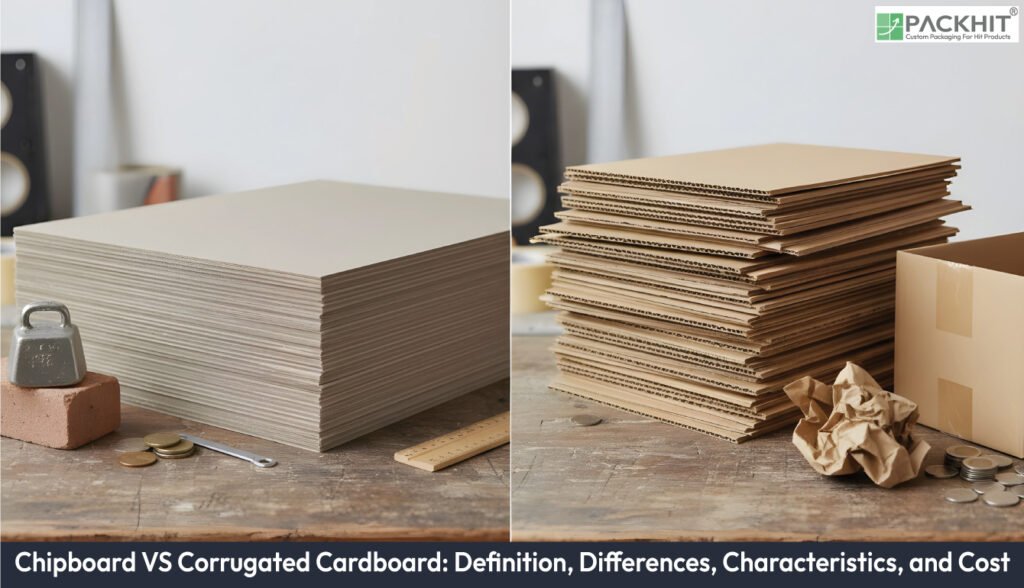
Chipboard and corrugated cardboard are two widely used packaging materials that differ in structure, performance and suitability for transport, display and product protection. Chipboard provides a dense, flat sheet for rigid panels, premium finishes and precise die-cutting, while corrugated cardboard delivers strength, cushioning and stacking capacity through its fluted construction. Their characteristics, differences, applications, cost factors and environmental challenges determine how manufacturers choose the right material for distribution, retail, or presentation-grade packaging. Understanding the distinctions between chipboard vs corrugated cardboard helps businesses match board grade to product needs, handling conditions and sustainability requirements.
- What is Chipboard?
- What is Corrugated Cardboard?
- What are the Differences Between the Chipboard and Corrugated Cardboard?
- Structure
- Material Behaviour
- Compression Behaviour
- Cushioning Response
- Surface and Print Behaviour
- Moisture Behaviour
- Conversion Demand
- What are the Characteristics of Chipboard vs Corrugated Cardboard?
- Which Factors Affect the Cost of Chipboard and Corrugated Cardboard?
- What are the Uses of Chipboard and Corrugated Cardboard?
- What are the Key Environmental Challenges of Chipboard and Corrugated Cardboard?
- Which Packaging Material to Choose: Chipboard vs Corrugated Cardboard?
What is Chipboard?
Chipboard is a dense paperboard sheet formed by compressing recycled fibres into a uniform layer that stays flat and rigid during handling. The sheet comes in thickness ranges from about 0.3 mm folding grades to 3 mm board used for book covers and rigid box panels. Most mills use recycled sources such as old corrugated containers or newsprint, then add small amounts of virgin pulp if extra stiffness is required. Producers apply surface coats when they need a smoother print face or moisture control. Common commercial categories include greyboard for bookbinding, folding boxboard for consumer cartons, and solid board for rigid shells; each category occupies a specific thickness band and surface quality level. Coatings such as clay, polymer films or foil add print accuracy or protect the board from humidity. Inserts, dividers and slip sheets often use uncoated grades where surface quality matters less than stiffness.
What is Corrugated Cardboard?
Corrugated cardboard forms a multi‑layer sheet made from a fluted medium glued between flat liners, and this geometry carries bending loads through alternating compression and tension paths that raise stiffness relative to its mass. Typical thickness ranges from about 0.8 mm micro‑flutes to more than 7 mm triple‑wall grades used for industrial cases. Common examples across UK manufacturing include single‑wall cartons for retail packs, double‑wall trays for pallet loads and triple‑wall sleeves for machinery shipments. Flute profiles appear in standard sizes such as A, C, B, E and F, each profile altering cushioning, calliper and print quality.
What are the Differences Between the Chipboard and Corrugated Cardboard?
Chipboard and corrugated cardboard differ in structure, material behaviour, compression behaviour, cushioning response, surface and print behaviour, moisture behaviour and conversion demands.
Structure
Structure defines how chipboard and corrugated cardboard hold loads and react during conversion. Chipboard keeps a single compact layer where fibres lie in a dense sheet that stays flat during die‑cutting. Corrugated cardboard uses a fluted medium between two liners; the voids alter bending, shear and fold behaviour. This layered geometry changes weight‑to‑stiffness ratios and creates orientation effects during scoring because flute direction influences fold accuracy. Chipboard maintains uniform thickness across the sheet, while corrugated relies on flute height, pitch and liner bond strength; these parameters shift design allowances for crease spacing, bend radii and print alignment.
Material Behaviour
Material behaviour describes how each substrate responds to tension, bending and shear during use and conversion. Chipboard reacts as a dense fibre matrix where deformation spreads through the sheet without internal voids; this produces stable planar stiffness but limited tolerance for repeated flexing. Corrugated cardboard behaves as a composite where the liners carry tensile loads while the fluted medium carries shear; this interaction changes as flute height, adhesive bond quality and liner basis weight vary across grades. Chipboard stores deformation through fibre compression without energy dissipation, while corrugated board dissipates energy through flute buckling and recovery. These mechanical distinctions guide designers when selecting substrates for folding accuracy, fatigue cycles or static loads in UK manufacturing lines.
Compression Behaviour
Compression behaviour separates chipboard from corrugated cardboard during stacking. Chipboard takes in‑plane shear and bending loads but loses stability under vertical force because its fibres compress without support from an internal core. Corrugated cardboard raises edgewise strength through its fluted column structure; the flute peaks create multiple load paths, which increase ECT and BCT values when liner weight and medium grade match box perimeter. Chipboard collapses suddenly under vertical loads, while corrugated absorbs repeated compression cycles during pallet transport and distribution because the flutes deform gradually.
Cushioning Response
Cushioning response depends on the presence of air pockets. Chipboard contains no internal voids, so it absorbs almost no impact energy; inserts or add‑ons handle any required protection. Corrugated cardboard produces controlled cushioning because its flutes compress and recover during handling. The displacement of each flute alters the impact duration when cartons drop or hit conveyor transitions. This predictable cushioning keeps corrugated as the dominant material for e‑commerce packaging and repetitive handling across UK distribution centres.
Surface and Print Behaviour
Surface and print behaviour change between chipboard and corrugated cardboard because of fibre density and liner texture. Chipboard accepts coatings that smooth the surface for litho printing and tight registration on display cartons. Corrugated prints through flexo stations, and micro‑flute grades such as E‑flute improve graphic detail by reducing flute shadow. Ink holdout shifts because chipboard has a denser face, while corrugated liners may show texture variation or minor washboard effects on lightweight liners. Chipboard produces cleaner die‑cut edges due to its solid sheet structure.
Moisture Behaviour
Moisture behaviour influences load strength during storage. Chipboard absorbs water quickly unless coated or laminated with polymer films or clay barriers. Corrugated cardboard loses strength at the adhesive bond line and the fluted medium during high humidity exposure. Kraft liners keep more strength during short wet cycles if the basis weight is adequate. Both substrates lose stiffness once moisture enters the fibre network, and converters use treated liners or laminated faces to stabilise corrugated grades in humid distribution routes.
Conversion Demand
Conversion demand reflects how each material runs through cutting and forming equipment. Chipboard processes through cutting and creasing stations with limited setup because of its uniform thickness. Corrugated cardboard requires slotting, scoring and folding lines that depend on flute direction; misaligned scoring weakens the board. Corrugated uses more machine space because flute height adds thickness. Chipboard turns tighter bend radii for small presentation packs, while corrugated fits automated case‑forming systems used for high‑volume SKUs in manufacturing and fulfilment.
What are the Characteristics of Chipboard vs Corrugated Cardboard?
The characteristics of chipboard and corrugated cardboard depend on fibre mix, sheet geometry and the way each substrate reacts to bending, stacking and print preparation. The table summarises the characteristics that influence packaging choice for UK manufacturers.
| Characteristic | Chipboard | Corrugated cardboard |
|---|---|---|
| Primary composition | Compressed recycled or mixed pulp (examples: greyboard, folding boxboard) | Linerboard + fluted medium bonded with starch adhesive (examples: kraft liners, testliners) |
| Structure | Homogeneous sheet, single-ply | Sandwich (flute(s) between liners); single/double/triple wall |
| Typical thickness | Thin to multi-millimetre | 0.8–5.0 mm single-wall (depends on flute type) |
| Bending stiffness | High per unit thickness in-plane | Stiffness-to-weight ratio raised by fluted core |
| Cushioning and shock resistance | Low; inserts required for impact control (examples: foam, corrugated inserts) | Cushioning generated by flute form; profile selection adjusts shock response |
| Print quality | Good when coated or calendered (examples: litho-laminated folding boxboard) | Good onliners; litho-lamination or micro‑flute improves detail (example: E‑flute) |
| Moisture sensitivity | High unless laminated or coated | High; wax, PE or treated liners adjust wet performance |
| Typical applications | Rigid boxes, bookbinding, backing boards, die-cut trays | Shipping boxes, retail packaging, point-of-sale displays, pallet packaging |
The comparison highlights how chipboard (homogeneous fibre sheets) suits flat and rigid panels, while (Corrugated cardboard) fluted composites support stacking and transport loads that occur during distribution.
Which Factors Affect the Cost of Chipboard and Corrugated Cardboard?
The factors that affect the cost are changes in fibre grade, board thickness, run length, print method and conversion steps. Cost shift with input costs, transport distances, and order quantity tiers used across UK packaging contracts.
- Fibre grade cost: Recycled chipboard and mixed-paper mediums sit at lower price bands, with ranges from £320–£480 per tonne for standard grades and £550–£720 per tonne for kraft‑liner corrugated grades.
- Board thickness cost: Thin chipboard panels (0.3–1.0 mm) fall around £350–£500 per tonne, while heavy chipboard (2.0–3.0 mm) costs £520–£740 per tonne; single‑wall corrugated sits around £0.35–£0.65 per m², and double‑wall rises to £0.55–£1.10 per m².
- Print method cost: Chipboard litho print surfaces add £0.12–£0.28 per unit on small runs; corrugated flexo print adds £0.04–£0.16 per unit depending on colour count.
- Run length cost: Short runs raise unit prices to £0.45–£1.20 per pack; long‑run corrugated shippers fall to £0.18–£0.42 per pack under pallet‑volume contracts.
- Conversion cost: Die‑cut chipboard inserts add £0.06–£0.22 per piece; corrugated case forming and slotting add £0.08–£0.30 per piece, depending on flute height and tooling wear.
- Transport cost: Chipboard pallets average £32–£55 per pallet movement; corrugated pallets range £28–£48 depending on stack height and distribution zone.
What are the Uses of Chipboard and Corrugated Cardboard?
Chipboard supports presentation, structural display and internal component work where a flat, rigid sheet improves alignment and finish. Typical uses include rigid gift boxes, book covers, product trays, folder backs and furniture cores. Manufacturers use chipboard as a lamination base for premium cartons and as die‑cut inserts that control product spacing in secondary packs. Coated grades add print accuracy for cosmetics and giftware, while uncoated greyboard supports dividers and backing panels. Chipboard fits low‑profile panel work in retail packaging lines, if distribution compression is handled by an outer corrugated case.
Corrugated cardboard supports distribution tasks that expose packs to compression, shock and repeated handling. Typical uses include e‑commerce parcels, palletised transport cases and appliance cartons where flute geometry controls cushioning and stacking loads. UK manufacturers specify single‑wall B‑ or C‑flute for general shipping, double‑wall grades for heavier SKUs and micro‑flute grades such as E‑flute when print resolution and tight folds matter in retail‑ready formats. Corrugated grades cover transit packaging, pallet trays, point‑of‑sale structures and modular sleeves that protect goods through multi‑stop distribution.
What are the Key Environmental Challenges of Chipboard and Corrugated Cardboard?
The key environmental challenges of chipboard and corrugated cardboard relate to fibre sourcing, water use, energy demand and contamination during recycling. Chipboard and corrugated grades both depend on recovered fibres, yet each material introduces different waste‑stream risks and processing loads. Mills draw recycled pulp from mixed papers such as OCC and newsprint; contamination from inks, adhesives and moisture reduces yield and shortens fibre life. Corrugated production runs steam‑intensive drying cycles, and chipboard relies on repeated water recirculation loops that carry chemical residues from de‑inking stages. Food‑contact contamination blocks recycling of retail cartons if oil or protein residues enter the fibre web. Transport distances increase emissions because the board moves between mills, sheet plants and fulfilment centres before final conversion. Both substrates degrade after 5–7 recovery cycles, which limits closed‑loop systems used across UK packaging.
Which Packaging Material to Choose: Chipboard vs Corrugated Cardboard?
Chipboard suits flat work, while corrugated cardboard supports transport loads that involve stacking, shock and repeated handling. The table below summarises when each material fits UK manufacturing tasks.
| Material | When to choose | Examples of packaging boxes |
|---|---|---|
| Chipboard | Use chipboard for rigid panels, precise print faces and shaped inserts, if distribution compression is managed by an outer case. | Rigid presentation boxes, book slipcases, cosmetics boxes, board‑backed folders |
| Corrugated cardboard | Use corrugated cardboard for pallet loads, drop‑tested transit packs and e‑commerce cartons if loads pass through multi‑stop distribution. | Single‑wall shipping boxes, double‑wall trays, micro‑flute retail‑ready boxes |
This table shows how chipboard supports display work and how corrugated cardboard supports shipping tasks across UK manufacturing.