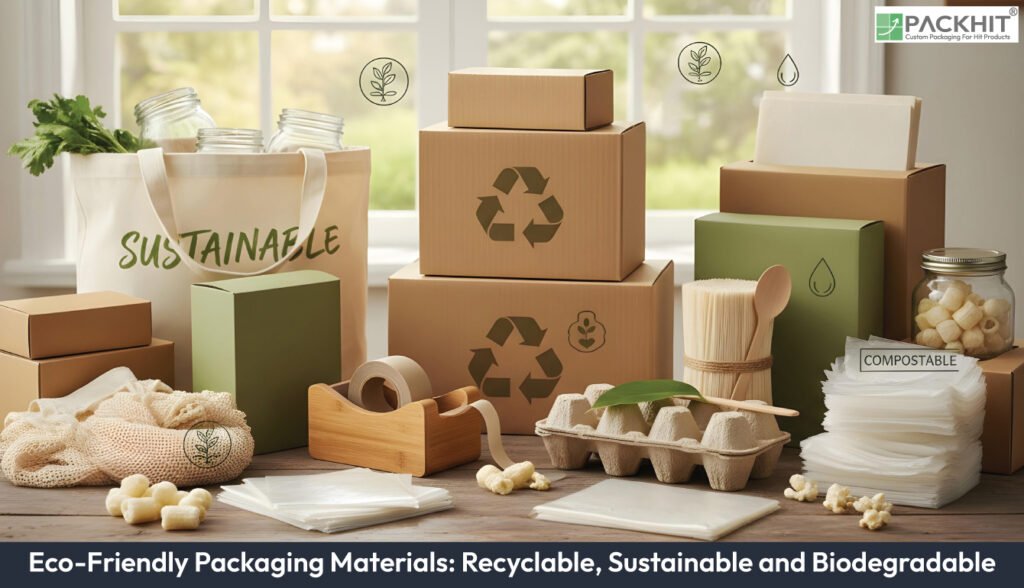
Eco-friendly packaging utilises recyclable, sustainable, and biodegradable materials designed to reduce environmental impact. Environmentally friendly packaging materials form the basis for selection. Distinctions between recyclability, sustainability, and biodegradability guide technical choices, while sustainable printing, coatings, and inks enhance environmental performance. Eco-friendly packaging offers benefits in protection, transport efficiency, brand presentation, and cost stability, supporting wider adoption. Selection criteria and manufacturing workflow adjustments of sustainable packaging shape usage in industries and among end consumers.
- What are Eco‑Friendly Packaging Materials?
- Which Materials are Used for Eco‑Friendly Packaging?
- Recyclable Materials
- Corrugated cardboard
- Recycled paperboard and kraft paper
- Moulded pulp (formed fibre)
- Aluminium‑based components
- Sustainable Materials
- Kraft paper and recycled paperboard
- Starch‑based biopolymers
- Mycelium and plant‑fibre composites
- Lightweight cellulose films
- Biodegradable and Compostable Materials
- Is Cardboard Eco‑Friendly?
- How Can Sustainable Printing, Coatings, and Inks Improve Eco-Friendly Packaging?
- How do Recyclable, Sustainable and Biodegradable Materials Differ for Packaging?
- Which Factors Make Packaging Recyclable or Compostable?
- Why Choose Eco‑Friendly Packaging?
- How Do Different Industries Use Eco-Friendly Packaging?
- Why Choose Eco-Friendly Packaging Despite Higher Costs?
- How Does Using Eco-Friendly Packaging Change Production Processes?
- What Operational Compromises Come With Eco-Friendly Packaging?
- How do Consumers Identify Eco‑Friendly Packaging?
What are Eco‑Friendly Packaging Materials?
Eco‑friendly packaging materials are materials intended to minimise environmental burden from sourcing through the end of life. Environmentally beneficial materials are cellulose, bio‑based polymer or low‑impact composite materials serving as packaging substrates, protective inserts and films in product packaging. Inherent features of eco-friendly packaging material include material type, main function, and disposal method, as well as intended use, barrier requirements, and dependence on local recycling systems.
Which Materials are Used for Eco‑Friendly Packaging?
Eco‑friendly packaging materials include recyclable, sustainable, and biodegradable options designed to reduce environmental impact while meeting functional requirements.
Recyclable Materials
Recyclable materials include fibre, metal, and single-polymer types that can enter existing recovery streams, with the following sections detailing how each grade performs at the end of life.
Corrugated cardboard
Corrugated cardboard uses fluted fibreboard to create a rigid structure that re-enters paper‑stream recovery if coatings, inks, and food residue remain low. Parcel cartons, subscription‑box outers, and bulk shippers rely on its compression strength. Print on both sides with eco‑friendly inks, if the fibre cleanliness must remain stable for recycling.
Recycled paperboard and kraft paper
Recycled paperboard and kraft paper use dense fibres with 60–100% recycled content that recycling plants accept if grease, wax, or laminated plastic layers are absent. Folding cartons, padded mailers, and wrap sleeves depend on their stiffness. Bulk purchasing reduces unit cost when production runs repeat a fixed size.
Moulded pulp (formed fibre)
Moulded pulp uses water‑formed cellulose fibres that reprocess in paper mills if additives remain minimal. Protective inserts for electronics, meal‑kit trays, and retail trays rely on its low‑mass cushioning. Fibre texture signals compostability in some local systems, if inks stay plant‑based and coverage remains light.
Aluminium‑based components
Aluminium‑based components use single‑layer aluminium that returns to metal‑stream recycling with near‑closed‑loop efficiency. Ready‑meal trays, beverage lids, and heat‑sealed food containers rely on its barrier properties and light weight. Cost steadies in bulk orders, if gauge thickness stays consistent across product lines.
Sustainable Materials
Sustainable materials consist of renewable, low-impact, or reusable substrates that minimise environmental footprint, with the following sections explaining their applications and performance.
Kraft paper and recycled paperboard
Kraft paper and recycled paperboard use recovered or renewable fibre to lower sourcing emissions and reduce polymer use. These substrates work in cartons and protective wraps for UK manufacturers that want stable procurement, if bulk runs repeat fixed dimensions.
Starch‑based biopolymers
Starch‑based biopolymers use plant feedstock that cuts fossil‑fuel demand and supports loose‑fill and light‑duty films. These films protect goods in transit and maintain low mass, if storage avoids humidity that weakens starch blends.
Mycelium and plant‑fibre composites
Mycelium and plant‑fibre composites grow through low‑energy processes that cut production emissions and form inserts that replace polymer foams. These inserts absorb impact in boxed goods, if drying keeps moisture at controlled levels.
Lightweight cellulose films
Lightweight cellulose films use regenerated cellulose that lowers shipping mass and supports moderate‑barrier packaging. These films work for overwraps and windows in fibre cartons, if coatings stay minimal to retain recyclability and fibre purity.
Biodegradable and Compostable Materials
Biodegradable and compostable materials include plant-based, starch, and fibre-derived substrates that break down under biological conditions, with the following sections describing their end-of-life behavior and uses.
Cellulose‑based films (regenerated cellulose)
Cellulose‑based films break down in controlled composting units through bacterial and enzymatic action. These films cover overwraps and carton windows, if coating levels stay low. Bulk orders lower unit cost, if the same width repeats across runs.
Polylactic acid (PLA)
Polylactic acid breaks down in industrial composting plants under heat and airflow. PLA forms clear containers and lids for short‑shelf‑life goods. Storage remains stable at ambient temperatures, if exposure to direct heat stays limited.
Starch‑based biopolymers
Starch‑based biopolymers degrade in aerobic compost systems through microbial activity. These blends shape packing peanuts and thin films for transit packaging. Material integrity stays consistent, if humidity control remains tight during storage.
Mycelium and plant‑fibre composites
Mycelium and plant‑fibre composites break down in natural soil through fungal and bacterial action. These composites form structural inserts for boxed goods and support shock absorption, if moisture levels stay within moderate ranges.
Eco-friendly packaging materials rely on local infrastructure. Recyclable items depend on sorting accuracy and coating purity. Sustainable items reduce upstream emissions through fibre recovery or low‑energy processing. Biodegradable items require matching composting routes when the material tested against relevant standards demonstrates reliable breakdown.
Is Cardboard Eco‑Friendly?
Cardboard is eco‑friendly when produced from recycled fibre and retained within an organised fibre collection and recycling system. Corrugated fibreboard provides high strength‑to‑mass performance and, if uncoated and uncontaminated by food or liquid, is widely accepted by municipal and industrial paper recycling systems. Coatings, inks and contamination change behaviour: waxed or metallised surfaces impede recycling and composting, and food‑soiled board is diverted to alternative waste streams.
How Can Sustainable Printing, Coatings, and Inks Improve Eco-Friendly Packaging?
Sustainable printing, coatings, and inks enhance eco-friendly packaging by maintaining recyclability and reducing environmental impact. Sustainable coatings such as water-based primers, barrier coatings, varnishes, and heat-sealing options protect packaging from moisture and abrasion without releasing harmful chemicals. Sustainable inks, including soy, vegetable, and water-based inks, replace petroleum-based inks, minimising air pollution and health risks.
How do Recyclable, Sustainable and Biodegradable Materials Differ for Packaging?
Recyclable denotes the capacity of a material to be reprocessed into secondary raw material through existing collection, sorting and reprocessing streams. Sustainable denotes a low life‑cycle environmental footprint when measured across raw‑material sourcing, production energy and water use, transport mass and end‑of‑life emissions. Biodegradable denotes the capacity of a material to be broken down to simpler compounds by biological agents under specified environmental conditions. Recyclability is conditional on material purity and mono‑material construction; biodegradation is conditional on environmental conditions such as industrial composting, and sustainability is conditional on upstream sourcing and downstream waste‑management options.
Which Factors Make Packaging Recyclable or Compostable?
Recyclability depends on material purity, local sorting capacity, and contamination levels. Compostability depends on feedstock type and composting conditions. The main factors include:
- Material composition affects recyclability when single-material fibres like paperboard, aluminium, or plant-based polymers are used.
- Coating type can block recycling or metal recovery when wax, laminates, or barrier films are applied.
- Contamination from food residue, oil, or adhesives prevents proper sorting in municipal facilities.
- Local facility capability determines which grades can be processed by mills or composting sites.
- Composting route requires PLA, starch, or cellulose films to have consistent heat and airflow in industrial composters.
- Home-compost tolerance allows fibre trays and some plant-fibre products to break down in garden compost systems.
- Standard test compliance ensures biodegradation, residue levels, and ecotoxicity meet EN13432 (the European standard that sets biodegradation, disintegration and ecotoxicity thresholds for industrial compostability) and similar standards.
- Print and ink choices influence fibre cleanliness, with eco-friendly inks and simple layouts helping maintain recycling streams.
- Bulk-order size stabilises costs for recyclable or compostable grades through economies of scale.
Why Choose Eco‑Friendly Packaging?
Eco‑friendly packaging reduces environmental load across sourcing, production and disposal. Environmentally beneficial packaging is used to cut waste, lower raw material impacts and improve correct sorting. Businesses shift to low‑impact substrates when recycled fibre or compostable feedstock meets product‑protection targets.
Some key benefits of eco-friendly packaging include:
- Lower waste generation through recyclable fibre, mono‑material paper wraps and compostable films that re‑enter recovery streams.
- Reduced sourcing emissions through recycled paperboard, kraft grades and plant‑based polymers that minimise fossil‑feedstock extraction.
- Better consumer sorting accuracy when uncoated kraft textures, fibre cues or recycled‑content statements guide disposal actions.
- Lower transport mass through lightweight fibre and cellulose films that reduce pallet weight in e‑commerce shipping.
- More stable procurement routes because bulk orders of recycled fibre or biopolymer inputs lower unit price variability.
- Cleaner print profiles through plant‑based inks and two‑sided print layouts that conserve ink and fibre.
- Improved compliance alignment where recycling systems accept corrugated cardboard, moulded pulp and aluminium trays without complex separation.
How Do Different Industries Use Eco-Friendly Packaging?
Eco-friendly packaging serves multiple industries through recyclable, sustainable, and biodegradable options. Recyclable materials such as paperboard, PET (polyethene terephthalate), and corrugated cardboard support food, beverage, and consumer goods sectors by enabling material recovery. Sustainable packaging, including glass jars, metal tins, and reusable bags, suits retail, cosmetics, and speciality products by extending product life and reducing waste. Biodegradable packaging made from PLA (polylactic acid), cornstarch, mycelium, and paper-based materials is ideal for foodservice, fresh produce, and disposable goods, breaking down naturally in compost systems.
Why Choose Eco-Friendly Packaging Despite Higher Costs?
Eco-friendly packaging may have higher upfront costs due to the use of sustainable materials, specialised coatings, and production processes designed for recyclability or compostability. Durable and reusable solutions lower long-term expenses through repeated use, while improved brand image and regulatory compliance add value. Advances in manufacturing and rising demand continue to reduce prices, making sustainable packaging a practical investment for businesses.
How Does Using Eco-Friendly Packaging Change Production Processes?
Adopting eco-friendly packaging involves coordinating procurement, design, testing, production, and distribution. Procurement secures suppliers with suitable feedstock and certifications. Design teams create mono-material or easily separable constructions from multi-layer assemblies. Prototyping and lab tests evaluate strength and barrier performance. Production adjusts machine settings and tooling for new materials. Distribution aligns palletisation and protection methods to minimise product damage. Waste management and labelling ensure end-of-life disposal matches local recycling or composting systems.
What Operational Compromises Come With Eco-Friendly Packaging?
Switching to eco-friendly packaging involves some trade-offs. Adding moisture protection can reduce recyclability. Using multiple materials makes recycling harder. Small production volumes increase the cost per unit. End-of-life performance depends on local infrastructure. Materials needing industrial composting do not work well where only basic recycling or landfill is available.
How do Consumers Identify Eco‑Friendly Packaging?
Consumers most readily recognise eco‑friendly packaging through explicit material cues and straightforward claims. Visual cues include uncoated kraft finishes, visible fibre texture and minimal use of coloured plastic windows. Clear statements of recycled content or specific end‑of‑life instructions increase correct consumer sorting. Market behaviour indicates a rising emphasis on sustainability, which has led brands to prioritise recyclability and recycled content in packaging design.