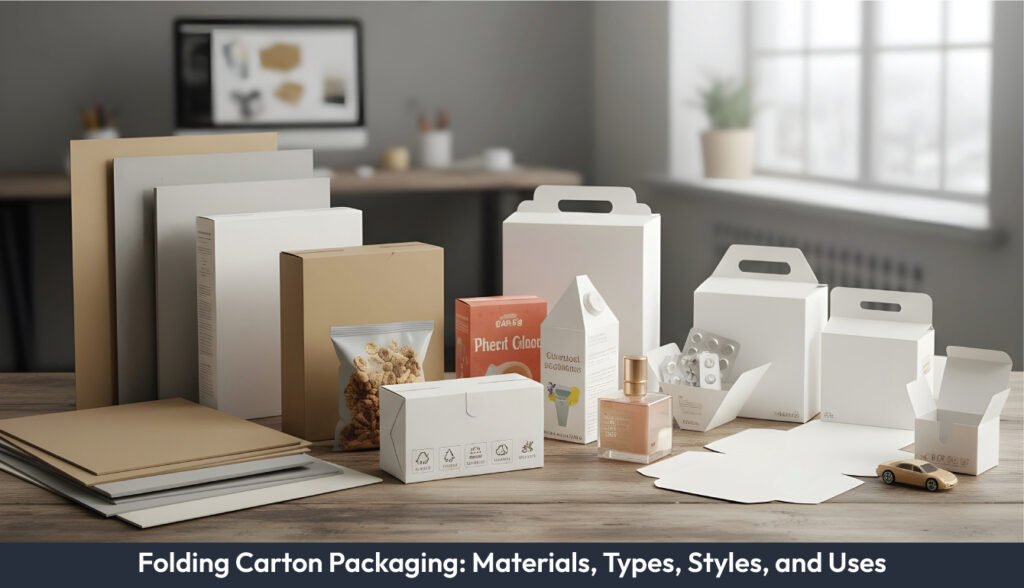
Folding carton packaging combines paperboard materials, coatings, and adhesives to balance print quality, stiffness, and barrier performance. Structural design of folding carton and finishing options shape how cartons fold, assemble, and present products, while production processes link dieline planning, printing, surface treatment, die-cutting, and assembly to efficiency and cost. The application of folding cartons spans across multiple industries, where material and construction choices influence recyclability, regulatory compliance, and product protection.
- What is Folding Carton Packaging?
- Which Types of Materials Form Folding Cartons?
- 1. Paperboard Grades
- SBS (Solid Bleached Sulfate)
- FBB (Folding Boxboard)
- CRB (Coated Recycled Board), WLC (White Lined Chipboard) and CCNB (Clay Coated News Back) (Recycled Boards)
- Which Adhesives, Coatings, and Barrier Layers Are Used in Folding Carton Packaging?
- What is the Process of Folding Carton Manufacturing?
- 1. Prepress and Tooling
- 2. Printing, Drying and Coating
- 3. Conversion: Die-cutting, Creasing, Folding and Glueing
- What are the Different Styles of Folding Carton Packaging?
- Which Industries Commonly Use Folding Cartons?
- Food and Beverage
- Cosmetics and Personal Care
- Pharmaceuticals
- Consumer Electronics
- Direct-Mail and Promotional Items
- High-Volume or Heavy Shipments
- How Can Folding Cartons Be Designed for Heavy or Delicate Items?
- How Do Design Choices Impact Folding Carton Strength and Cost?
- What Sustainability Factors Should be Considered for Folding Carton Selection?
- What Are Common Problems in Folding Carton Projects?
- What is the Difference Between Folding Cartons, Corrugated, and Flexible Packaging?
What is Folding Carton Packaging?
Folding carton packaging is a paperboard container produced from flat printed sheets that are creased, die-cut and folded to form a product-facing box that ships and stores flat before assembly. The finished object comprises panels, glue flaps, and one or more closure elements and functions as primary packaging or secondary retail packaging depending on application. Folding cartons are designed for visual communication and moderate protection rather than heavy load-bearing. Paperboard containers combine structural geometry with surface finishing to control appearance, tactile feel, and limited barrier properties. Typical supply-chain behaviour is flat-pack shipping to the packer, high-speed folder-gluer assembly at pack time, and display or consumer use at the point of sale.
Which Types of Materials Form Folding Cartons?
Folding cartons are made from paperboard as the structural base. Paperboard provides stiffness, edge strength, and dimensional stability, ensuring the carton maintains its shape during handling, shipping, and storage. Paperboard also offers a smooth surface for high-quality printing and finishing, making the packaging both durable and visually appealing.
1. Paperboard Grades
Paperboard forms the structural core of folding cartons, determining strength, rigidity, and print quality. Selection depends on product weight, protection needs, and finishing requirements. Various grades and constructions allow packaging to balance durability, appearance, and cost efficiency.
SBS (Solid Bleached Sulfate)
SBS supports maximum surface whiteness and tight print fidelity. Cosmetics, pharmaceuticals, and gift items use SBS for clean edges and consistent ink laydown. SBS maintains form on tight folds when the crease geometry matches the board thickness. Foil stamping, soft‑touch varnish and multi-level coatings sit cleanly on SBS due to its uniform fibre matrix.
FBB (Folding Boxboard)
FBB supplies stiffness at lower grammages while reducing weight without compromising panel strength. Frozen food cartons and retail multipacks use FBB because its multi‑ply structure resists warp through chill chains. FBB creases predictably if the grain direction aligns with the main fold axis, and it accepts aqueous varnish or UV varnish with stable absorption rates. The Packers use FBB for high‑speed lines because panel memory remains consistent during fold‑glue cycles.
CRB (Coated Recycled Board), WLC (White Lined Chipboard) and CCNB (Clay Coated News Back) (Recycled Boards)
Recycled boards support cost‑controlled runs where graphic intensity is moderate. Cereal cartons, lightweight hardware packs and mass‑market retail boxes use CRB or WLC due to their recycled fibre blend. Clay coating on CCNB improves print density on the outside face while keeping material cost low. These grades deform sooner under high emboss pressure, so designs with deep relief or heavy foil areas often shift back to SBS. Recycled boards match procurement goals when recycled content is required.
Which Adhesives, Coatings, and Barrier Layers Are Used in Folding Carton Packaging?
Paperboard is combined with functional finishes such as adhesives, coatings, and barrier layers for folding carton packaging. Adhesives, varnishes, and laminates act as the functional finishing layer of any carton, shaping how strong it feels, how well the print holds up, and how effectively moisture, oxygen, or grease are resisted. Functional finishing layers determine assembly reliability, surface durability, and product-specific protection, and each option supports a different performance need.
PVA and Dispersion Adhesives
PVA systems bond paperboard panels at fast cycle times. Carton adhesives set under compression, hold glue flaps on tuck‑end and auto‑bottom designs, and retain bond strength across chill chains used for frozen foods.
Hot‑Melt Adhesives
Hot‑melt lines support high‑speed folder‑gluer runs for cartons with heavier contents. The adhesive cools quickly, fixes crash‑lock bottoms and stabilises multi‑panel structures that move through pack lines with continuous feed.
Cold‑Seal Coatings
Cold‑seal layers activate under pressure without heat. Materials for heat-sensitive goods support carton functionality and simplify assembly when plants run multiple product variants that need quick changeovers.
Aqueous and UV Varnishes
Aqueous varnish adds surface scuff resistance while UV varnish changes gloss and surface hardness. Both systems protect graphics used for retail communication and minimise abrasion during transport.
Laminated Films
BOPP matt and gloss films change tactile feel and regulate moisture interaction with the outer surface. Laminated sheets travel predictably through die‑cutting and folding when thickness tolerances and crease geometry match the added film layer.
Barrier Laminates
Polyethene extrusion and aluminium foil laminates introduce oxygen and grease barriers. These layers add functional protection but reduce fibre recovery in recycling streams unless used as monomaterial systems.
What is the Process of Folding Carton Manufacturing?
Folding-carton manufacturing follows a linear workflow, beginning with structural design, followed by prepress and proofing, then printing and finishing, die-cutting and creasing, folding and glueing, and finally inspection and shipment. Each step affects the next, as explained below:
1. Prepress and Tooling
Convert structural CAD and artwork into press‑ready plates or calibrated digital files. Create a dieline with fold vectors, glue panels and tolerance notes. Check grain direction against primary folds. Produce steel‑rule or laser tooling that sets cut depth and crease geometry. Build 1–2 physical samples to confirm board memory and fold behaviour, if a new grade or coating enters the run.
2. Printing, Drying and Coating
Select the printing method based on run length and image density: offset for photographic panels, flexo for simple lines, and digital for short batches or variable codes. Match the ink system to the drying method to keep colour holdout stable. Use IR or convection on aqueous systems and UV energy on UV‑curable layers. Verify that drying speed supports downstream die‑cut tolerances and keeps scuff on coated areas within spec.
3. Conversion: Die-cutting, Creasing, Folding and Glueing
Cut printed sheets with a registered die that maintains shear accuracy at each notch. Form creases with channel widths matched to the board calliper. Fold panels on a folder‑gluer that aligns registration marks and applies adhesive at a controlled weight. Check glue compression on the manufacturer’s joint to prevent skew. Run crash‑lock or tuck styles at line speeds that keep panel memory stable if pack lines run multiple SKUs.
What are the Different Styles of Folding Carton Packaging?
Folding carton packaging styles (straight tuck end box, reverse tuck end box, two-piece folding box, auto lock box, and sleeve box) are defined by flap arrangement, base design, and assembly method. Each style supports different print densities, closure strengths, and fold behaviours. The common styles of folding cartons are given below in detail, covering structure, ideal use, and design benefits:
1. Straight Tuck End (STE) Boxes
STE cartons use parallel tuck panels on both ends to create a flat, uniform closure. Fast fold-glue behaviour supports high-volume lines that run cosmetics, nutraceuticals and compact food items. Panels crease cleanly on SBS or FBB grades if the grain direction supports the main fold axis.
2. Reverse Tuck End (RTE) Boxes
RTE cartons use opposing tuck directions that tighten end‑panel retention and reduce pop‑open risk during transit. Automated lines pack RTE cartons for toys, midweight electronics, and regulated items that carry inserts. RTE geometry trims make‑ready adjustments on folder‑gluers, if crease depth matches board thickness.
3. Two-Piece Folding Boxes
Two-piece cartons use separate lid and base components that add rigidity and surface area for print. Jewellery, limited-run confectionery and premium cosmetic sets use this structure when stacking accuracy and controlled lift-off clearance matter. Board selection prioritises edge integrity during die‑cutting and uniform lid fit across long runs.
4. Auto-Lock / Crash-Lock Bottom Boxes
Crash-lock bottoms use pre‑glued panels that collapse and spring into position during opening. Wine, craft beverages and industrial components rely on this geometry for faster pack rates and bottom strength. Folder‑gluers apply controlled glue patterns during make‑ready to avoid skew and maintain squareness.
5. Lock-Bottom / Snap-Lock / 1‑2‑3 Bottom Boxes
Lock-bottom cartons use four interlocking panels that form a stable base once opened. Medium-load goods such as supplements, bottled vials and kitchen accessories use this style. Structural stiffness depends on accurate die‑cut tolerances and adhesive hold on the manufacturer’s joint, if heavier contents shift during handling.
6. Window Boxes
Windowed cartons provide quick visual identification in food packs and toy lines when the window shape supports die-cut stability. Windowed cartons maintain print graphics around the aperture to ensure colour consistency across runs. Display window cartons incorporate crease layouts that prevent weak edges around the window.
7. Tray and Sleeve Boxes
Sleeve cartons slide over trays or inner packs and create a rigid band that carries artwork. Gift sets and cosmetic lines run sleeves in multi-SKU programs if frequent art changes occur. Flat sleeves stack tightly in storage and keep stability on conveyors when varnish or film improves scuff resistance.
8. Gable-Top Boxes
Gable-top cartons form a peaked roof and integrate a grip or spout that guides pouring. Liquid foods use this shape in chilled chains where board coatings resist moisture. Structural teams shape the top panels to prevent misalignment during the machine-forming process.
9. Pillow Boxes
Tuck corner cartons produce curved outlines that grip small products. Candy, sample sachets and trial items use this form when fast-glueing supports large run counts. Light board grades hold shape around the arcs without cracking if the increased pressure matches the fibre direction.
Which Industries Commonly Use Folding Cartons?
Folding cartons are used across consumer-facing industries such as food, beverage, cosmetics, pharmaceuticals, and electronics, where print quality, shelf presence and moderate protection are required.
Food and Beverage
Folding cartons pack cereal, frozen meals, snacks, and beverages and keep consistent branding across multiple SKUs. Packaging teams specify grease or moisture barriers for chilled chains if direct contact risk appears. Structural staff maintain crease integrity so cartons run flat on conveyors without panel warp. Retail groups request tight colour control because cartons often sit in high‑traffic aisles.
Cosmetics and Personal Care
Folding cartons protect skincare, perfumes, and makeup during transport and communicate surface detail through foil stamping, embossing, or soft‑touch coatings. Production teams maintain smooth edges because close-up inspection happens at the point of sale. Brand groups request multiple artwork versions during launch cycles when frequent design changes occur.
Pharmaceuticals
Folding cartons pack medicines, supplements, and medical devices and support strict labelling formats. Pack lines apply tamper-evident features so pharmacists detect interference fast. Internal partitions hold blister packs or vials so movement does not trigger abrasion or cracked seals. Regulatory staff review proofs before each run.
Consumer Electronics
Folding cartons hold headphones, chargers, and accessories and provide clean print so users can read specifications without distraction. Insert trays keep cables and devices in fixed positions, if irregular shapes cause lean or shift. Production teams keep die-cut edges precise so barcodes scan on the first pass.
Direct-Mail and Promotional Items
Folding cartons carry marketing kits, sample sets, and product literature. Variable data printing supports campaign-level personalisation. Structural teams add quick-open features so recipients can access contents fast. Cartons ship flat to reduce freight when bulk mail volumes rise.
High-Volume or Heavy Shipments
Folding cartons pair with corrugated units for pallet loads or rough transit. Reinforced panels reduce crush when weight concentrates on one axis. Manufacturers choose thicker grades if heavy components move inside during long-distance distribution. Pack groups track dimensional stability so cartons stack without twist.
How Can Folding Cartons Be Designed for Heavy or Delicate Items?
Folding cartons can be designed for heavy or delicate items by selecting stronger paperboard grades, adding protective coatings, and using reinforced structures such as auto-bottom or two-piece designs. Such enhancements increase durability, maintain shape during handling, and protect the product inside.
How Do Design Choices Impact Folding Carton Strength and Cost?
Design sets carton purpose: display, light protection, or secondary packaging. Purpose guides board thickness, internal supports, and finishing. Light products with visual focus use thinner, high-whiteness board and premium finishes. Heavy or fragile products use microflute, higher grammage, or partitions. Assembly method affects cost: tuck-end boxes lower tooling but slow packing; auto-bottom boxes raise tooling and unit cost but save labour. Decorative finishes increase cost and affect recyclability, so choose with end-of-life in mind.
What Sustainability Factors Should be Considered for Folding Carton Selection?
The following sustainability factors influence recyclability, environmental impact, and regulatory compliance when selecting folding cartons:
- Eco-Friendly Materials: Using monomaterial paperboard, water-based or biodegradable coatings, recycled content, and low-VOC or vegetable-based inks to maximise recyclability and reduce environmental impact.
- Sustainable Design: Following sustainability certifications like FSC, PEFC, ISO 14001, and ISO 9001, minimize multi-material laminates, and ensure adhesives and coatings comply with regulatory standards for circular and responsible packaging.
What Are Common Problems in Folding Carton Projects?
Common problems in folding carton projects come from incorrect grain direction, weak creasing, incompatible coatings, and under-specified barrier layers. Faults during folding cartons cause cracked edges, poor folds, ink set-off, or failed protection. A board with the wrong grain direction splits at the corners. A film laminate on a carton intended for recycling blocks fibre recovery. A closure that needs repeated pack‑line adjustment raises labour cost. Early samples catch these issues and support clear print, strong folds, and the level of feel expected from a carton that reflects precise structural work.
What is the Difference Between Folding Cartons, Corrugated, and Flexible Packaging?
- Folding cartons suit moderate protection where high print quality and shelf presentation matter. Folding cartons offer superior graphics but lower stacking strength.
- Corrugated packaging provides strength for heavy or palletised shipments. Corrugated packaging provides high puncture and compression resistance but lower print fidelity.
- Flexible packaging delivers lightweight, high-barrier containment. Flexible pouches minimise material use and provide excellent barriers but limited structural support.
Packaging choice between folding cartons, corrugated, and flexible formats depends on product weight, fragility, barrier needs, and brand positioning.