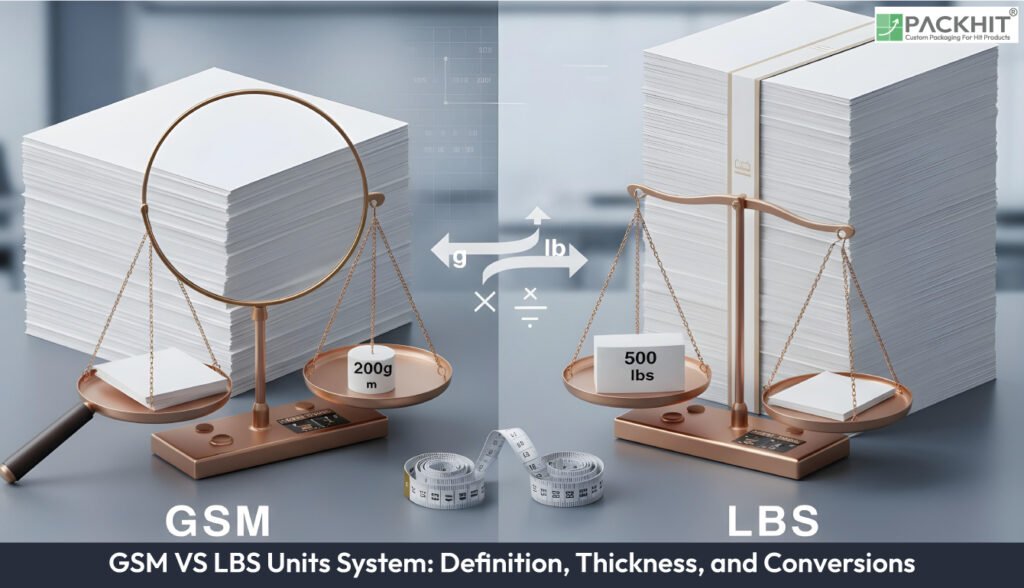
GSM (grams per square metre) defines mass per square metre for paper and board, and it frames material weight without reference to sheet size. LBS (pounds) states the basis weight for 500 sheets at a grade-specific size, so the number changes with the paper family. GSM supports packaging and printing decisions where precise mass per area matters, while LBS persists in grade‑led procurement across bond, text, and cover stocks. Thickness sits apart from both systems because density controls the link between GSM and calliper in micrometres, millimetres, or points. Conversion between GSM and LBS depends on the basic sheet area for each category, and errors arise if that reference size is wrong. Converters in the packaging sector rely on clear definitions, accurate conversions, and correct density assumptions to predict sheet stiffness, board strength, and pack performance.
- What is GSM in Paper and Board, and How is it Used?
- What is LBS in Paper Specification?
- How do GSM and LBS Differ in Function and Sector Usage?
- How is Thickness (Calliper) Expressed, and What is its Relation to GSM and Points (pt)?
- What is the Correct Conversion Formula Between GSM and Pounds (lb)?
- What Errors Occur When Converting GSM, Pounds, and Callipers?
What is GSM in Paper and Board, and How is it Used?
GSM measures sheet mass per unit area in grams per square metre (g/m²). It defines material substance independently of sheet dimensions. GSM equals the weight in grams of a one-metre by one-metre sheet. In printing, packaging, and converting, GSM appears on product datasheets to compare substrates across suppliers. The metric indicates stiffness, opacity, and printing yield. Identical GSM values can correspond to different callipers if bulk or density varies, such as between coated and uncoated boards.
What is LBS in Paper Specification?
Pounds (lb) in paper specification denote the basis weight, defined as the weight in pounds of 500 sheets cut to a grade-specific basic size. The numeric value depends on the paper category, as different grade families have different reference sheet dimensions. Common grade families include bond/writing, text/book, and cover/card. The same pound value, such as 80 lb, represents different GSM values when applied to different grades. Accurate conversion to GSM requires selecting the correct paper category because the pounds figure reflects the grade’s reference basis rather than a universal mass-per-area measurement.
How do GSM and LBS Differ in Function and Sector Usage?
GSM (grams per square metre) provides a direct metric measure of mass per unit area, making it ideal for product specification and international comparison. Pounds (lb) represents a category-bound basis weight tied to specific grade families. Industries requiring precise mass per area, such as international printing, large-scale packaging, or scientific testing, commonly use GSM. Suppliers that reference stock by traditional sheet sizes or price by ream often use pounds. Procurement operations rely on conversion between the systems to ensure consistent mass, calliper, and stiffness for die design, box strength, and print quality.
How is Thickness (Calliper) Expressed, and What is its Relation to GSM and Points (pt)?
Calliper is an independent, geometric measurement normally expressed in micrometres (µm), millimetres (mm) or in points where 1 point (pt) = 0.001 inch = 0.0254 mm; calliper must be measured with a micrometre or thickness gauge and averaged across multiple points on a sheet. Calliper does not map one‑to‑one to GSM because the relation depends on the material’s apparent density or bulk; the linking equation is direct when density is known.
Formula (answer first): thickness (mm) = GSM / density (kg·m⁻³)
- Reason: GSM is g·m⁻², convert to kg·m⁻² by dividing by 1000; dividing mass per area by density (kg·m⁻³) yields thickness in metres, then convert to millimetres.
- Equivalently: thickness_mm = GSM / d where d is density in kg·m⁻³ (for example, d = 800 kg·m⁻³ gives thickness_mm = GSM / 800).
Examples using typical density assumptions (note: density varies with manufacture and coating):
- Assume d = 800 kg·m⁻³ (common for many uncoated papers): 80 g/m² → 80 / 800 = 0.10 mm (≈ 100 µm); 300 g/m² → 300 / 800 = 0.375 mm (≈ 375 µm).
- Assume d = 1 200 kg·m⁻³ (denser boards/coated laminates): 300 g/m² → 300 / 1 200 = 0.25 mm (≈ 250 µm).
Converting calliper to points: points = thickness_mm / 0.0254. Example: 0.3048 mm → 0.3048 / 0.0254 = 12 pt (paper calliper points). Because density changes produce wide variation, expect a range of possible GSM values for any given point‑thickness; always state the assumed density when converting.
What is the Correct Conversion Formula Between GSM and Pounds (lb)?
Direct conversion between GSM (grams per square metre) and pounds (lb) requires the basic sheet area for the paper family because a pound figure equals the mass of 500 sheets at that basic size. The stepwise derivation produces a compact formula.
Derivation and formula (answer first): GSM = (lb × 453.59237) / (500 × A)
- Explanation: lb is pounds per 500 sheets; 1 lb = 453.59237 g; A is the single‑sheet basic area in square metres; mass of one sheet = (lb × 453.59237) / 500 (g); divide that mass by A to get g/m² (GSM).
- Inverse formula: lb = (GSM × 500 × A) / 453.59237
To make the formula directly usable for common grade families, compute the factor F = 453.59237 / (500 × A), so GSM = lb × F. The following commonly used basic sizes and factors are given as practical conversion constants (rounded to three significant figures):
| Grade family | Basic sheet size (in) | Basic sheet area (m²) | Factor F (GSM per lb) | Representative conversions (rounded) |
|---|---|---|---|---|
| Bond / Writing | 17 × 22 | 0.24129 | ≈ 3.758 | 20 lb bond → 75 g/m²; 24 lb → 90 g/m² |
| Text / Book | 25 × 38 | 0.61290 | ≈ 1.480 | 80 lb text → 118 g/m²; 100 lb → 148 g/m² |
| Cover / Card | 20 × 26 | 0.33548 | ≈ 2.704 | 65 lb cover → 176 g/m²; 80 lb → 216 g/m² |
Worked example 1 (forward): Convert 80 lb cover to GSM. GSM = 80 × 2.704 ≈ 216.3 g/m². Worked example 2 (reverse): Convert 300 g/m² to cover pounds. lb = 300 / 2.704 ≈ 110.95 lb (cover basis size).
What Errors Occur When Converting GSM, Pounds, and Callipers?
Frequent conversion errors arise from misidentifying paper family, using universal factors, confusing point types, or relying solely on supplier data. Each issue can be mitigated through proper checks:
- Ignoring paper family causes incorrect GSM-to-pound conversions. Confirm the correct grade family and basic sheet size before converting.
- Assuming a universal conversion factor leads to inaccurate specifications across paper types. Apply the factor specific to the selected paper family.
- Confusing typographic points with calliper points results in thickness misinterpretation. Always use calliper points (0.001 in) when measuring substrate thickness.
- Relying solely on supplier data may mask deviations in mass or thickness. Verify material by weighing a known area and measuring with a calliper at multiple points, then cross-check with test certificates.