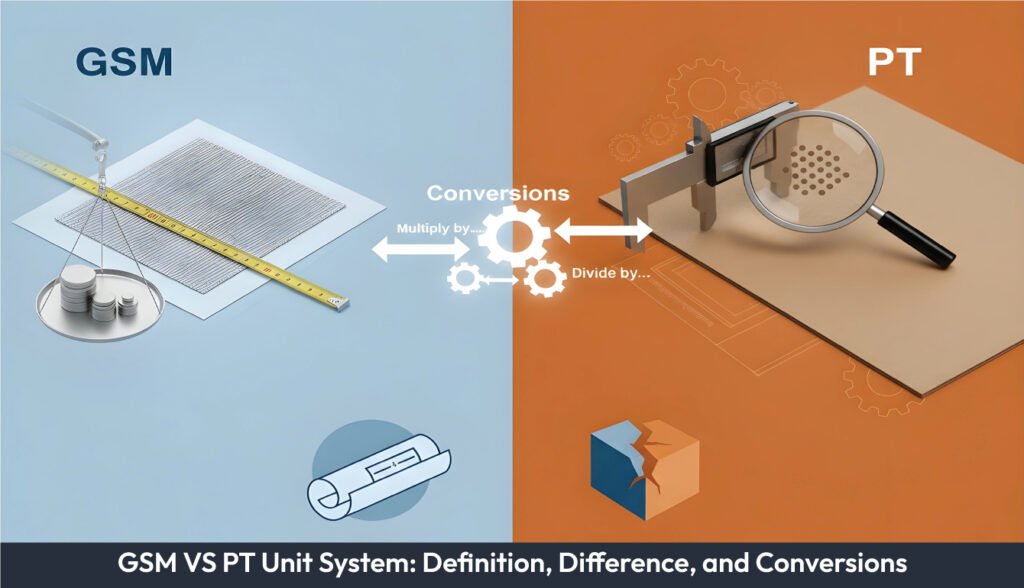
GSM (Grams per Square Meter) and PT (Point) are two measurement systems used in the packaging and printing industries to evaluate paper and paperboard materials, although they represent different properties. GSM measures weight per square metre, while PT measures material thickness. Understanding how these units relate and how to convert between them is essential for selecting the right substrate, ensuring print compatibility, meeting structural requirements, and communicating accurately with global suppliers. GSM and PT measure different physical characteristics; specific formulas must be used to convert between them. Errors can occur during the conversion process, but several best practices help ensure accuracy.
- What is Grams per Square Meter (GSM)?
- What is a Point (PT)?
- What is the Difference Between GSM and PT?
- How to Convert Between GSM (Grams per Square Meter) and PT (Point)?
- How to Ensure Accurate Conversions Between GSM and PT?
- What are the Typical Errors that Occur When Measuring GSM and PT?
- How to Choose Between GSM and PT in Packaging Specifications?
What is Grams per Square Meter (GSM)?
GSM (grams per square metre) measures the weight of paper, cardboard, or other sheet materials per square metre. Although GSM often correlates with thickness, it technically reflects mass per area. Higher GSM values usually indicate thicker, stronger materials, while lower GSM values correspond to lighter, thinner sheets. GSM strongly affects durability, print quality, and cost.
Examples:
- Standard office paper: ~80 g/m²
- Corrugated cardboard: 200–400 g/m²
- Label stock: 120–150 g/m²
- Lightweight packaging films typically have lower GSM, whereas rigid cartons require higher GSM for strength.
What is a Point (PT)?
PT (point) is a unit used to measure the thickness of paper, board, and other sheet materials. One point equals 0.001 inches. Higher PT values indicate thicker, more rigid materials, while lower PT values correspond to thinner, more flexible sheets.
Examples:
- Standard business cards: 10–12 PT
- Corrugated board liners: 20–30 PT
- Rigid carton boards: 12–16 PT
What is the Difference Between GSM and PT?
The difference between GSM (Grams per Square Meter) and PT (Point) describes two separate measurements. Manufacturers use this distinction to compare materials with different densities, coatings, and fibre structures. The table below lists the core contrasts, using factors applied in packaging selection across paperboard, chipboard, and carton stocks.
| Factors | GSM (Grams per Square Meter) | PT (Point) |
|---|---|---|
| Measurement Type | Weight per square meter of the sheet | Thickness measured in 0.001-inch increments |
| Primary Use in Packaging | Evaluates strength, density, and fibre mass | Evaluates stiffness, fold behaviour, and calliper |
| Influence of Density | Changes according to substrate density and coatings | Does not reflect density; only physical thickness |
| Interpretation | Heavier GSM signals indicate higher material mass | Higher PT signals a thicker sheet structure |
| Common Usage Examples | Office paper (80 GSM), folding cartons (250–400 GSM) | Business cards (10–12 PT), chipboard (16–24 PT) |
| Role in Custom Packaging | Helps compare substrates with different fibre blends | Helps match dielines and structural design tolerances |
| Conversion Dependency | Requires density to convert to PT | Requires density to convert to GSM |
The comparison in the above table supports buyers and converters who receive mixed specifications from global suppliers, because GSM reflects mass and PT reflects thickness. Both units describe substrate behaviour differently, so packaging teams evaluate them together when confirming printability, folding response, and structural load.
How to Convert Between GSM (Grams per Square Meter) and PT (Point)?
To convert between GSM and PT, follow the steps given below:
- Start with density ρ in g/cm³ and sheet thickness t in millimetres.
- Convert density to g/m³ by multiplying ρ by 1000000 and convert thickness to metres by dividing t by 1000.
- Mass per unit area then equals volumetric density multiplied by thickness, so GSM equals ρ × t × 1000. This relationship states the direct link between bulk density, sheet thickness, and resulting areal mass.
- Replace t with PT × 0.0254 mm, because one point equals 0.0254 mm. Substitution produces the simplified expression:
- GSM = PT × 25.4 × ρ(g/cm³)
- This form helps packaging teams compare PT and GSM without measuring both values if density is known. Recover PT from GSM by rearranging the same expression:
- PT = GSM / (25.4 × ρ(g/cm³))
- Manufacturers use these paired equations in carton development, if a buyer specifies weight-based metrics, while converters rely on the calliper. The relationship supports a consistent specification when different suppliers quote materials in PT or GSM, especially across coated, uncoated, and multi‑ply stocks listed in common packaging catalogues. Use the actual bulk density of the substrate (including coatings, fillers, and porosity) for accurate results. This ensures proper material selection for packaging, printing, and structural applications.
Use the formula GSM = PT × 25.4 × ρ and substitute an assumed density to produce numeric estimates. The table below provides estimated GSM values for common materials with PT thicknesses using different assumed densities, allowing manufacturers and designers to approximate material weight from its thickness.
| Material / PT | Thickness (mm) | GSM (ρ = 0.7 g/cm³) | GSM (ρ = 0.9 g/cm³) | GSM (ρ = 1.0 g/cm³) |
|---|---|---|---|---|
| Single-ply Paper / 6 PT | 0.1524 mm | 106.7 gsm | 137.2 gsm | 152.4 gsm |
| Cardboard / 10 PT | 0.2540 mm | 177.8 gsm | 228.6 gsm | 254.0 gsm |
| Corrugated Board / 12 PT | 0.3048 mm | 213.4 gsm | 274.3 gsm | 304.8 gsm |
| Chipboard / 16 PT | 0.4064 mm | 284.5 gsm | 365.8 gsm | 406.4 gsm |
The values in the table above provide a practical reference for estimating the weight of paper and cardboard based on thickness and assumed density. Actual GSM may vary depending on the material composition and manufacturing process, so these conversions should be used as guidelines rather than exact measurements.
How to Ensure Accurate Conversions Between GSM and PT?
To ensure accurate conversions between GSM and PT, follow the steps below:
- Use the correct bulk density for the specific material, because both units measure different physical properties: weight versus thickness.
- Verify the material’s density from technical datasheets.
- Measure thickness with a calibrated micrometre.
- Avoid relying on generic charts unless the density matches your substrate.
- For coated, laminated, or multi-ply boards, take separate measurements because coatings and fillers change density and affect conversion accuracy.
What are the Typical Errors that Occur When Measuring GSM and PT?
The typical errors that occur when measuring GSM and PT include:
- Improper Sample Cutting: Using uneven or uncleanly cut samples skews GSM readings.
- Moisture Variation: High or low moisture content in the substrate alters weight and thickness measurements.
- Incorrect Calibration: Scales or micrometres not properly calibrated lead to systematic errors.
- Insufficient Sample Size: Measuring too few sheets produces non-representative results.
- Compression During Measurement: Excessive pressure when measuring PT can reduce thickness readings.
- Temperature Effects: Extreme temperatures expand or contract fibres, affecting both GSM and PT.
- Ignoring Substrate Variability: Variations within the batch (coatings, fillers, or uneven fibres) lead to inconsistent measurements.
- Instrument Misalignment: Misaligned micrometres or balances can produce inaccurate readings.
How to Choose Between GSM and PT in Packaging Specifications?
Choosing between GSM and PT in packaging specifications is dependent on the type of material, the manufacturing process, and the priority of the measurement. GSM, which measures the weight of paper or board per square meter, is ideal when strength, thickness, and durability are key factors. It is commonly used for paperboard, corrugated liners, and flexible packaging, as it reflects material density and allows for easy comparison between different substrates.
PT, on the other hand, measures sheet thickness in thousandths of an inch (1 PT = 0.001 inch) and is often preferred in industries like folding cartons, chipboard, and rigid packaging, where physical thickness, folding performance, and stackability are more relevant than weight. Designers and converters frequently use PT to match dieline specifications or ensure proper box construction. In practice, GSM should be used when the focus is on material weight, fibre composition, or strength, while PT is more suitable when thickness, stacking, or folding behaviour is critical.