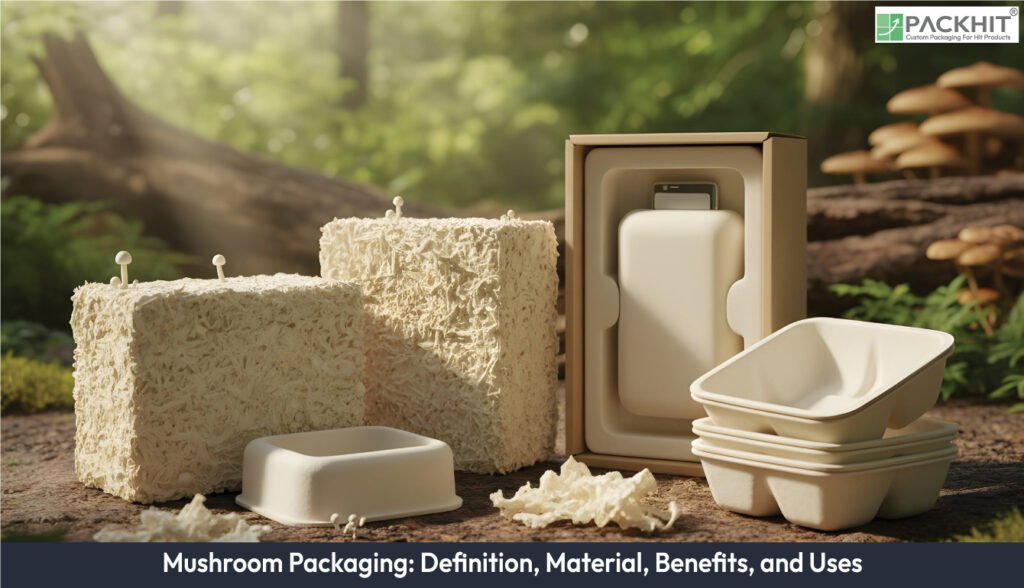
Mushroom packaging leverages mycelium grown on agricultural residues to provide a sustainable, biodegradable alternative to conventional foams. The material delivers protective performance while remaining lightweight and highly moldable, making it suitable for applications in electronics, retail, food, and luxury sectors. Adoption depends on production scale, material durability, and the development of local supply chains. Ongoing process improvements and innovations in moulding, incubation, and preservation continue to expand its practical applications and market potential.
- What is Mushroom Packaging?
- What Materials are Used to Make Mushroom Packaging?
- How is Mushroom Packaging Manufactured?
- What are the Benefits of Mushroom Packaging?
- Rapid Biodegradability
- Renewable Feedstock Use
- Customisable Moulding
- Protective Cushioning
- Efficient Shipping
- Low-Energy Production
- Cost-Effective Sourcing
- Sustainability-Focused Brand Value
- What are the Uses of Mushroom Packaging?
- Electronics Packaging
- Retail and Fulfilment Packaging
- Food and Hospitality Packaging
- Luxury Goods Packaging
- How do Production Costs Affect Mushroom Packaging?
- What Constraints and Limitations Affect Mushroom Packaging?
- What is the Future of Mushroom Packaging?
What is Mushroom Packaging?
Mushroom packaging is a packaging material formed from mycelium that substitutes polystyrene and rigid plastic trays for protective shipping applications. Mushroom packaging was developed via a MycoComposite approach and is associated with inventor Jan Berbee; the product is classified as a renewable, biobased packaging material with the primary function of cushioning and secure shipment of goods.
What Properties Does Mushroom Packaging Provide?
Mushroom packaging delivers protective performance for fragile devices and heavier items by combining cushioning, structural stability, and moisture tolerance. The material supports products such as computer servers, furniture pieces, and glass jars during shipping and handling.
- Sturdiness: Provides firm structural support and reduces impact risk during transit. Used for inserts that hold bottles or electronics securely inside a parcel.
- Cushioning: Absorbs energy during drops or shocks. Applied to foam-like inserts that protect laptops and delicate components.
- Mouldability: Forms precise geometry that matches product contours. Seen in custom inner trays for premium or high-value goods.
- Lightweight Mass: Reduces shipping weight and improves shipping efficiency. Helps lower fuel use across e-commerce shipments.
- Water Resistance: Maintains integrity under normal humidity and logistics conditions. Provides reliable protection for glass bottles during wet-weather transit.
Mechanical limitations include lower long-term durability than many fossil-fuel plastics and shorter service lifespans, making it unsuitable for applications requiring extended outdoor exposure or multi-year structural protection.
What Materials are Used to Make Mushroom Packaging?
Mycelium forms the structural foundation of mushroom packaging, grown on a combination of lignocellulosic substrates, live mycelial inoculum, and small amounts of binding or processing aids. These key components work together to create a lightweight, moldable, and biodegradable composite, which is described in detail in the sections below.
- Lignocellulosic Substrate: Agricultural waste such as hemp hurds, straw, or bran provides structure and nutrients for mycelial growth. It contributes to the composite’s lightweight nature and moldability, enabling precise shaping.
- Live Mycelial Inoculum: The fungal root network binds and colonises the substrate, forming the structural foundation of the packaging. It ensures biodegradability, compostability, and overall durability of the material.
- Binding or Processing Aids: Small additives help consolidate the mixture into a solid composite, commonly called MycoComposite, and enhance water resistance, stability during handling, and maintain moldable properties for custom geometries.
Is Mushroom Packaging Environmentally Friendly?
Mushroom packaging delivers strong environmental advantages because it uses renewable feedstock, consumes little energy during production, and returns safely to natural systems at the end of life. The material is biodegradable and compostable, and it often outperforms petroleum-based foams across several life-cycle impact categories.
Environmental attributes include rapid biodegradation in soil, effective composting alongside food waste, moderate CO₂ uptake during mycelial growth, and low energy inputs during manufacturing. The material typically reduces carbon footprint compared with expanded polystyrene when used for equivalent protective functions.
How is Mushroom Packaging Manufactured?
Mushroom packaging follows a controlled sequence that guides growth, shaping, and stabilisation. Each stage prepares the material for the next to ensure consistent structure and performance.
- Substrate Preparation: Agricultural residues are cleaned, sized, and conditioned to create a nutrient-rich base that supports mycelial growth.
- Inoculation: Live mycelium is mixed evenly through the prepared substrate to initiate biological activity and begin network formation.
- Mould Filling: The inoculated mixture is placed into reusable or single-use moulds designed for the required packaging geometry.
- Incubation and Colonisation: Mycelium grows through the substrate under controlled temperature and humidity, binding particles into a cohesive, mould-shaped composite.
- Stabilisation: A low-energy preservation step stops further biological activity, dries the material, and locks the final structure in place.
The full cycle usually completes in about one week and produces a lightweight, compostable, and form-stable packaging component.
What are the Benefits of Mushroom Packaging?
Mushroom packaging offers meaningful ecological and logistical advantages that influence material selection, sustainability strategy, and product presentation. Mushroom packaging’s biological origin, adaptable form, and low-energy manufacturing support both environmental goals and practical performance needs across industries.
Rapid Biodegradability
Mushroom packaging breaks down quickly in soil and compost, allowing discarded parts to return to natural cycles without specialised processing. Many post-consumer pieces decompose within weeks when added to food-waste compost, creating a low-impact end-of-life pathway.
Renewable Feedstock Use
Production relies on agricultural residues such as hemp hurds and bran, reducing dependence on virgin petrochemicals. Using waste biomass as the primary input strengthens the circular value of the material and reduces overall resource extraction.
Customisable Moulding
Mycelium grows into virtually any moulded shape, enabling packaging components that match product contours with high accuracy. Luxury goods, perfumes, and other fragile items often benefit from these tailored cavities that ensure stable in-box positioning.
Protective Cushioning
The composite structure delivers cushioning and shock absorption suitable for many delicate items. Electronics, glassware, and small appliances gain consistent impact resistance, often comparable to conventional foam inserts used in protective transit packaging.
Efficient Shipping
The material remains significantly lighter than many petroleum-based foams, which supports lower fuel use across logistics networks. E-commerce shipments, parcel carriers, and fulfilment centres often experience reduced transport loads when switching to mycelium-based inserts.
Low-Energy Production
Manufacturing depends on incubation rather than high-heat polymer processing, resulting in modest energy requirements. Growth chambers operate at stable, low temperatures, and the preservation step avoids intensive mechanical or thermal treatment.
Cost-Effective Sourcing
Feedstocks remain inexpensive and widely available, enabling economical production in regions with access to agricultural by-products. Many supply scenarios demonstrate cost parity with polystyrene foam, especially when disposal savings or sustainability commitments are factored in.
Sustainability-Focused Brand Value
Brands often adopt mushroom packaging to communicate environmental responsibility and align with consumer expectations for greener materials. The natural appearance and compostable profile of mushroom packaging reinforce sustainability narratives for organic, luxury, and eco-focused product lines.
What are the Uses of Mushroom Packaging?
Mushroom packaging appears primarily in protective shipping applications across electronics, food and hospitality, consumer goods, e-commerce, and luxury markets. Growing adoption reflects the material’s ability to provide moulded protection, reduce plastic use, and support sustainability-led branding.
Electronics Packaging
Electronics manufacturers have adopted mycelium inserts for laptops, peripherals, and small components. Custom-shaped trays stabilise products in transit and replace conventional foams in pilot and commercial shipments.
Retail and Fulfilment Packaging
Direct-to-consumer brands employ mycelium moulds for candles, glassware, and other fragile items. Moulded supports enhance presentation, lower breakage rates, and offer an eco-friendly unboxing moment.
Food and Hospitality Packaging
Organic producers and bakeries use mushroom-based trays and boxes for fresh produce, baked goods, and meal kits. Compostable formats align well with short shelf-life products and waste-stream compatibility.
Luxury Goods Packaging
Premium perfumes, spirits, and gifting assortments often rely on mycelium mouldings to cradle delicate bottles. Sustainable material choice reinforces luxury positioning while ensuring high-quality protection during shipping.
How do Production Costs Affect Mushroom Packaging?
Production costs and manufacturing scale determine mushroom packaging adoption. Small-scale operations face higher unit costs due to mould tooling, controlled incubation, and feedstock preparation. Local agricultural residues and optimised workflows reduce expenses. Scaling production spreads fixed costs over larger volumes, increases throughput, and improves material durability. Expanded manufacturing capacity and process efficiency make mushroom packaging a cost-competitive, sustainable alternative to conventional plastics.
What Constraints and Limitations Affect Mushroom Packaging?
Mushroom packaging faces several constraints that influence its suitability for different applications. Shorter storage lifespan and lower durability compared with some fossil-fuel plastics limit use in products requiring multi-year storage or repeated outdoor exposure. Limited commercial availability and regional production challenges, especially in climates unsuitable for low-cost cultivation, restrict widespread deployment.
Cost and supply factors vary: raw materials are inexpensive, and production can remain low-energy, but current market prices are sometimes higher than EPS (expanded polystyrene). Scaling production and improving local supply chains can make mushroom packaging more cost-competitive with conventional polystyrene foams.
What is the Future of Mushroom Packaging?
Mushroom packaging is gaining interest across industries as a sustainable alternative to EPS (expanded polystyrene). Early adoption includes luxury brands, consumer products, and technology manufacturers, while retail chains explore pilot projects for furniture, fragile items, and other product categories.
Wider adoption depends on improving material durability, expanding local production capacity to lower tooling and logistics costs, and establishing reliable composting and end-of-life systems. Scaling production and implementing process innovations are expected to reduce unit costs and increase market penetration, especially in sectors driven by sustainability priorities and regulatory pressures.