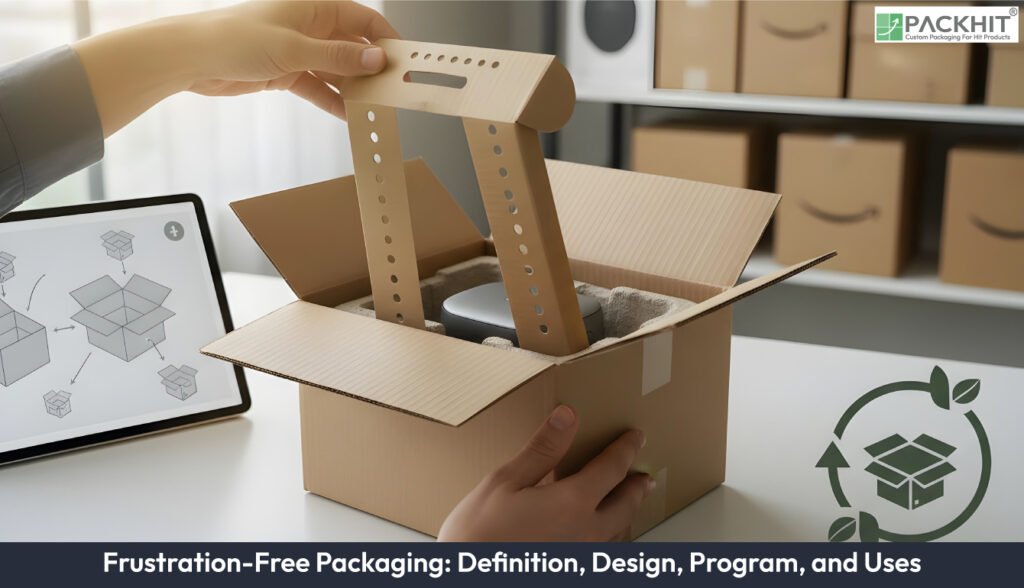
Frustration-free packaging minimises material use, streamlines opening, and enhances recyclability while maintaining adequate product protection. The approach integrates design principles such as right-sizing, single-material construction, and engineered restraint. Frustration-free packaging is applied through structured programmes that guide sellers, validate performance, and influence supply-chain operations. Measurable outcomes include reduced packaging mass, improved consumer handling, and alignment with sustainability and operational efficiency goals across retail and e-commerce channels.
- What is Frustration-Free Packaging (FFP)?
- What are the Functional Roles of Frustration-Free Packaging?
- How is Frustration-Free Packaging Designed?
- 1. Assess Product Dimensions and Fragility
- 2. Right-Size the Package
- 3. Select Single-Material Construction
- 4. Integrate Product Support
- 5. Design Accessible Closures
- 6. Evaluate Material Properties
- 7. Apply Clear Labelling
- 8. Prototype and Test
- How Does Amazon’s Frustration-Free Packaging Programme Operate?
- Programme Purpose and Scope
- Packaging Design Requirements
- Protection and Performance Expectations
- Seller Compliance and Validation
- Impact on Sellers and Listings
- Where is Frustration-Free Packaging (FFP) Applied?
- E-Commerce Shipments
- Consumer Electronics
- Household and Everyday Products
- Subscription and Direct-to-Consumer Products
- Retail-Ready Online Orders
- Sustainability-Focused Brands
- What are the Workflow Steps for Implementing Frustration-Free Packaging?
- What are the Benefits of Frustration-Free Packaging?
- What Challenges are Associated With Frustration-Free Packaging?
- What are Emerging Frustration-Free Packaging Trends?
- What is the Difference Between Frustration-Free and Standard Packaging?
What is Frustration-Free Packaging (FFP)?
Frustration-free packaging minimises excess material and simplifies product opening while maintaining adequate protection during handling and transport. It focuses on using the smallest combination of components and geometry needed to secure the product, removing unnecessary secondary packaging and non-recyclable elements.
What are the Functional Roles of Frustration-Free Packaging?
Specifications aim to reduce packaging mass per unit, streamline the unboxing experience, and improve recyclability. Functional roles include optimising package dimensions for storage and palletisation, lowering material waste and landfill impact, and reducing costs through less material use and lower dimensional-weight shipping charges.
How is Frustration-Free Packaging Designed?
Design for frustration-free packaging follows engineering constraints that trade material reduction against protection requirements; the primary design principle is to remove redundant material while retaining structural integrity for the shipment environment.
1. Assess Product Dimensions and Fragility
Measure length, width, height and mass, then review fragile zones such as protrusions or thin panels. Map these points against expected transport loads like 1.2 m drops or compression from stacking, and set a minimum protection threshold that avoids excess stabilising material.
2. Right-Size the Package
Create a close-fit geometry that removes surplus void volume. Use the measured tolerances with small clearance bands, and align internal dimensions with parcel carrier brackets that reduce dimensional‑weight charges. Reduce void areas if they do not support fixation or impact absorption.
3. Select Single-Material Construction
Pick one recyclable substrate such as corrugated kraft, moulded pulp or fibreboard. Match board grade or pulp density to expected vibration and compression patterns. Keep coatings minimal so the complete unit enters standard recycling streams without material separation.
4. Integrate Product Support
Add inserts, sleeves or die-cut partitions that restrain the item at contact points. Use structural folds, pulp trays or corrugated ribs that provide retention without loose fill such as airbags or peanuts. Ensure each support part shares the same material family as the outer box.
5. Design Accessible Closures
Set up opening lines with tear strips, perforated bands or single-action tabs that cut opening time. Trim tape usage where mechanical locks or slot‑and‑tab joints already secure the flaps. Keep closure paths predictable so end‑users avoid tools.
6. Evaluate Material Properties
Check stiffness, burst strength and edge‑crush values against transport loads. Match these numbers with the product’s fragility class. Reduce board thickness or switch flute profiles only if the new structure maintains adequate resistance to impact and flex.
7. Apply Clear Labelling
Print recycling marks and opening guidance near principal seams. Use concise arrows or numbered steps that prevent incorrect tearing paths or disposal errors. Keep ink coverage low so recyclability stays consistent with single-material design.
8. Prototype and Test
The packaging prototype involves building a pre-production sample and testing it for drop, vibration, and compression performance. Panel deflection and internal movement are observed. The insert geometry or board grade is adjusted as needed, and opening paths are checked to ensure simple handling during consumer trials.
How Does Amazon’s Frustration-Free Packaging Programme Operate?
Amazon’s Frustration-Free Packaging (FFP) programme operates as a set of mandatory packaging guidelines that sellers must meet to reduce waste, simplify opening, and maintain in-transit protection within Amazon fulfilment networks.
Programme Purpose and Scope
The programme aims to minimise excess packaging and improve the customer unboxing experience while ensuring products withstand standard fulfilment handling. Compliance applies to eligible products sold through Amazon and can affect listing eligibility, visibility, and fulfilment options.
Packaging Design Requirements
The guidelines require reduced material use, elimination of unnecessary secondary packaging, and packaging that opens without tools. Designs prioritise right-sized, ship-ready formats that can move through fulfilment without an additional overbox.
Protection and Performance Expectations
Packaging must protect products from damage under typical fulfilment stresses, including drops, vibration, and stacking. Structural integrity remains a requirement even as material volume and components are reduced.
Seller Compliance and Validation
Sellers submit packaging designs for testing against Amazon’s performance criteria. Approved packaging qualifies for programme tiers and may receive operational or merchandising benefits within the platform.
Impact on Sellers and Listings
Participation can lower packaging costs, reduce damage rates, and improve customer satisfaction. Non-compliant products may face additional packaging requirements or reduced programme eligibility.
Where is Frustration-Free Packaging (FFP) Applied?
Frustration-free packaging is applied where efficient protection, simplified opening, and reduced material use improve logistics and user experience without compromising product safety.
E-Commerce Shipments
E-commerce shipments use frustration-free packaging to ship products directly to customers without extra overboxing. Right-sized, ship-ready packs reduce void fill, lower dimensional weight, and simplify fulfilment operations.
Consumer Electronics
Consumer electronics apply frustration-free packaging to protect devices while eliminating plastic clamshells, ties, and complex inserts. Single-box corrugated designs with fitted supports provide protection and easy access.
Household and Everyday Products
Household goods such as small appliances, personal care items, and home accessories use frustration-free packaging to streamline unboxing and reduce disposal waste. Designs focus on minimal components and intuitive opening paths.
Subscription and Direct-to-Consumer Products
Subscription and DTC products use frustration-free packaging to support repeat shipments and a consistent customer experience. Lightweight, recyclable materials reduce shipping costs and simplify end-of-life handling.
Retail-Ready Online Orders
Retail-ready items sold online use frustration-free packaging to combine product presentation with transport protection. Packaging serves both shipping and display functions without secondary cartons.
Sustainability-Focused Brands
Sustainability-led brands apply frustration-free packaging to meet waste-reduction goals and recycling commitments. Mono-material fibre solutions and clear recovery labelling support circular-economy objectives.
What are the Workflow Steps for Implementing Frustration-Free Packaging?
Implementation proceeds through product characterisation, packaging design iteration, pilot shipments, performance measurement and scale-up into fulfilment operations.
- Product characterisation: The product’s mass, geometry, fragile features, and handling sensitivities are identified to define itsprotection needs.
- Protection specification: Acceptable damage rates and transport limits, such as drop height, vibration, and compression, are set.
- Design and material selection: Right-sized, single-material packaging concepts are developed to strike a balance between protection, recyclability, and efficiency.
- Prototype production: Physical samples are created for fit, protection performance, and ease of opening.
- Pilot shipments: Limited production runs move through real fulfilment channels to capture damage, return, and customer feedback data.
- Performance validation: Pilot results are reviewed against protection, cost, and experience targets.
- Scale-up and integration: Approved designs are released to suppliers and integrated into fulfilment and packing operations.
What are the Benefits of Frustration-Free Packaging?
Frustration-free packaging delivers measurable material, logistics, and user-experience benefits, while introducing design and merchandising trade-offs that must be managed during implementation.
- Material reduction: Frustration-free packaging lowers material use per unit by removing redundant layers and components, with documented reductions of around 30–40% in optimised cases.
- Transport efficiency: Right-sized packs reduce dimensional weight charges and improve pallet density, which lowers freight cost and emissions per shipment.
- Consumer experience: Simplified opening paths reduce effort, remove the need for tools, and decrease perceived packaging waste, improving customer satisfaction.
- Environmental performance: Reduced material mass and simplified material mixes support recycling targets and lower life-cycle impacts.
- Engineering trade-off: Reduced material margins require tighter tolerances, more prototyping, and additional testing to maintain damage performance.
- Retail presentation trade-off: Minimal designs can limit decorative finishes or shelf impact, which may be a constraint for products intended for in-store merchandising.
What Challenges are Associated With Frustration-Free Packaging?
Frustration-free packaging delivers efficiency gains but introduces several practical challenges that must be managed during design and deployment.
- Engineering sensitivity arises because reduced material leaves less tolerance for shock, vibration, and compression errors.
- Higher upfront effort is required for design iteration, prototyping, and performance testing to maintain protection.
- Damage risk exposure increases if protection criteria or distribution hazards are underestimated.
- Retail presentation limits occur where simplified structures reduce branding surface or shelf impact.
- Supplier capability gaps appear when converters lack tooling or experience with precision die-cuts or moulded pulp.
- Process integration complexity emerges when new pack formats must align with automated fulfilment or packing lines.
What are Emerging Frustration-Free Packaging Trends?
The frustration-free packaging has shifted from isolated initiatives to a systematic approach. The following observable trends highlight how brands and retailers are advancing design, sustainability, and operational efficiency.
- Structured frameworks now replace ad hoc optimisation, with clear guidelines for material use, protection, and opening experience.
- Sustainability alignment has strengthened, as packaging metrics link directly to waste reduction targets and environmental reporting.
- Ship-ready design adoption is increasing, with brands shifting from decorative multi-substrate packs to single-unit recyclable formats.
- E-commerce focus continues to grow, driven by high parcel volumes and the need for efficient fulfilment packaging.
- Data-driven evaluation is expanding, using damage rates, material intensity, and customer feedback to refine designs.
What is the Difference Between Frustration-Free and Standard Packaging?
Frustration-free packaging emphasises minimal material, recyclability and opening simplicity; standard packaging often prioritises multi-layer protection and display characteristics over material minimisation. The table below highlights the key distinctions between frustration-free packaging and standard packaging, focusing on material use, unboxing experience, recyclability, and protective strategies.
| Characteristic | Frustration-Free Packaging | Standard Packaging |
|---|---|---|
| Material intensity | Low; removes non-essential components (e.g., no excessive plastic clamshells) | Higher; uses multiple substrates for protection and presentation (e.g., blister packs plus outer boxes) |
| Unboxing | Simplified; accessible closures and minimal seals (e.g., perforations, tear tabs) | Complex; sealed blisters, glued inserts, multiple layers (e.g., sealed trays requiring tools) |
| Recyclability | Optimised for single-material recovery (e.g., corrugated-only constructions) | Often mixed materials that complicate recycling (e.g., plastic-coated paper, mixed plastics) |
| Protection philosophy | Engineered restraint and impact absorption using minimal material (e.g., tailored inserts) | Redundancy and cushion via excess void fill (e.g., loose-fill peanuts, thick bubble wrap) |
Frustration-free packaging prioritises material efficiency, consumer convenience, and recyclability, while standard packaging often emphasises multi-layer protection and retail presentation.