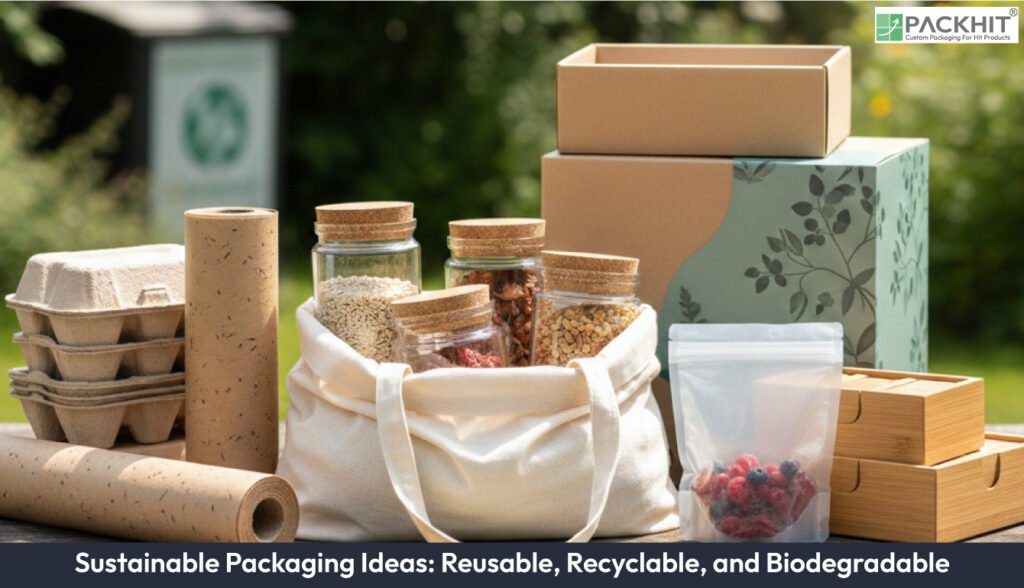
Sustainable packaging ideas cover reusable formats, recyclable fibre or polymer systems, and biodegradable grades that break down through biological activity. Reusable packaging ideas focus on durable formats such as reusable mailers, HDPE refill bottles, glass containers, steel tins, and returnable crates that withstand washing, transport stress, and repeated circulation. Recyclable packaging ideas rely on mono-material or fibre-pure formats, including kraft paper, corrugated board, mono-polymer bottles, aluminium containers, environmentally friendly labels, and brown paper that sort and reprocess cleanly. Biodegradable and compostable packaging ideas cover compostable films, plantable seed papers and capsules, mushroom packaging, cellulose packaging, and edible packaging that break down under biological conditions when uncontaminated. Each material’s performance depends on coatings, inks, adhesives, and structural design. For liquids, sustainable packaging ideas perform best when barrier needs match the system, with refillable glass and HDPE, mono-polymer bottles or pouches, and aluminium containers leading recovery outcomes. Leak-proof closures, washable containers, and returnable crates support reuse and refill logistics. Overall, sustainable packaging works best when claims match how the pack is actually reused, recycled, or composted in the UK system.
The sustainable packaging ideas are detailed below:
- Reusable Packaging Ideas
- 2. Recyclable Packaging Ideas
- Kraft Paper
- Corrugated Fibreboard
- Mono‑Polymer Bottles
- Aluminium Containers
- Environmentally Friendly Labels
- Brown Paper
- 3. Biodegradable and Compostable Packaging Ideas
- Compostable Films
- Plantable Seed Paper
- Plantable Seed Capsules
- Mushroom Packaging
- Cellulose Packaging
- Edible Packaging
- Which Sustainable Packaging Ideas Perform Best for Liquids?
- What is the Difference Between Reusable, Recyclable, and Biodegradable Packaging?
- What is Practical, Sustainable Packaging for Cosmetics?
- What are the Most Effective Sustainable Packaging Options for Retail and E-commerce?
- What Certifications and Tests Substantiate Sustainable Packaging Claims?
Reusable Packaging Ideas
Reusable packaging ideas describe container formats that repeat service cycles with controlled washing, predictable return loops and stable mechanical strength in transit. Reusable packaging ideas are explained below:
Reusable Mailers
Reusable mailers use polymer laminates or textile fibres that withstand the flex, drag and abrasion seen during multi‑stop courier routes. Reusable mailers rely on stitched seams that hold tensile loads during return cycles. Reusable mailers carry zips or snap systems that maintain alignment through repeated use, and detachable labels use dispersible adhesives that release in fibre or polymer recycling lines.
HDPE Refill Bottles
HDPE Refill Bottles use melt‑strength grades that keep panel shape during hot filling, crate stacking and courier compression. HDPE Refill Bottles hold dimensional stability through sanitation cycles at refill points, if temperatures stay inside the polymer’s tolerance range. HDPE Refill Bottles keep neck geometry consistent across repeated torque loads, and scuff‑resistant pigments reduce abrasion during pooled transport. HDPE Refill Bottles shed water‑dispersible adhesives in wash tanks used by UK recycling plants, and straight‑wall bodies reduce label lift during return circulation.
Glass Containers
Glass Containers use thick‑walled soda‑lime bodies that keep dimensional tolerance through alkaline wash cycles and multi‑stop crate transport, if impact loads stay below fracture limits. Glass Containers keep thread alignment stable during repeated sealing because thermal expansion stays low, and pooled IDs track circulation counts across UK refill routes. Glass Containers move through standardised refill stations where neck finishes match automated washers and fillers, and fibre‑free outer labels detach in wash tanks used by regional recovery networks.
Steel Tins
Steel Tins use drawn or rolled alloys that stay rigid across repeated loops for powders, grains and dry household items. Steel Tins rely on thin food‑safe lacquers that slow moisture‑driven corrosion if packers prevent abrasion during filling and transit. Steel Tins keep seams tight under pooled distribution loads, and printed coatings detach during high‑temperature recovery because pigment layers separate from the substrate. Steel Tins pass magnetic separation in UK facilities, and uniform wall geometry supports stable stacking through warehouse returns and bulk transport.
Returnable Crates
Returnable crates use HDPE walls that resist deformation through repeated pool cycles and dense warehouse stacking. Returnable crates rely on rib structures that manage scuff loads when crates slide or pivot during handling, and these ribs reduce wall fatigue across long return chains. Returnable crates move through wash tunnels that clear residues without distorting the frame if operators control the wash temperature. Returnable crates carry barcodes or pooled identifiers that track circulation counts in UK networks, and footprint consistency maintains pallet stability during mixed rotations of liquids and fragile items.
2. Recyclable Packaging Ideas
Recyclable packaging ideas use mono-material formats or fibre recovery systems with predictable sorting behaviour. These recyclable packaging ideas are mentioned below:
Kraft Paper
Kraft paper uses unbleached fibres with long tensile strands that stabilise parcels during multi-stop delivery, and fibre purity raises recovery yields in UK mills. Kraft paper supports recyclable use because water-based inks detach during re‑pulping and dispersible adhesives clear in screening, if converters keep pigment and adhesive loads low. Thin barrier coatings protect dry goods without blocking fibre access, and single-material wraps reduce sorting errors across municipal collections. Uncoated kraft paper returns to fibre cycles or soil systems with minimal residue.
Corrugated Fibreboard
Corrugated fibreboard uses fluted mediums between kraft liners that maintain compressive strength during warehouse stacking and courier drops. Uncoated liners re‑pulp cleanly in UK fibre streams, and flutes collapse during shredding without contaminating other grades. Moisture exposure softens untreated boards; if humidity rises, packers adjust liner weight and flute ratios to match handling risks. Flat‑packed boxes minimise contamination at collection points and maintain predictable sorting in MRFs.
Mono‑Polymer Bottles
Mono‑polymer bottles use single‑resin PE or PP forms that pass UK sorting lines with fewer false reads because optical sensors detect one polymer type. Bottles reduce contamination in reprocessing streams if caps match the main resin grade. Thicker bases hold shape under courier compression, and dispersible‑adhesive sleeves detach in wash tanks without pigment carryover. Simplified builds raise capture rates and keep polymer loops cleaner.
Aluminium Containers
Aluminium containers use rolled or drawn alloys that block oxygen, light and moisture while retaining compatibility with eddy‑current separation. Internal lacquers provide inert contact layers if coating weights stay within remelting tolerances. Scored lines guide controlled tearing, and consistent wall thickness reduces denting during transit. Closed recycling loops keep alloy quality stable across repeated cycles.
Environmentally Friendly Labels
Environmentally friendly labels use paper or cellulose facestocks that release during re‑pulping and limit pigment loads in fibre mills. Dispersible adhesives fragment at standard wash temperatures if converters avoid permanent bonding systems. Vegetable‑based inks cut solvent residues in recycling, and thin facestocks reduce sort errors on curved bottles. Clean detachment preserves the recyclability of kraft mailers, corrugated cartons and mono‑polymer bottles.
Brown Paper
Brown paper relies on unbleached pulp with a lower chemical load than bleached grades. It wraps parcels, lines boxes and supports simple bags. Fibre recovery remains strong if coatings are absent.
Brightness and print quality remain lower than bleached stock. Moisture‑barrier coatings change recyclability. Water‑based inks and minimal surface treatments protect fibre yield during re‑pulping. Brown paper holds compostability when free from polymer layers
3. Biodegradable and Compostable Packaging Ideas
Biodegradable and compostable items break down through biological activity in controlled or natural environments, and the sections below describe each material type in detail:
Compostable Films
Compostable films use PLA, starch blends, and cellulose derivatives that break down under industrial temperatures near 50–60°C, if contamination stays low. Extrusion and thermoforming shape wraps, or trays with stable thickness, and converters keep pigment loads minimal to support clean decay. Compostable films pass EN 13432 conditions when fragments disintegrate within controlled time windows, and UK handlers separate them from fibre or polyolefin streams to limit disruption in recycling lines.
Plantable Seed Paper
Plantable seed paper embeds native seeds within fibre matrices that disintegrate in soil and support germination if moisture remains consistent. Facestocks rely on unbleached pulp, and inks stay non‑toxic to protect seed viability during storage. Plantable seed paper suits small product sleeves or tags where users convert the pack into a growth substrate, and humidity control during warehousing prevents premature sprouting in UK retail channels.
Plantable Seed Capsules
Plantable Seed Capsules press fibres around seed clusters and create a compact pod that keeps its shape during handling and storage. The dense body regulates moisture exposure around the seeds and supports steady germination across UK climates. Break‑up occurs as soil microbes penetrate the fibres if the moisture stays consistent during the first growth phase. Brands use capsules on small craft goods or seasonal kits where users convert packaging into a growth unit without mixing materials.
Mushroom Packaging
Mushroom Packaging grows mycelium through agricultural by‑product substrates and forms protective shapes that cushion cosmetics, electronics or small home goods. Heat treatment locks the form and stops biological activity, while the low‑mass structure absorbs short‑drop shocks in courier networks. The fibres break down in home or industrial compost systems, if contamination stays low, and the single‑material build avoids sorting problems found in multi‑layer plastics. UK producers shape inserts in small mould batches for right‑sized retail packs.
Cellulose Packaging
Cellulose packaging refers to regenerated cellulose films and papers derived from purified wood pulp that provide oxygen barrier properties and biodegrade in composting environments if uncoated.
Regenerated cellulose films form when producers dissolve pulp and reconstitute it through cellulose‑derivative casting processes. The films show clear surfaces and a moderate oxygen barrier in tea bags and fresh produce wraps. Water vapour permeability stays higher than polyolefins, so converters use cellulose films where oxygen control matters and moisture tolerance exists. Polyester coatings or metalised layers block biodegradation and recycling, so uncoated films or coatings compatible with composting maintain circularity.
Edible Packaging
Edible Packaging uses seaweed extracts, alginate films and protein coatings that wrap single‑portion foods or hold small liquid servings, and the films break down when eaten because the polymers dissolve in moisture. Barrier strength varies across extract grades, and converters adjust thickness to stop leaks during short‑distance transport. Allergen checks confirm food‑contact safety if proteins appear in the coating, and UK handlers classify these packs as direct‑consumption formats that avoid waste streams. Brands apply edible skins on confectionery or sample units where portion size stays small, and storage temperatures remain steady.
Which Sustainable Packaging Ideas Perform Best for Liquids?
Sustainable packaging ideas that are best for liquids are discussed below:
- Reusable glass containers keep liquids stable against oxygen and moisture transfer, and thick walls reduce breakage during repeated crate cycles. Mechanical threads hold closures that resist leaks if gasket compression remains constant after alkaline washing. UK refill points accept standardised volumes, and crate tracking stabilises return rates.
- HDPE refill bottles tolerate repeated wash cycles and keep light‑sensitive liquids protected. Melt‑strength grades limit panel collapse after hot filling. Threaded finishes grip screw caps with compression liners that hold seal pressure. Paper or starch sleeves detach in water during recycling if converters specify dispersible adhesives.
- Mono‑material pouches rely on single‑polymer PE or PP films that pass through UK sorting lines. Seal seams resist compression in parcel networks, and converters thicken stress points around spouts. Water‑based inks sit on the print layer and avoid pigment bleed in recycling if users empty residual liquid.
- Aluminium containers block light and oxygen, and drawn walls resist deformation during filling. Pressed domes hold internal pressure for carbonated drinks. Internal lacquers protect against acidic liquids without excluding the pack from aluminium recycling. Caps machined from the same alloy prevent sorting loss.
- Leak‑proof closures depend on mechanical compression between the cap and the finish. Liner hardness sets seal strength for detergents, soaps and cosmetic liquids. PP stems and valves in pumps hold viscous products. Heat‑sealed flexible packs form hermetic seams at controlled temperatures, if particles do not obstruct the seal area.
- Multi‑layer laminates stack polymer or foil layers to control oxygen, moisture and light. Liquids that degrade under oxygen rely on these layers. Adhesive tie‑layers stop delamination in recycling lines, so MRFs reject them. These laminates appear in long shelf‑life categories where barrier strength outweighs recyclability.
- Returnable crates move filled glass or HDPE containers through warehouse loops. Base ribs prevent scuff on glass. Barcode or pooled IDs track crate movement. Cycle counts shift with route distance and handling frequency. Wash tunnels remove residues without distorting crate walls.
- Washable containers endure alkaline wash cycles used at refill stations. Wall thickness maintains rigidity during heated sanitation. Removable labels carry variable data and detach in recycling. UK refill operators accept these containers at controlled return points that stabilise container flow.
- Mono‑polymer retail formats use PE or PP bottles that match UK mechanical recycling. Heavier bases hold liquid weight and limit toppling. Caps that match the bottle polymer increase capture rates. Sleeves detach cleanly, if adhesives disperse in water, and prevent contamination in paper or plastic streams.
What is the Difference Between Reusable, Recyclable, and Biodegradable Packaging?
Reusable packaging repeats service cycles and keeps structural stability after washing or return handling, while recyclable packaging enters fibre or polymer recovery streams when material purity matches local sorting rules. Biodegradable formats break down through biological activity in soil or controlled composting. Reusable items rely on durability, recyclable items rely on mono‑material design, and biodegradable packs rely on composting conditions that support material disintegration.
What is Practical, Sustainable Packaging for Cosmetics?
Practical sustainable packaging for cosmeticsuses refill cartridges, mono‑material bottles and recycled-content components that tolerate creams, gels and surfactants. Small formats rely on precise dosing, so brands keep cartridges, pumps and caps in compatible polymers or aluminium, if product chemistry stays stable. Composite tubes shift to aluminium bodies with recyclable liners, and glass jars pair with PP or aluminium caps that disassemble without tools. Minimal inks, low‑load coatings and recyclable labels keep sorting simple in UK systems, and brands avoid metallised foils because fibre and polymer plants reject them.
What are the Most Effective Sustainable Packaging Options for Retail and E-commerce?
Retail and e-commerce packaging prioritises mechanical protection, right-sizing and easy separation of materials for recycling. Corrugated boxes with proper board specification and kraft mailers sized to the product minimise void fill and transport emissions. Replace bubble wrap with moulded fibre or paper-based cushioning where shock tolerance allows; integrate clear recycling instructions and use recyclable labels. Shelf-ready corrugated that doubles as a retail display reduces double handling and waste streams.
What Certifications and Tests Substantiate Sustainable Packaging Claims?
Certified claims use test standards that verify material breakdown or recyclability in the conditions stated. Industrial‑compostable grades pass controlled biodegradation and disintegration checks at fixed temperatures, if contamination stays low. Recyclable items match UK sorting criteria when fibres or polymers remain mono‑format.
EN 13432 and ASTM D6400 set measurable composting thresholds such as 90% biodegradation within defined time windows, and UK fibre or polymer tests confirm whether packs clear pulping or wash‑line stages without residue. Brands record evidence through lab certificates, reprocessing trials or independent assessments used by UK waste networks.
Clear test documentation limits inaccurate claims because packaging remains verifiable only when it matches an active UK recovery route and behaves predictably during end‑of‑life processing, if users avoid contaminating the material before disposal.