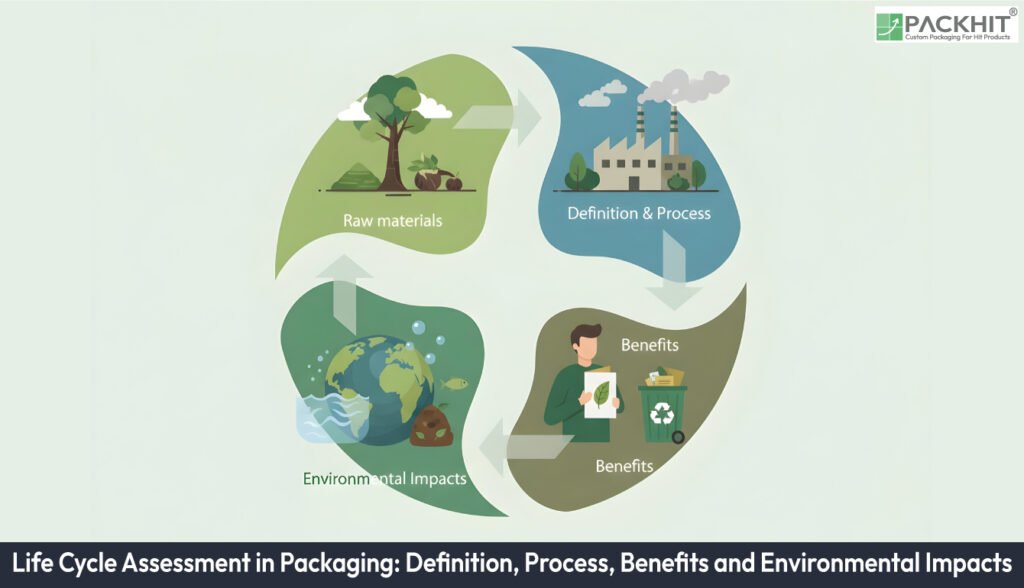
Life Cycle Assessment (LCA) in packaging provides a structured way to understand how packaging choices influence environmental performance across production, use, and recovery systems. The approach links material sourcing, manufacturing routes, logistics, and end-of-life pathways into a single analytical framework that supports evidence-based decisions. Within packaging development, LCA is used to compare design options consistently, material efficiency, and environmental load, and translate technical performance into measurable sustainability outcomes. As packaging systems become more complex and sustainability expectations increase, LCA increasingly informs both design strategy and formal environmental communication without being limited to a single impact or stage.
- What is a Packaging Life Cycle Assessment in Packaging?
- What are the Stages of the Packaging Life Cycle Assessment (LCA)?
- What Benefits Does Packaging LCA Deliver?
- Optimised Design Decisions
- Informed Material Selection
- Comparable Benchmarking Outcomes
- Credible Reporting and Disclosure
- Reduced Decision Risk
- What Environmental Impacts are Captured by Packaging LCA?
- How Should System Boundaries and End-of-Life Be Treated in a Packaging LCA?
- How is LCA Used in Practical Packaging Applications?
- Which Methodological Choices Most Influence LCA Results?
- What Limitations Affect Packaging LCAs?
- Which Emerging Trends are Shaping Packaging LCA?
What is a Packaging Life Cycle Assessment in Packaging?
A packaging life cycle assessment (LCA) is a systematic methodology that quantifies environmental impacts attributable to a packaging item over its life span. It is a method for assessing the environmental impacts of packaging throughout production, use and end‑of‑life. As a defining specification, the approach captures material production, energy inputs, transport, manufacturing processes, and disposal pathways; its outputs feed into standardised disclosure mechanisms such as product‑category rules (PCRs) and environmental product declarations (EPDs) to permit reproducible comparison. The technique supports cross‑product comparisons only when functional performance and reporting rules are aligned.
What are the Stages of the Packaging Life Cycle Assessment (LCA)?
A packaging LCA proceeds through iterative stages: goal and scope definition, life‑cycle inventory assembly, impact assessment and interpretation with reporting. Each stage carries methodological choices that alter outcomes and comparability.
Goal and Scope Definition
State the purpose, the functional unit and the system boundary up front. The functional unit quantifies the package’s required service (for example, contain and protect X grams of product over Y distribution kilometres); the system boundary determines whether the study is cradle‑to‑grave, cradle‑to‑gate or another configuration. Performance requirements that underpin the functional unit—barrier properties, crush resistance, and shelf life—must be explicit because they determine the baseline for all comparisons.
Life‑Cycle Inventory (LCI)
Collect process‑level flows for raw materials, intermediate processing, energy use, transport distances, packaging manufacture and filling, distribution and end‑of‑life outcomes. Data sources include primary measurements from manufacturers and secondary database records; record temporal and geographic representativeness and data uncertainty. Inventory assembly yields mass and energy flows, emissions to air, water and soil, and material transfers that map to impact categories in the next stage.
Impact Assessment
Map inventory flows to chosen impact categories and aggregate results per functional unit. Typical categories include climate change (greenhouse‑gas emissions), resource depletion (fossil and mineral resource use), water consumption, human and ecosystem toxicity potentials and waste generation; choose categories relevant to the packaging function and stakeholder needs. Normalisation and weighting are optional but must be documented if used for decision support or communication.
Interpretation and Reporting
Interpretation identifies life‑cycle hotspots and tests robustness via sensitivity and scenario analyses. Report results with transparent assumptions: functional unit, system boundary, allocation rules for multi‑output processes and end‑of‑life scenarios. Where applicable, structure reporting to meet PCR requirements so outputs can be converted to EPDs for external comparison.
What Benefits Does Packaging LCA Deliver?
Packaging LCA (Life Cycle Assessment)provides quantitative evidence to support design trade‑offs, informs consistent external declarations and enables cross‑product benchmarking when reporting rules match. Benefits include:
Optimised Design Decisions
Packaging LCA enables optimised design decisions by identifying life-cycle hotspots and quantifying the environmental impact of changes in material choice, structure, or protective performance. Results support impact reduction without compromising functional requirements.
Informed Material Selection
Packaging LCA enables informed material selection by comparing substrates, coatings, and barrier systems across production, use, and end-of-life stages. Quantified trade-offs support balanced decisions between protection and environmental performance.
Comparable Benchmarking Outcomes
Packaging LCA delivers comparable benchmarking outcomes when functional units, system boundaries, and product category rules are aligned. Harmonised studies allow credible side-by-side evaluation of alternative packaging solutions.
Credible Reporting and Disclosure
Packaging LCA supports credible reporting and disclosure through transparent inventories and documented assumptions. Results underpin environmental product declarations and standardised sustainability claims.
Reduced Decision Risk
Packaging LCA reduces decision risk by revealing sensitivity to key assumptions such as recycling rates, transport distances, and energy mix. Early identification of dominant drivers improves the robustness of sustainability targets.
What Environmental Impacts are Captured by Packaging LCA?
Packaging LCA quantifies multiple environmental endpoints and mid‑point categories that arise from life‑cycle exchanges. Commonly assessed impacts include:
Climate Change
Packaging LCA captures climate change impacts by quantifying greenhouse-gas emissions released during raw-material extraction, material processing, converting operations, and transport. Emissions intensity varies by material type and energy source, with production stages often contributing the largest share.
Resource Depletion
Resource depletion assessment measures the use of non-renewable and renewable resources such as fossil fuels, virgin fibres, and mineral inputs. Packaging materials with high virgin content or energy-intensive processing typically show higher depletion burdens.
Water Use
Water use impacts account for freshwater withdrawal and consumptive use across material manufacturing and finishing processes. Fibre-based materials and some polymer processes can dominate this category due to pulping, washing, or cooling requirements.
Toxicity Potentials
Toxicity indicators capture emissions of substances that pose risks to human health or ecosystems. Packaging LCA links these impacts to chemical releases during material production, coatings, inks, adhesives, and waste treatment stages.
Waste Generation
Waste generation analysis records residual material flows sent to landfill, incineration, or recycling. End-of-life pathways strongly influence this category, as disposal and recovery routes determine long-term emissions, material losses, and potential recovery benefits.
How Should System Boundaries and End-of-Life Be Treated in a Packaging LCA?
A packaging LCA should define system boundaries that capture all relevant life-cycle stages, from raw-material extraction and material processing through manufacturing, filling, distribution, use where applicable, and final disposal, to represent cradle-to-grave impacts. Any boundary exclusions must be explicitly justified and their influence on results assessed through sensitivity analysis. End-of-life modelling should state clear assumptions for collection rates, recycling efficiency, landfill behaviour, incineration and energy recovery. Recycling credits should be applied only when recovered material is assumed to substitute for virgin production. Allocation rules for shared processes, co-products or multi-material packaging must be declared, as allocation choices can materially affect outcomes.
How is LCA Used in Practical Packaging Applications?
LCA is used in practical packaging applications to support evidence-based design, material, and system decisions by comparing environmental impacts across defined life-cycle stages.
- Design evaluation assesses alternative structures, formats, or weight reductions to identify options with lower life-cycle impacts while maintaining protection and functionality.
- Material substitution studies compare virgin and recycled content, fibre-based and polymer substrates, or mono-material and multilayer solutions to quantify trade-offs across production and end-of-life.
- Reusable system appraisal evaluates single-use versus returnable packaging by modelling use cycles, transport distances, cleaning impacts, and breakage rates.
- Lightweighting analysis measures the impact of reductions achieved by reducing material mass and tests whether performance losses offset environmental gains.
- Environmental product declarations (EPDs) use LCA results to produce verified, standardised disclosures for customers, procurement, and regulatory reporting.
Valid application requires consistent functional units, aligned system boundaries, and explicit end-of-life assumptions to ensure meaningful comparison between options.
Which Methodological Choices Most Influence LCA Results?
The methodological choices that most influence LCA results are the definition of the functional unit, the system boundary, allocation rules for recycling and co-products, data quality, and the selection of impact categories. A wider system boundary that includes distribution and end-of-life stages increases the influence of transport, disposal, and material recovery, while excluding end-of-life removes potential recycling or energy-recovery benefits. Allocation approaches for recycled content or shared processes can materially shift outcomes between alternatives. Comparative conclusions remain valid only when functional units, boundaries, data sources, and allocation methods are consistently aligned across all options.
What Limitations Affect Packaging LCAs?
Packaging LCAs are affected by methodological and data-related uncertainties that influence the accuracy and comparability.
- Data availability limitations occur when secondary databases fail to reflect actual manufacturing conditions, energy mixes, or material formulations used in production.
- Consumer behaviour uncertainty arises because real-world use, disposal, and collection rates vary widely and strongly affect end-of-life results.
- Recycling allocation uncertainty results from different approaches to assigning benefits from material recovery, which can materially change impact outcomes.
- Reporting inconsistency appears when differing PCRs, system boundaries, or undisclosed assumptions prevent reliable comparison between studies.
Mitigation relies on sensitivity analysis, prioritisation of primary data for key processes, and clear documentation of assumptions, data sources, and quality indicators.
Which Emerging Trends are Shaping Packaging LCA?
Packaging LCA is evolving from a retrospective assessment tool into an integrated decision-support method used throughout design and reporting.
- Early-stage design integration embeds life-cycle modelling into concept development so environmental performance is assessed alongside cost and functionality.
- Reporting rule harmonisation aligns PCRs with EPD practices to improve consistency, transparency, and comparability across studies.
- Circular-economy scenario modelling evaluates higher recycling rates, material recovery pathways, and reuse systems to reflect future operating conditions.