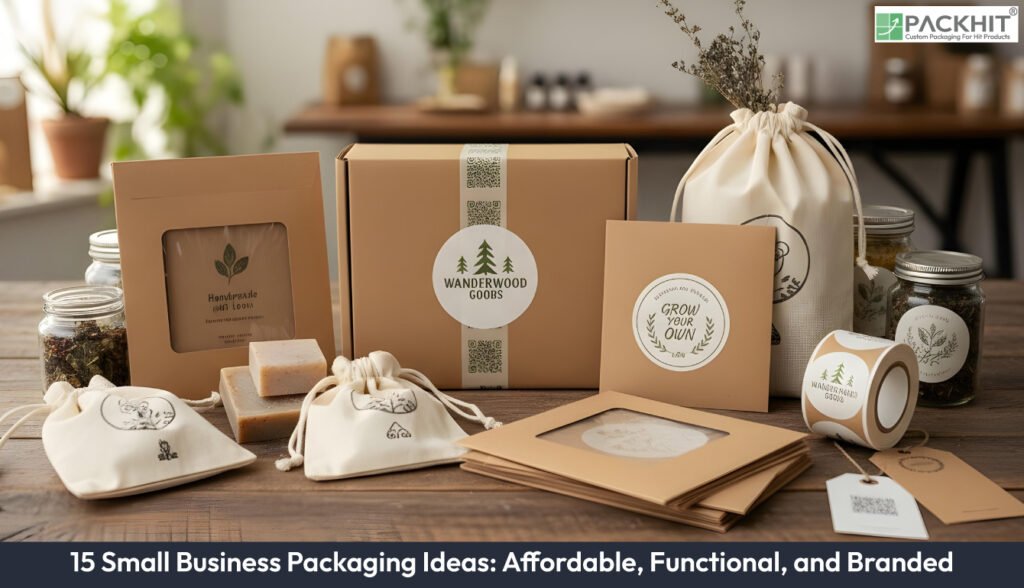
Small business packaging ideas focus on combining affordability, functionality, and brand visibility to create practical solutions for shipping, storage, and customer engagement. Effective packaging for small businesses protects products during transit, reduces shipping costs, and reinforces brand identity through visual cues, inserts, and personal touches. Popular small business packaging ideas range from custom mailer boxes and corrugated cartons to poly and foil bags, padded mailers, and branded tissue wraps. By balancing cost, protection, and presentation, fifteen packaging ideas help small businesses deliver professional, memorable, and branded experiences.
The fifteen packaging design ideas for small businesses are given below:
- Kraft Packaging for Low-Cost Visual Consistency
- Poly Bags for Lightweight Product Containment
- Poly Mailers for Apparel and Soft Goods
- Flat and Padded Mailers for Postal Efficiency
- Bubble Mailers for Impact Absorption
- Inserts as Retention Mechanisms
- Thank You and Handwritten Cards for Personal Signalling
- Corrugated Boxes for Load-Bearing Protection
- Foil-Sealed Bags for Freshness Control
- Mylar Bags for Barrier Performance and Resealability
- Hang Tags for Product-Level Identification
- Coupon Cards for Measurable Follow-Up
- Custom Mailer Boxes for Branded Shipping
- Branded Tissue Paper as Internal Wrapping
- Custom Tapes and Stickers for Closure Branding
- 1. Kraft Packaging for Low-Cost Visual Consistency
- 2. Poly Bags for Lightweight Product Containment
- 3. Flat and Padded Mailers for Postal Efficiency
- 4. Bubble Mailers for Impact Absorption
- 5. Poly Mailers for Apparel and Soft Goods
- 6. Freebie Inserts as Retention Mechanisms
- 7. Thank You and Handwritten Cards for Personal Signalling
- 8. Corrugated Boxes for Load-Bearing Protection
- 9. Foil-Sealed Bags for Freshness Control
- 10. Mylar Bags for Barrier Performance and Resealability
- 11. Hang Tags for Product-Level Identification
- 12. Coupon Cards for Measurable Follow-Up
- 13. Custom Mailer Boxes for Branded Shipping
- 14. Branded Tissue Paper as Internal Wrapping
- 15. Custom Tapes and Stickers for Closure Branding
1. Kraft Packaging for Low-Cost Visual Consistency
Kraft packaging uses unbleached paperboard or paper bags with a natural brown surface. Its material cost remains lower than coated alternatives, while the surface texture supports stamped or single-ink printing. Handmade goods, candles, and soap producers use kraft boxes and bags to signal simplicity and material transparency.
2. Poly Bags for Lightweight Product Containment
Poly bags are thin polyethene sleeves or pouches that shield products from dust and moisture. They reduce packaging mass and postage costs when used as inner protection for clothing, printed goods, and accessories. Branding commonly appears as a single-colour logo or warning print, applied during extrusion or surface printing.
3. Flat and Padded Mailers for Postal Efficiency
Mailers include paper envelopes, padded kraft mailers, and lightweight cardboard sleeves. Their primary role is dimensional efficiency, reducing shipping charges under postal pricing rules. Print areas remain limited, so branding often relies on exterior labels or stamps rather than full-surface printing.
4. Bubble Mailers for Impact Absorption
Bubble mailers combine outer paper or plastic layers with internal air pockets. They protect fragile flat items such as electronics accessories, prints, and cosmetics. Their structure reduces the need for additional void fill, shortening packing time.
5. Poly Mailers for Apparel and Soft Goods
Poly mailers are flexible polyethene envelopes designed for non-fragile items. Tear resistance and water resistance are their defining properties. Apparel brands favour them for their low unit cost and compatibility with automated label application.
6. Freebie Inserts as Retention Mechanisms
Freebies are low-cost items placed inside packaging, such as sample sachets, stickers, or trial-size products. Their function is behavioural, encouraging repeat orders rather than protecting the shipped item. Small businesses restrict freebies to lightweight formats to avoid affecting postage bands.
7. Thank You and Handwritten Cards for Personal Signalling
Thank-you cards are small printed or handwritten notes included during packing. They communicate order confirmation and brand presence in physical form. Handwritten variants are typically reserved for limited orders or high-margin products due to labour time requirements.
8. Corrugated Boxes for Load-Bearing Protection
Corrugated boxes consist of fluted paperboard layers that distribute compression forces during stacking and transit. Single-wall variants handle lightweight goods such as books and homeware, while double-wall formats support heavier items like ceramics. Small businesses standardise two or three box sizes to control storage space and shipping rate variability.
9. Foil-Sealed Bags for Freshness Control
Foil-sealed bags incorporate aluminium layers that block oxygen and light. They are used for consumables such as coffee, spices, and supplements, where shelf stability matters. Small businesses typically combine stock foil pouches with adhesive labels, allowing compliance information and branding without custom tooling.
10. Mylar Bags for Barrier Performance and Resealability
Mylar bags are polyester-based pouches with high tensile strength and vapour resistance. Zipper closures allow repeated opening without degrading the seal area. Small businesses selling snacks, supplements, and digital accessories use them to combine product protection with compact storage.
11. Hang Tags for Product-Level Identification
Hang tags attach directly to products using string or plastic fasteners. They carry pricing, care instructions, or batch information while also supporting branding. Apparel, accessories, and handmade goods use them to avoid printing directly on the product or container.
12. Coupon Cards for Measurable Follow-Up
Coupon cards contain discount codes or referral prompts tied to subsequent purchases. Their effectiveness depends on clear redemption terms and expiry dates. Small businesses use unique codes to track repeat purchase rates without modifying digital checkout flows.
13. Custom Mailer Boxes for Branded Shipping
Custom mailer boxes are self-locking cardboard boxes printed externally or internally with brand marks. They function as both a shipping container and a presentation surface. Small businesses use digital or flexographic short-run printing to apply logos and colour blocks, reducing the need for outer cartons. Apparel brands, cosmetics sellers, and stationery shops use them to replace plain shipping boxes without increasing dimensional weight.
14. Branded Tissue Paper as Internal Wrapping
Branded tissue paper is thin paper printed with repeating logos or motifs. It separates the product from container walls, limits abrasion, and adds visual continuity. Jewellery, apparel, and gift items commonly use one or two tissue sheets per order to regulate cost while maintaining presentation control.
15. Custom Tapes and Stickers for Closure Branding
Custom tapes and stickers replace plain packing tape or seals with branded versions. They secure boxes while marking tampering and origin. Small businesses adopt them because minimum order quantities remain lower than custom box printing, allowing incremental brand visibility.