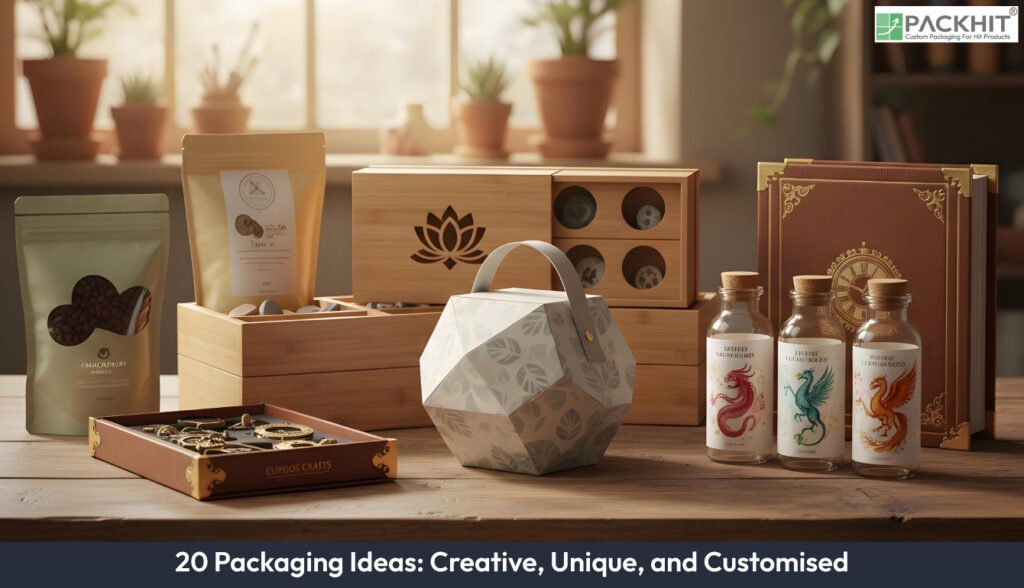
Packaging communicates brand, guides experience, and extends utility. Repeated patterns, bold colours, and original artwork enhance recognition and collectability, while theme-based and limited-edition designs create context and scarcity appeal. Minimalist structures, Kraft wraps, and textured surfaces highlight sustainability and tactile engagement, whereas luxury rigid boards, magnetic closures, and functional forms emphasize quality and reusability. Structured unboxing, ribbons, layered cushioning, slogans, and inserts foster engagement and storytelling, while handwritten notes, informational inserts, custom prints, and 3D-printed forms add personalisation, clarity, and precision to the customer experience.
The twenty packaging ideas listed below present different design approaches in which a defining visual, material, or structural attribute shapes how packaging is created, used, and experienced.
- 1. Pattern-led surface design
- 2. Bold colour-based packaging
- 3. Original artwork-led packaging
- 4. Theme-based packaging systems
- 5. Limited edition packaging runs
- 6. Minimal and reduced material packaging
- 7. Kraft paper and natural wraps
- 8. Textured surface packaging
- 9. Luxury-oriented rigid packaging
- 10. Magnetic closure box formats
- 11. Functional packaging structures
- 12. Structured unboxing layouts
- 13. Ribbon and paper band closures
- 14. Layered internal cushioning systems
- 15. Slogan-led packaging messaging
- 16. Printed thank-you card inserts
- 17. Handwritten note additions
- 18. Informational packaging inserts
- 19. Custom printed box exteriors
- 20. Custom 3D printed packaging forms
1. Pattern-led surface design
Pattern-led packaging uses repeated surface graphics as the primary visual attribute, with formats including geometric grids, textile repeats, and tiled brand symbols. Repetition distributes abrasion marks across panels. Customers reuse patterned boxes for storage, gift wrapping, and subscription refills, with wear visually absorbed by the print.
2. Bold colour-based packaging
Bold colour packaging applies high-saturation inks as a classification attribute, with colour blocks assigned to flavours, sizes, or variants, such as red for spicy foods or blue for cooling cosmetics. Colour contrast reduces label reading time. Customers select products through colour recognition.
3. Original artwork-led packaging
Artwork-led packaging uses commissioned illustrations as a unique identification attribute, with one artwork linked to one product batch, such as seasonal snacks or capsule clothing. Artwork replaces standard branding repetition. Customers keep boxes as display items or collectables.
4. Theme-based packaging systems
Theme-based packaging applies a single conceptual framework as the organising attribute, with aligned colours, typography, and materials, such as winter palettes or cultural motifs. The system standardises production assets. Customers treat themed packs as ready-to-gift packaging.
5. Limited edition packaging runs
Limited edition packaging assigns scarcity as the core attribute, defined by fixed print quantities, date stamps, or numbered units, such as 500-unit cosmetic releases. Controlled volume signals collectability. Customers retain or resell limited packs after product use.
6. Minimal and reduced material packaging
Minimal packaging uses material reduction as the primary attribute, with one-layer cartons and two-colour ink limits, common in chargers and stationery. Fewer components shorten recycling steps. Customers discard or store minimal packs with low effort.
7. Kraft paper and natural wraps
Kraft packaging uses unbleached paper fibre as the defining material attribute, with visible texture and brown tone, common in handmade foods and clothing accessories. The surface accepts stamps and ink. Customers reuse Kraft wraps for shipping and archiving.
8. Textured surface packaging
Textured packaging adds physical surface variation as a tactile attribute, using embossing, debossing, fabric wraps, or soft-touch coatings. Texture increases grip friction. Customers associate texture with care handling and keep boxes for keepsakes.
9. Luxury-oriented rigid packaging
Luxury rigid packaging uses high-density greyboard as the structural attribute, with wall thickness above 1.5 mm and tight corner tolerances. Added mass signal protection. Customers reuse rigid boxes for clothing, watches, and document storage.
10. Magnetic closure box formats
Magnetic closure packaging embeds neodymium magnets as the closure attribute, positioned inside flaps or lids for alignment repeatability. The mechanism limits accidental opening. Customers reuse magnetic boxes for jewellery and home organisation.
11. Functional packaging structures
Functional packaging assigns secondary use as a structural attribute, converting cartons into display stands, organisers, or trays through fold lines and perforations. The form extends product visibility. Customers retain packs as daily-use objects.
12. Structured unboxing layouts
Unboxing-focused packaging uses layer order as the organisational attribute, with fixed sequences of outer carton, protective wrap, and inner tray. Controlled layout reduces movement damage. Customers document unboxing steps for social media posts.
13. Ribbon and paper band closures
Ribbon and band closures use removable fasteners as the securing attribute, replacing adhesive tapes with cotton ribbons or paper sleeves. Clean opening protects surfaces. Customers reuse ribbons for crafts, cable tying, and re-gifting.
14. Layered internal cushioning systems
Layered cushioning packaging uses modular inserts as the protection attribute, combining folded board, moulded pulp, or fabric pads sized to product dimensions, such as glassware or electronics. Modules adapt across SKUs. Customers recycle cushioning without separation.
15. Slogan-led packaging messaging
Slogan-led packaging places short phrases as the messaging attribute, positioned on high-visibility panels using controlled typography, such as three-word brand statements. Limited text improves recall speed. Customers remember slogans during repeat purchases.
16. Printed thank-you card inserts
Thank-you card inserts use printed cards as the relationship attribute, placed inside packaging but separated from external branding, often in A7 or A6 size. Cards confirm order context. Customers keep cards for reorder and warranty reference.
17. Handwritten note additions
Handwritten notes use manual writing as the personalisation attribute, visible through ink pressure variation and spacing differences. Human marks contrast with print uniformity. Customers retain notes with handmade goods and limited clothing.
18. Informational packaging inserts
Informational inserts use structured content as the guidance attribute, presenting care instructions, size charts, or usage diagrams in a clear hierarchy. Information reduces misuse. Customers store inserts for later reference.
19. Custom printed box exteriors
Custom printed boxes use direct carton printing as the branding attribute, applying graphics through digital or offset processes without adhesive labels. Direct print resists peeling. Customers identify shipments quickly during delivery handling.
20. Custom 3D printed packaging forms
3D printed packaging uses additive manufacturing as the shaping attribute, producing internal supports or outer shells matched to product geometry, such as electronics or tools. Precise fit reduces void space. Customers reuse forms for storage and display.